Artur Davis Opens Mobile Field Office in Bid to Make Alabama History
About 50 supporters gathered at Skyland Shopping Center as the congressman opened a Mobile campaign office, telling the crowd he was not the candidate for anyone content with insider politics.
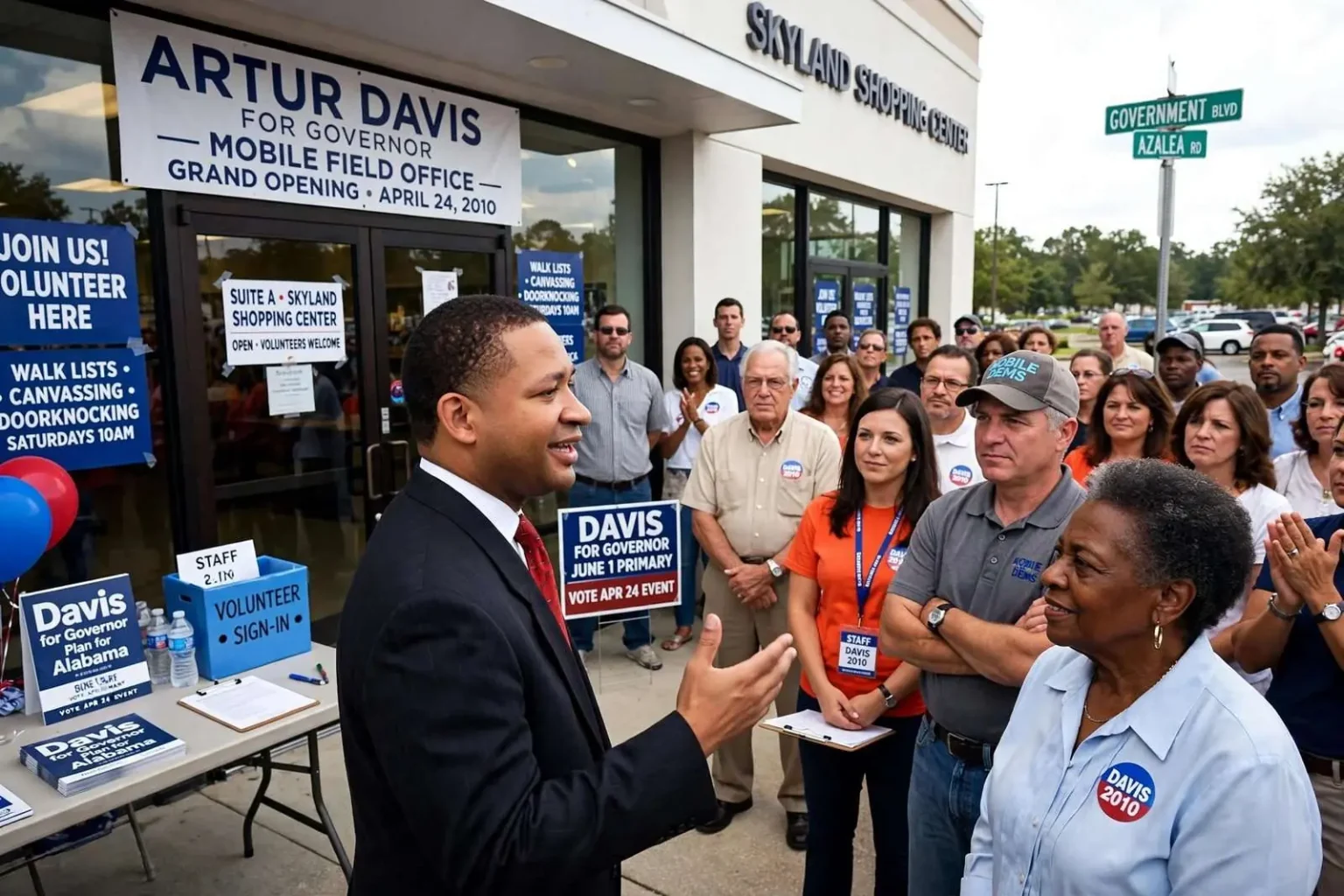
About 50 supporters turned out on a Saturday afternoon in Mobile for the grand opening of a new field office for Artur Davis, the Democratic congressman seeking his party’s nomination for governor of Alabama in the June 1 primary.
The office opened in Suite A of the Skyland Shopping Center, at the intersection of Government Boulevard and Azalea Road — a location chosen for visibility on one of the busiest corridors in the city and for its reach into precincts the campaign considered essential. Government Boulevard cuts across the heart of Mobile, linking downtown to the western neighborhoods, and the shopping center sits in a corridor the campaign’s organizers view as a crossroads of the city’s Democratic electorate.
The gathering was modest by the standards of a statewide campaign, but it was deliberate. Field offices cost money and staff time, and campaigns open them where they intend to work. Davis’s operation committed to Mobile early and visibly, a signal that the Gulf Coast would be contested rather than ceded in the primary.
A Pitch Against Insider Politics
Davis used his remarks to draw a line between his candidacy and the machinery of state government in Montgomery. If voters were satisfied with state government and with insider politics, he told the crowd, then he “wasn’t their guy.” But if they wanted the kind of fresh, open-minded politics that had elected Sam Jones mayor of Mobile, he said, then he was the candidate they should support.
The reference to Jones was deliberate. Jones had been elected in 2005 as the first Black mayor of Alabama’s oldest city, and Davis was campaigning to become the first Black governor in Alabama history. In a Democratic primary in which turnout among Black voters in Mobile, Birmingham and the Black Belt would matter enormously, the comparison offered supporters a template for what Davis argued was possible.
Jones’s 2005 victory had been built on a coalition that crossed racial and neighborhood lines in Mobile, combining strong support from Black precincts with enough votes from white and moderate voters to win a citywide race. For Davis, invoking that coalition was both a compliment to the local audience and an argument: that a Black candidate with a reform message could win statewide in Alabama if the campaign ran everywhere and asked everyone for their vote.
The anti-insider theme has been the through-line of Davis’s candidacy. He has campaigned against the old ways of doing business in Montgomery — the influence of special interests, the caution of a Legislature that he argues has kicked the state’s problems from session to session. His four terms in Congress give him a record to defend, but he has positioned himself as an outsider to the state’s own political establishment, a framing that sets up the contrast with his primary rival.
The Democratic Field
Davis, who represented Alabama’s 7th Congressional District, faced state Agriculture Commissioner Ron Sparks for the Democratic nomination. The two men had spent the spring drawing sharp contrasts — Davis presenting himself as a reformer willing to break with entrenched interests, Sparks running a more traditional Alabama Democratic campaign built on rural votes and populist economics.
The 7th District Davis has held since 2003 stretches from Birmingham through the Black Belt to portions of southwest Alabama, one of the most heavily Black districts in the nation. His decision to give up the safe seat for a run at governor was the gamble of his career: win, and he makes history and leads the state; lose, and he leaves Congress with no office to return to.
Sparks, as the state’s agriculture commissioner, carried the kind of down-home profile that has long anchored Alabama Democratic politics. His campaign has emphasized rural economies, gambling revenue for education and the concerns of small towns, a message aimed at the party’s traditional base in the counties between Huntsville and Mobile. Davis has countered with a platform built on ethics reform, education and a more modern economic vision for the state.
For Mobile County Democrats, the primary carried unusual local weight. The county has long been one of the largest Democratic vote banks outside Jefferson County, and both campaigns treated the Gulf Coast as territory worth contesting rather than conceding.
Campaign Season in Full Swing
The office opening came as the political calendar in Mobile filled up ahead of the June 1 primary. The Mobile Area Chamber of Commerce scheduled its annual Pork & Politics in the Park barbecue for Tuesday, May 11, at the aircraft pavilion at Battleship Memorial Park, an event long billed as the largest and most diverse political rally in the city.
All announced candidates for local, state and federal office were invited, and tickets were $15, which included a barbecue dinner. For campaigns, the barbecue is one of the few occasions in the region where candidates for everything from county commission to governor stand in the same park, shaking the same hands and working the same picnic tables. Davis’s decision to open his Mobile office in the weeks before the event gave his volunteers a base of operations for what amounts to the city’s political open house.
The calendar gives the campaign a clear sequence: qualify, staff the field office, work the precincts through May, then face the voters on June 1. The general election follows on Tuesday, Nov. 2, 2010, and whichever Democrat emerges from the primary will carry the party’s hopes against the Republican nominee in a state where Republicans have held the governor’s office for most of the past two decades.
The Democratic candidates for governor are U.S. Rep. Artur Davis and Agriculture Commissioner Ron Sparks. The primary matchup has divided Democratic loyalists across the state, with some drawn to Davis’s outsider message and others to Sparks’s traditional appeal, and Mobile County’s large Democratic electorate will supply a meaningful share of the votes both men need.
Why Mobile Matters in a Statewide Race
Mobile County’s demographics give it a unique role in Democratic primaries. The county combines a substantial Black electorate, a working-class white vote and a history of producing competitive countywide races, which means candidates cannot reach it with a message aimed at a single group. Davis’s decision to invoke Sam Jones reflected precisely that reality: the coalition that elected Mobile’s mayor is the kind of coalition his campaign argues it can assemble statewide.
Field operations are how campaigns try to build such coalitions. Volunteers staffing a shopping-center office can canvass nearby precincts, register voters, recruit poll workers and turn out supporters on primary day. The Skyland Shopping Center location puts those volunteers within reach of neighborhoods across west Mobile while keeping the campaign’s sign visible to thousands of motorists who pass the Government Boulevard and Azalea Road intersection every day.
Davis closed his remarks by urging volunteers to work the neighborhoods surrounding the new office in the weeks remaining, telling them the campaign would be decided less by television than by conversations at doors and in church parking lots across Mobile County. It was a fitting close for an afternoon organized around the unglamorous infrastructure of a statewide campaign: a rented suite, a stack of walk lists and fifty people willing to spend a Saturday afternoon on the work.
Whether the gamble pays off will be measured in June. But the opening of the Mobile office made one thing clear: Davis intends to compete in Mobile County precinct by precinct, and his campaign believes that the city that elected Sam Jones mayor can help elect the state’s first Black governor.
The Stakes of the 7th District Seat
Davis’s run carries a cost that voters sometimes overlook: the 7th Congressional District seat he leaves behind. Because the district was drawn to concentrate the state’s Black voting population, it almost certainly remains in Democratic hands, meaning several Democrats are positioned to compete for the vacancy while Davis pursues the governorship. His departure from the seat also removes one of Alabama’s most visible Black officeholders from Congress, a trade-off his supporters accept as the price of attempting history at the state level.
That calculus is part of what makes the June 1 primary so consequential for Alabama Democrats. The party has not won the governor’s office since 1998, and its legislative numbers have eroded for most of the past two decades. Davis has argued that only a candidacy capable of exciting new voters and crossing racial lines can reverse the slide; Sparks has argued that the party’s path runs through its traditional base, energized and turned out. Mobile County Democrats will get a direct say in which theory prevails.
The primary electorate itself will tell a story. Alabama’s open primary system allows voters to choose either party’s ballot, and in a year when Republicans are contesting their own crowded race for governor, crossover participation could shape the Democratic outcome in unpredictable ways. Campaigns plan for this by identifying reliable primary voters and building turnout operations around them, which is precisely the work the new Mobile field office was opened to do.
For the fifty supporters who gathered at Skyland Shopping Center, the afternoon ended with walk lists and assignments. The primary is now close enough that every weekend counts, and the campaign’s Mobile operation — visible on one of the city’s busiest corners, staffed by volunteers who heard the candidate’s pitch in person — will spend them working the precincts that Davis believes will decide whether an Alabama congressman becomes an Alabama governor.