Mobile’s Police Union Backs Ashley Rich in the Race to Succeed Tyson
The Mobile County Law Enforcement Association endorsed Assistant District Attorney Ashley Rich in the Republican primary for district attorney, as chief assistant Nicki Patterson ruled out a run.
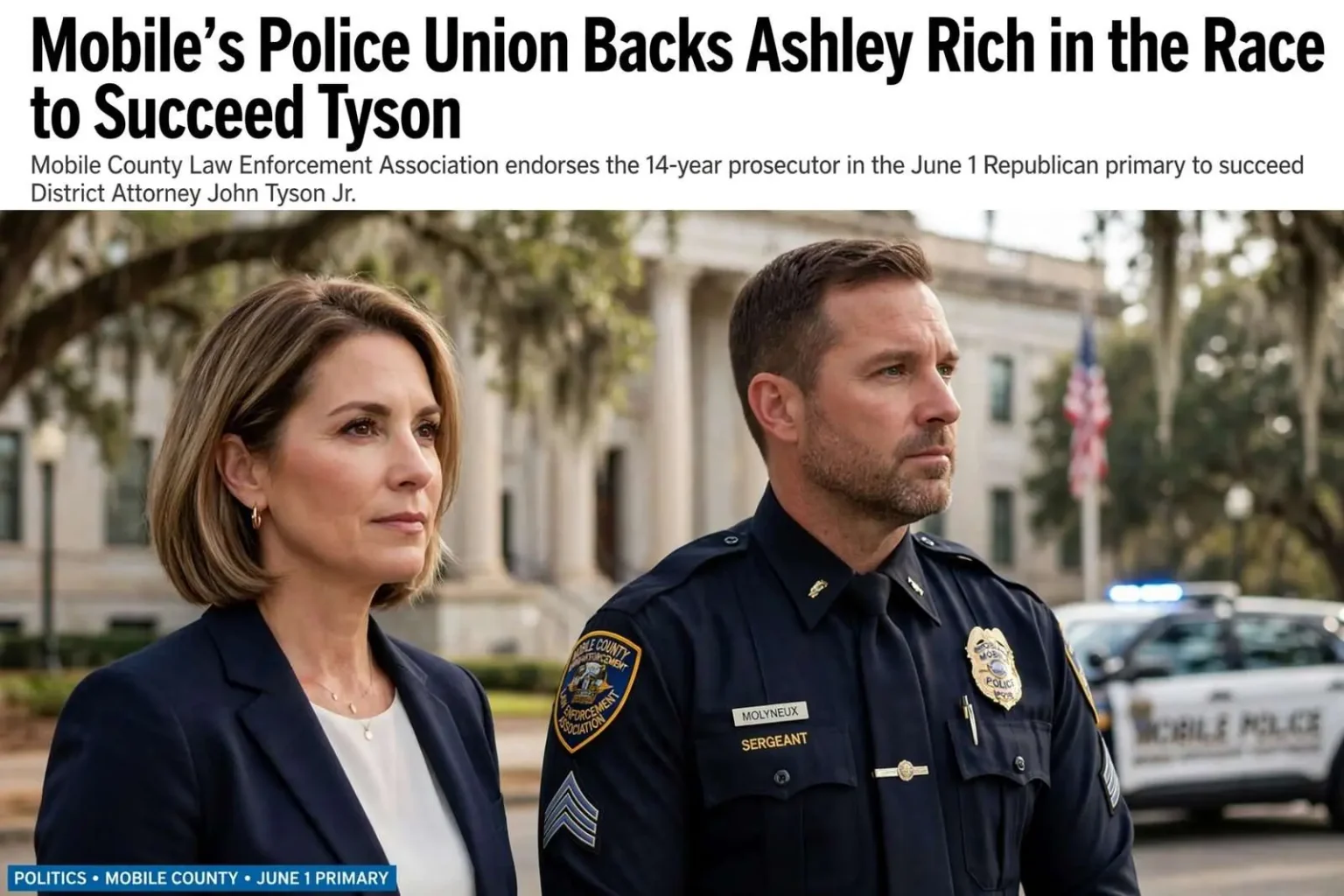
The Mobile County Law Enforcement Association has endorsed Assistant District Attorney Ashley Rich in her Republican bid to become the county’s top prosecutor — giving her the backing of the officers who bring her the cases she tries.
“The choice was clear in this race,” said Sgt. John Molyneux, chairman of the association. “After working with Ashley Rich for so many years on some of the worst cases Mobile has seen, we will be standing behind Ashley in this campaign.” “Her ability to stand up to criminals in the courtroom and reputation for being tough on crime is exactly what our community needs,” Molyneux said.
Endorsements in a district attorney’s race come with varied weights, but none carries quite the professional force of the badge. Rich now has it. The association speaks for the officers who investigate the county’s homicides, robberies and sexual assaults — the same officers who carry those files across the street to the district attorney’s office and sit beside the prosecutor at trial. Their verdict on a candidate is not a poll of opinion; it is a performance review conducted by the people best positioned to give one. Fourteen years of case assignments, trial outcomes and late-night phone calls stand behind the association’s one-line explanation: the choice was clear.
What the endorsement is worth
The association has roughly 120 members, nearly all of them officers with the Mobile Police Department. Rich won its support after a vote of the board and membership last week. As a nonprofit, the association cannot contribute money to Rich’s campaign, Molyneux said — but its members can help in other ways, and in a district attorney’s race those other ways matter a great deal.
The limits and the possibilities of that help define what the endorsement is actually worth. What it cannot buy is advertising: no contribution, no fundraising check, no media buy from the association’s accounts. What it can provide is everything money approximates — credibility with the exact constituency a prosecutor must win, and the voluntary labor of a hundred and twenty officers who talk about candidates every day. Officers direct traffic at campaign events, put signs in yards, and answer the questions their neighbors ask at ballgames and barbecues. A campaign cannot purchase that kind of advocacy at any price, because its value depends entirely on its sincerity.
An endorsement from the working police is the closest thing to a professional credential a prosecutor can display, and it travels by word of mouth through precincts, neighborhood watch groups and church parking lots in a way no television buy can duplicate. Political scientists who study down-ballot races have long noted that low-information contests — and a district attorney’s primary, where neither candidate is yet a household name, is exactly that — are decided by precisely these channels: the shorthand judgments passed along by people whose judgment on matters of law enforcement carries weight in the community.
There is also a subtler mechanism at work. Police officers are the county’s most credible transmitters of information about how the justice system actually functions. When an officer tells a neighbor that a candidate has tried the worst cases Mobile has seen and stood up to criminals in the courtroom, the listener receives a fact pattern rather than a slogan. In a race where both candidates will spend the spring describing their experience, the endorsement functions as a third-party audit of Rich’s record — conducted, notably, by people who have no reason to flatter a prosecutor whose office they work with every week.
Rich, 41, said she was humbled by the support.
The race
Rich is a 14-year veteran prosecutor in the office of District Attorney John Tyson Jr. She faces Mobile attorney Mark Erwin, a former chairman of the Mobile County Republican Party, in the June 1 primary. The seat is open because Tyson announced he would not seek to continue beyond his current term.
Appointed district attorney in 1994, he twice won election to the job, and by 2010 he was also serving as head of Gov. Bob Riley’s task force on illegal gambling — a role that had made him one of the most visible and most contested law enforcement figures in the state.
Tyson’s gambling task force deserves its own place in the campaign’s backdrop, because it explains the political weather around the office he is leaving. The task force’s raids on electronic bingo casinos across Alabama made headlines for months, drew lawsuits from the facilities it targeted and put the district attorney’s name at the center of the most polarizing law-enforcement controversy in the state. Whoever succeeds Tyson inherits not only the county’s criminal docket but the shadow of that fight — and a field of voters who have strong feelings, in both directions, about the aggressive exercise of the prosecutor’s power. Both Rich and Erwin have spent the campaign positioning themselves relative to that legacy.
Rich’s own credentials are of the courtroom rather than the clubhouse variety. Fourteen years in the office means she has risen through the divisions that handle the county’s most serious felonies, built relationships with every investigating agency, and accumulated the trial record that the association’s endorsement certified. Her campaign has leaned on that distinction: she is the candidate who has spent her career doing the job, Erwin the candidate who arrives from practice and politics. That contrast is a familiar one in prosecutor races, and it usually works to the advantage of the sitting prosecutor — particularly when the working officers vouch for her.
Erwin, for his part, brings to the race the assets of organization and money: a former party chairman’s network across Mobile County’s civic and business leadership, and a fundraising operation whose reach became visible in the host list of his March reception. He has argued that the office needs management experience and fresh leadership rather than an heir to the incumbent’s administration. The race between the two will test whether, in a Republican primary, the machinery of the party establishment can outweigh the endorsement of the street — an unusually direct matchup of the two currencies in which local law-enforcement politics are paid.
No Nicki
Chief Assistant District Attorney Nicki Patterson, long mentioned as Tyson’s likely successor, confirmed she would not be a candidate. Patterson had drawn favorable mention at a recent meeting of the Mobile Area Democratic Association during a discussion of possible contenders to replace Tyson on the June ballot.
Patterson’s decision reshapes the race on both sides. As Tyson’s chief assistant, she had perhaps the most obvious claim on the office — the person who has run its day-to-day operations, supervised its felony divisions and tried its hardest cases alongside the district attorney for years. Had she run as a Republican, she would have made the primary a three-way contest among the office’s own leadership; had she run as a Democrat, she might have been the party’s only credible candidate. Declining to run leaves Rich as the office’s standard-bearer and the Democratic field empty — a consequence that ripples through every part of the county’s 2010 ballot.
The discussion at the Mobile Area Democratic Association meeting, where her name surfaced as a possible contender, illustrated the kind of interest her candidacy would have generated across party lines. Prosecutors occupy one of the few offices where a candidate’s professional reputation can attract voters of either party, and Patterson’s record — including the most prominent prosecution Mobile has seen in years — gave her a profile most aspirants spend a career building.
That record is the Herman Thomas case. The discussion carried an irony that no one in the room could have missed: seated among the small gathering, on Senior Bowl Saturday morning, was former judge Herman Thomas. Patterson had led the prosecution against Thomas, who was accused of paddling young inmates in exchange for leniency and who was acquitted last fall of all charges — at one point numbering 103 counts. Thomas, for his part, was himself a candidate, weighing a challenge to state Sen. Vivian Figures in the Senate District 33 Democratic primary. Figures had testified for the prosecution at his trial, as had her son, Akil.
The tableau — an acquitted former judge considering a Senate run, in the same room where the prosecutor who tried him was being touted for district attorney, with the senator he might challenge having testified against him — compresses Mobile County politics into a single morning. It also illustrates how small the county’s legal-political world is: the same handful of names recur as prosecutors, defendants, witnesses and candidates, often within the same year. Thomas’s acquittal, whatever else it decided, left him free to pursue office, and his prospective entry into a Democratic primary against Figures promised to relitigate, in campaign form, the very allegations a jury had considered for months.
The partisan question
No Democrat had announced for district attorney. That was itself notable. A Democrat had held the office since 1978, when Gov. Fob James appointed Chris Galanos to fill the vacancy created by Charlie Graddick’s election as attorney general. The party’s difficulty in fielding a candidate was a small, precise measure of a larger shift.
The history matters for understanding what changed. Graddick, a former Mobile County district attorney, won the attorney general’s office in 1978, and his elevation opened the seat that James filled with Galanos — a Democrat who then won the office in his own right and held it through the 1980s before moving on, with the Democratic line continuing unbroken through Tyson’s appointment and elections. For more than three decades, the county’s chief prosecutor was a Democrat not because the party ran flawless candidates but because the office sat inside a Democratic county government that included the courthouse’s entire leadership. Prosecutors, sheriffs, judges and commissioners shared a ticket and a tradition.
That world has been dismantled piece by piece. As Mobile County’s electorate has shifted Republican in federal and state contests, the county’s down-ballot offices have followed — some swept in particular waves, others falling after long incumbents retired. By February 2010, the district attorney’s office stood among the last non-judicial countywide prizes still in Democratic hands, and with Tyson stepping down, the party faced the choice of defending it or conceding it. The silence in the field so far suggests the party’s bench, at least for this office, is thin: would-be candidates look at the county’s voter arithmetic and see a general election that may never matter, because the Republican primary will have already decided who holds the job.
That is the deeper meaning of the week’s news. The association’s endorsement of Rich, the negotiations and decisions among the county’s legal establishment, the calculations of Patterson and other potential candidates — all of it is happening inside one party’s contest. The Democrats’ absence from the district attorney’s race is not a temporary lull but a structural fact of the county’s new politics, and the Republican primary on June 1 will function, in practice, as the general election. Whoever emerges — the prosecutor with the police behind her, or the former party chairman with the establishment behind him — will take an office that, for the first time in a generation, changes hands entirely within one primary.
For Rich, the endorsement fits that reality precisely. In a primary that will decide the office, the votes that matter most are the ones Republican ballots command in Mobile County — and no constituency within that electorate is more attentive to a prosecutor’s credentials than the law-enforcement community and the voters who trust it. The association’s hundred and twenty members cannot fund her campaign, but they have done something the campaign could not otherwise buy: they have told the county’s Republican electorate, in effect, that the working police have already made their choice clear.