Drafting Gore, Backing Gingrich: The Candidates Mobile Wished Were Running
A restaurateur was writing letters urging Al Gore to run. A CPA was backing Newt Gingrich, who had not announced. Across the Mobile area, the most enthusiastic 2008 supporters were backing candidates who did not exist.
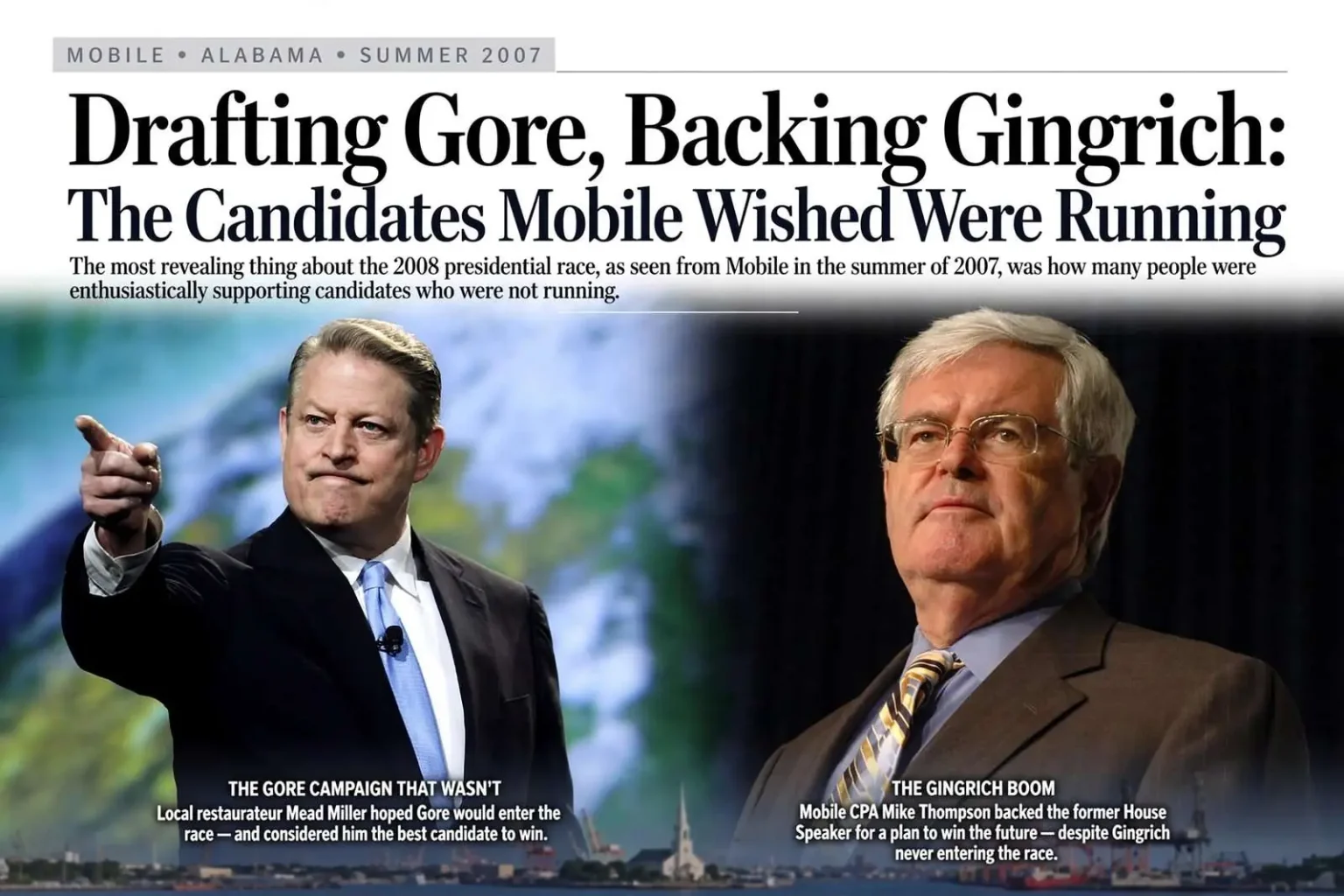
The most revealing thing about the 2008 presidential race, as seen from Mobile in the summer of 2007, was how many people were enthusiastically supporting candidates who were not running.
The Gore campaign that wasn’t
Mead Miller, a restaurateur, was not merely hoping Al Gore would enter the race. He was corresponding with him about it. Miller considered Gore far and away the best candidate and openly doubted whether either Hillary Clinton or Barack Obama could actually win a general election. His proposed solution was a Gore-Obama ticket, reasoning that a lot of voters would be more comfortable with a Black vice president before a Black president.
Clinton, he thought, carried heavy negatives, and sexism would hurt her. He believed Gore was seriously considering a run, though he was careful to label that a hunch rather than anything the former vice president had told him.
Miller was far from alone in that belief. The summer of 2007 was the peak of a genuine draft-Gore movement that had taken root online, with petition drives, draft committees and a cottage industry of commentary arguing that the 2000 popular-vote winner — vindicated by the years since on climate change, which he had made the subject of “An Inconvenient Truth” and an Academy Award earlier that year — owed the country one more campaign. Gore, who had spent the interval building a media company and a global lecture circuit around climate science, let the speculation run for months before closing the door for good later that year.
Gore did not run. Obama won the presidency the following year without the intermediate step Miller thought necessary.
The contrast between Miller’s prediction and the actual result was instructive. The electoral calculus he described — an electorate supposedly unready to elect a Black president — assumed that race would function as an absolute ceiling. The 2008 campaign demonstrated instead that a well-funded, well-organized candidacy could convert inspiration into turnout, caucus by caucus, and that the general electorate of 2008 was more willing to cross that line than even sympathetic observers had wagered.
Mobile attorney Christ Coumanis was equally unequivocal about a candidate who was running and going nowhere. New Mexico Gov. Bill Richardson, he said, was absolutely the most qualified contender in either party, and he supported him without hesitation. He would happily see Iowa Gov. Tom Vilsack or Sen. Christopher Dodd as running mate, and if Gore jumped in, he would back a Gore-Richardson ticket.
Coumanis’ assessment was, on paper, defensible. Richardson had served as a congressman, United Nations ambassador and Energy secretary before two terms as governor of a border state, and his resume dwarfed those of most rivals in both parties. But qualification was not the currency of the 2008 campaign. Obama’s candidacy ran on judgment and change rather than length of service, Clinton traded on familiarity, and Richardson’s thick resume and halting debate performances never translated into traction. He was out of the race by January.
The Gingrich boom
On the Republican side, a Mobile CPA named Mike Thompson gave the most emphatic answer of the entire survey, and it was for a man who never entered the race.
“I am supporting the candidate who has yet to announce, Newt Gingrich,” he said.
Thompson conceded that Gingrich might have a few skeletons in his closet, then asked which politician did not. What mattered, he argued, was that Gingrich was the only candidate with a plan, laid out in his book “Winning the Future.” He did not claim everyone would agree with that plan. He claimed it would force intelligent people to think seriously about the country’s direction, and he warned that unless the United States addressed Social Security, health care, education, homeland security and immigration, it would find itself answering to China by 2020.
The rest of the field, in his estimation, was flip-flopping away.
Thompson’s embrace of Gingrich captured a strain of Republican opinion that never found a home in the 2008 field. Gingrich had engineered the 1994 Republican takeover of the House and remained, in conservative eyes, the party’s best idea generator — a former professor who published policy books at a clip no announced candidate matched. He was also, by mid-2007, a man with a turbulent personal history and a reputation for volatility, which is a large part of why his boomlet never required him to actually campaign. He, like Gore, stayed out, and the “candidate with a plan” remained hypothetical.
The China warning Thompson invoked was already a fixture of conservative policy writing by 2007, and it has aged as a marker of its moment: the concern then was economic and generational — whether American institutions could sustain the country’s standing through the century’s first decades — and it cut across party lines even as the parties disagreed about what to do about it.
The professionals hold back
The people whose jobs required caution were, predictably, cautious. Mark Erwin, the Mobile County Republican chairman, said he would not endorse or actively participate in a contested Republican primary until the general election, noting with some interest that several county chairs across the state had gone public for one candidate or another.
Erwin’s neutrality was textbook county-chair discipline. A chairman who commits early not only spends his credibility but alienates whichever campaign wins, and the local party’s machinery — the fundraising, the headquarters, the get-out-the-vote operation — is worth more to the eventual nominee if it stays intact through the primary. His observation that chairs elsewhere had endorsed anyway pointed to a split in party circles between those who saw early commitment as influence and those who saw it as exposure.
He watched for whether Tommy Thompson’s entry would shake up the running order, and made a structural prediction that proved shrewd: whoever led the field would need a Southern or Midwestern social conservative as a running mate to solidify the base.
That prediction described the eventual Republican ticket almost exactly. The party’s frontrunner came from Arizona, with a record of defying movement conservatives, and the base’s suspicion of him was a standing story of the primary season. The nominee’s solution was a first-term governor from Alaska — socially conservative, politically fresh and Southern-Midwestern in cultural identity if not geography — chosen to close precisely the gap Erwin identified.
Luther Strange, fresh off his loss in the lieutenant governor’s race, said simply that he did not have a candidate yet. Sydney Raine of Mobile Works said it was too early to get involved. Riley Boykin Smith, the former state conservation director, was not sure.
The McCain holdouts
Two responses pointed toward the man who would actually be nominated. Former state Sen. George Callahan intended to run as a candidate for delegate to the Republican convention and, while not finally decided, named John McCain as his first choice at that date.
Callahan’s delegate plan was the practical side of presidential politics, the part voters rarely see. Alabama’s delegates to the national convention are allocated through the primary and bound to candidates, but the people who fill those delegate seats are chosen individually — local activists, officeholders and party loyalists who commit to a campaign months before anyone else does. A delegate slot is both a ticket to the convention and an early signal of which campaigns have real organizations on the ground in places like Mobile County.
John Furman, an assistant district attorney, described himself as presently uncommitted but probably leaning toward McCain as a moderate Republican, preferring him to Giuliani on the strength of his experience at the national level.
Furman’s reasoning tracked the choice many Republican-leaning voters faced that summer. Rudy Giuliani led national polling through most of 2007 on the strength of his post-Sept. 11 reputation, but his record on social questions put him at odds with the party’s activist base, and his decision to skip the early caucuses and primaries where McCain fought stripped his candidacy of momentum. McCain’s own campaign had collapsed that summer — money exhausted, staff shed, written off by the press — which is precisely why a soft-lean response like Furman’s, recorded before the comeback, reads so differently in hindsight. McCain rebuilt around New Hampshire, won it in January, and secured the nomination by spring.
Callahan, for his part, knew McCain from the Senator’s frequent campaign swings through Alabama, where his Straight Talk operation cultivated county-level supporters years before the primaries arrived.
The lesson of the draft candidates
Read now, this collection of preferences is a study in the psychology of an early primary. The candidates who inspired the most passion in Mobile were the ones who existed mainly as possibilities: Gore, Gingrich, and in other conversations that summer, Fred Thompson.
An unannounced candidate carries no record of recent votes, no gaffes and no compromises. He is whatever the supporter needs him to be. The moment he announces, he becomes an actual politician with actual liabilities, which is precisely why the enthusiasm rarely survives the announcement.
Fred Thompson’s entry proved the point in real time. The former Tennessee senator and television actor was courted all summer by conservatives dissatisfied with the announced field, polled near the top of the race while still a non-candidate, and then watched his support plateau the moment he declared and had to debate, fundraise and answer for a thin, interrupted Senate record. He was out by January. The pattern repeated on both sides: the hypothetical candidate drew passion precisely because he was hypothetical.
The two men who ultimately won their parties’ nominations drew, in this survey, a tepid lean and no mention at all. That gap between measurable early enthusiasm and eventual victory is a standing lesson for anyone who reads too much into a primary survey taken a year and a half out: voters fall in love with possibilities, but parties nominate politicians. The names that dominated conversation in Mobile that summer — Gore, Gingrich, the unannounced Thompson — exited history without casting a single delegate-bound vote, while the candidacy Furman called a lean and Callahan called a first choice went on to win the White House.