Booted From the Primary, RaShawn Figures Tries an End Run as an Independent
Disqualified from the Democratic primary, RaShawn Figures began gathering 300 signatures to run as an independent, while Rep. James Buskey's attorney laid out the evidence behind the residency ruling.
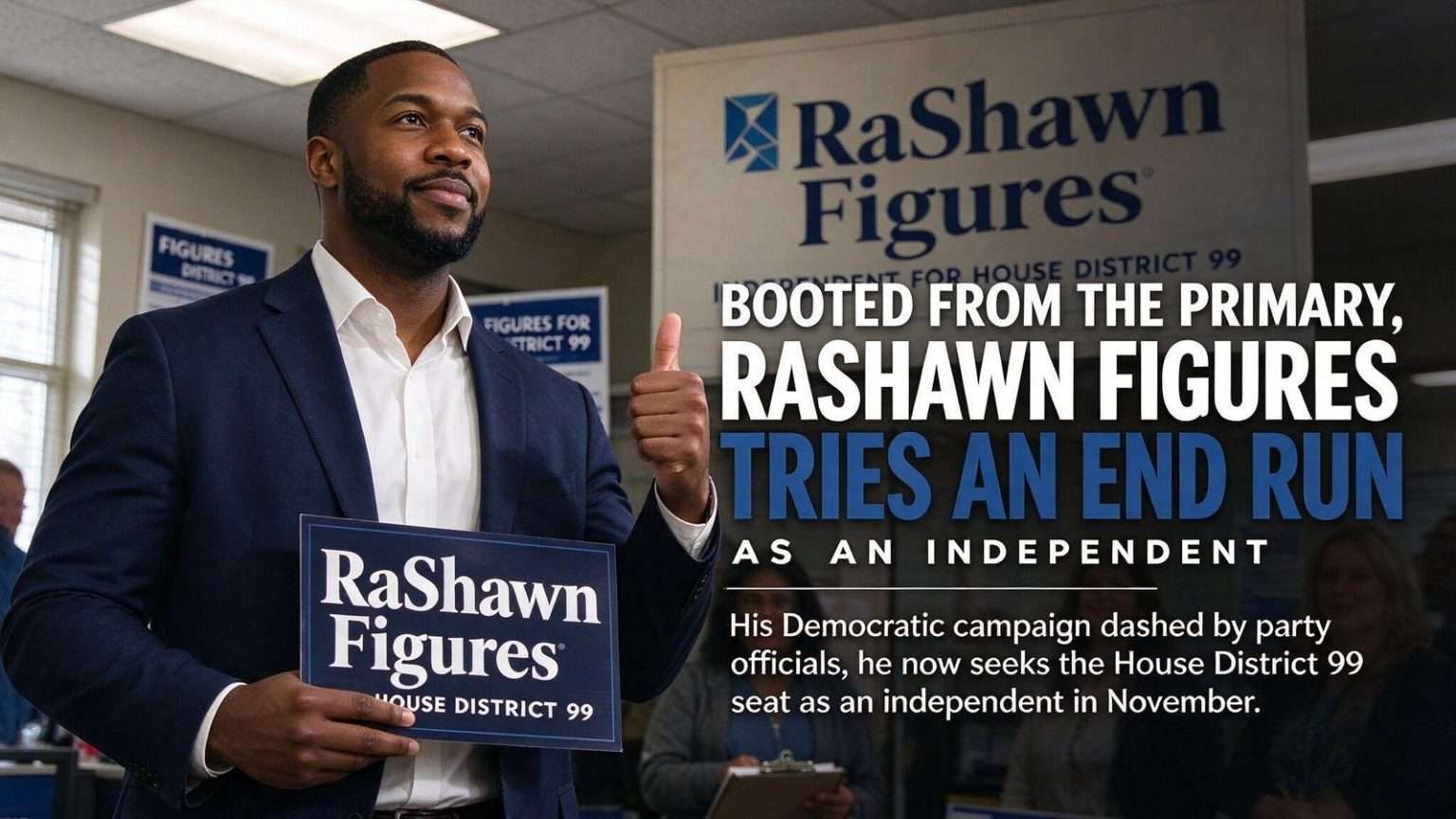
His Democratic campaign to unseat incumbent state Rep. James Buskey dashed by party officials, RaShawn Figures has launched an effort to win the House District 99 seat by another route: as an independent candidate in November.
The state Democratic Party rejected the young real estate investor’s appeal on Tuesday, upholding a subcommittee ruling that he did not satisfy the requirement that a candidate reside in a district for one year before running to represent it.
“Regardless of the factual information presented to the committee, ‘politics as usual’ prevailed,” Figures said. “The ruling will not stop me; moreover, it energizes me.”
The residency rule Figures ran afoul of is one of Alabama’s basic qualifications for legislative office: a House candidate must have lived in the district for the year preceding the election. Party officials, acting under their own challenge procedures, sit in judgment of that requirement during qualifying, and their rulings routinely decide candidacies before any voter has cast a ballot. An appeal to the state party is the first and usually final stop; from there, the options shrink to court or an end run around the primary altogether.
Figures chose the end run. The decision converted a party dispute into a general-election campaign, an altogether different kind of race in which he would face whoever the Democrats nominated — almost certainly the incumbent he had set out to beat — without a party line beside his name.
The Signature Hunt
To qualify as an independent, Figures must gather the signatures of 300 voters within District 99. His campaign said petitions would be available at FunkFest, at campaign headquarters on North Sage Avenue, and at community churches across the district.
The number is small by petition standards, but the geography is unforgiving. Every signature must come from a registered voter who lives inside the district’s lines, and each petition sheet has to be verifiable. In a compact urban district, the campaign’s distribution strategy — a festival, a headquarters, and the churches that anchor neighborhood life — reflected the places where district voters actually gather.
It is a demanding path. Independent candidates in Alabama forgo the organizational apparatus of a party: no primary voters to mobilize, no party committee’s field operation, no slate of fellow partisans sharing a ticket. A legislative seat held since 1976 is not an easy target under any banner. But it is a legal one, and it moves the fight from a party subcommittee room in Montgomery to the voters of the district.
The move also changed the calendar. Instead of a June primary, Figures’s campaign would run straight through the summer and into November, when turnout would be larger and less predictable, and when the incumbent’s thirty-year record would be the object of scrutiny rather than a party committee’s reading of a residency affidavit.
Buskey’s Attorney Answers
Figures’ lawyer, John Lawler, has called the disqualification a shameless celebration of the rule of man over the rule of law, arguing that while Figures owned several properties — including one outside the district — there was no evidence he had actually lived outside District 99.
Buskey’s attorney, Cecil Gardner, said the record was rather less flattering, and that Lawler’s “self-righteous indignation” was “a little misplaced” in light of the evidence.
“The argument to the subcommittee was not that the candidate had a specific residence outside the district,” Gardner said. “To the contrary, the argument was that Mr. Figures was not credible when he testified that he lived or was domiciled in the district for one year prior to the election.”
The distinction Gardner drew was the legal heart of the case. Residency challenges do not always require proving the candidate lives somewhere else; they can rest on showing that the candidate’s own account of where he lived is unreliable. Credibility, once broken, can defeat a candidacy without a single contradicted fact — the panel need only decline to believe the testimony on which the one-year claim rests.
The Evidence Cited
Gardner laid out the specifics the party panel weighed: Figures first said he moved to 75 N. Sage Avenue around Mardi Gras 2009, then later said it may have been between June and August.
“One can understand being off by a month or so,” Gardner said, “but the difference between Mobile weather at Mardi Gras and summer is such that such a statement would raise an eyebrow.”
Although Figures said he rarely used a land line, relying on his cell phone, a land line was in service in his name at an Ansley Drive address outside the district as recently as two months ago.
Neighbors near the North Sage Avenue address submitted affidavits stating they had observed ongoing construction there during the relevant period but had seen no sign of a family with four children living in the home.
Traffic citations issued to Figures in February 2010 listed 3672 Ansley Drive as his residence. Figures said that was not his legal residence and that the officer did not ask for it.
“In the unlikely event the trooper did not ask,” Gardner observed, “one would think it would be prudent to nevertheless tell a law enforcement officer the correct address.”
Gardner’s research, he said, turned up six residential addresses associated with Figures’ name across overlapping periods: Wagner Street, Flint Street, Plant Street, Durant Street, Ansley Drive and North Sage Avenue.
“If there are simple explanations for these inconsistencies,” Gardner said, “they were not brought in the evidence at the first hearing nor in arguments at the second.”
The affidavit evidence was the panel’s most concrete material. Neighbors who watched a renovation proceed month after month, without the comings and goings of a household, could describe what they saw without guessing at anyone’s intentions — the kind of testimony that is difficult to rebut with a lease document. Combined with the utility record and the citation addresses, it built a documentary picture at odds with the testimony.
Lawler’s Reply
Lawler acknowledged that a divorce and Figures’ real estate career had muddied the documentary record. But there was, he maintained, no conclusive evidence that Figures did not live in District 99 during the period in question, and ample reason to believe he did.
The reply was a fair description of how such records get tangled. A real estate investor’s name attaches to properties the way a business owner’s name attaches to accounts — title records, utilities and listings pile up across addresses that are assets rather than homes. A divorce multiplies the confusion, splitting one household’s paperwork into two. Lawler’s argument was that the ordinary noise of such a life should not be mistaken for evidence of a false residence claim.
The party panel had weighed exactly that tension — paperwork noise against neighbor affidavits — and sided with Gardner’s reading of it. The appeal court of last resort in the dispute was the state party itself, and Figures’s response was not to litigate further but to run around the ruling entirely.
Buskey, 73, a retired educator, has held the seat since 1976. Businessman Henry Haseeb of St. Stephens Road has qualified to run against him in the June 1 Democratic primary.
The incumbent’s longevity made him a fixture of Mobile politics few districts can match. Elected in the mid-1970s, Buskey had represented the district through five decades of the city’s demographic and economic change, and his seniority in the House carried committee influence that a first-term challenger could not hope to match for years.
Haseeb’s qualification meant the primary would proceed as scheduled regardless of Figures’s status. If Buskey won it, the November ballot would carry the incumbent, the independent Figures, and any Republican qualifier — a three-way general election in a district where Democratic nomination has historically been the whole contest.
The dispute also marked a generational passing in district politics. Figures is the son of a prominent political family with deep roots in Mobile, and his challenge to a seatless incumbent was read by many observers as the newest chapter in a long local contest over who speaks for the district’s neighborhoods. The party’s ruling did not resolve that contest; it only changed the venue in which it would be fought.
For further information on the independent bid, the Figures campaign asked that voters call 591-7617.
The aftermath left both camps claiming the higher ground. To Figures and Lawler, the disqualification was a party protecting its incumbent by technical means, and the independent run was the remedy politics left them. To Buskey’s side, the panel had done no more than weigh evidence and find a candidate’s testimony wanting — the ordinary work of enforcing a qualification every legislative candidate must satisfy.
What neither side disputed was the shape of the race to come: a signature drive through the district’s churches and festivals, a summer of campaigning without a party label, and a November election in which a thirty-four-year incumbent would face the young challenger the party had kept off its own ballot.