Mobile’s District Attorney Hired a Fundraiser and a Media Man for a Run at Attorney General
District Attorney John Tyson Jr. brought on a West Virginia fundraising firm and a Mobile media consultant for his Democratic campaign for Alabama attorney general against Republican incumbent Troy King.
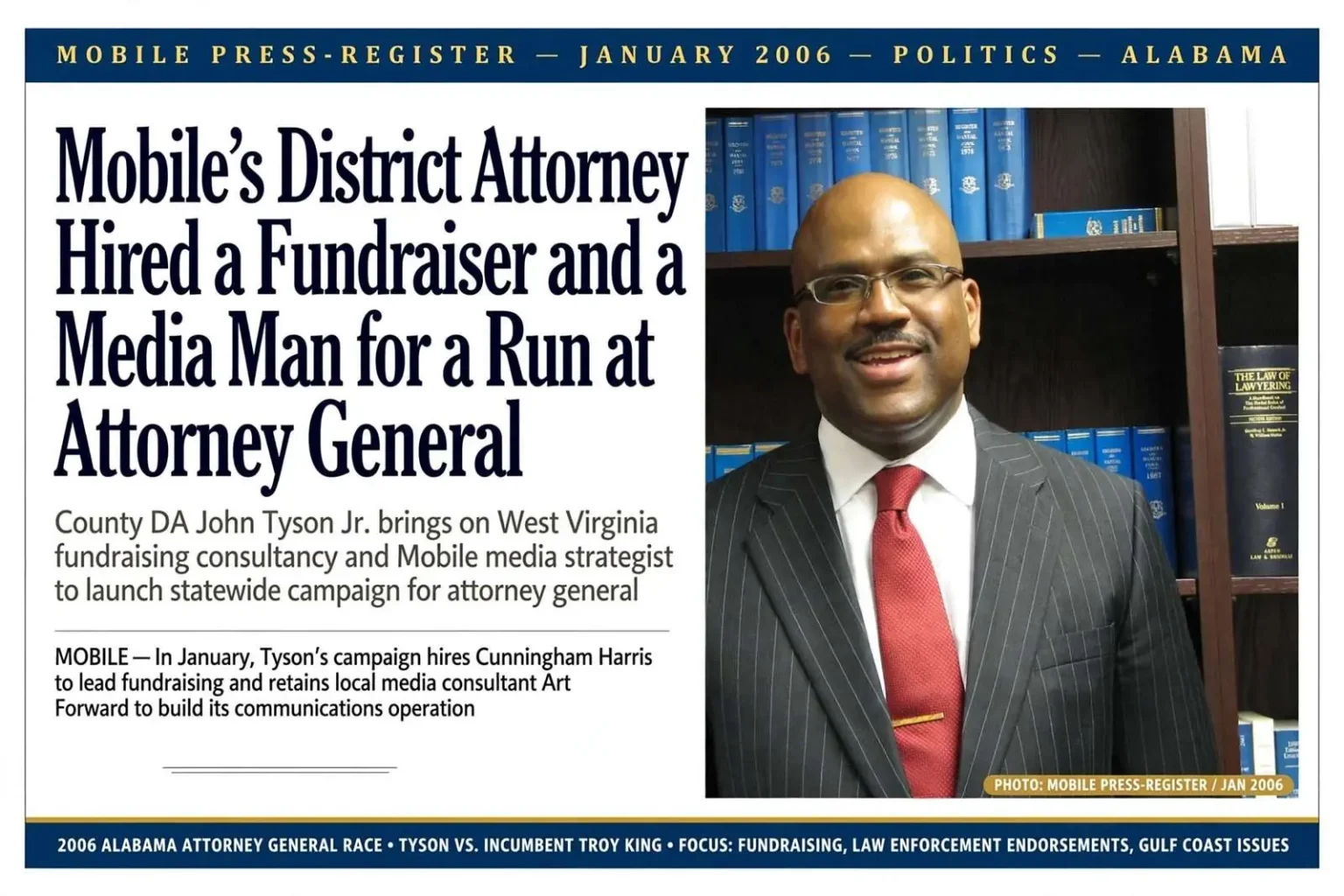
MOBILE — Mobile County District Attorney John Tyson Jr. put the machinery of a statewide campaign into gear, engaging Jim Cunningham of Cunningham Harris, a West Virginia-based fundraising consultancy, to help finance his run for Alabama attorney general. The hire was not a random one. Cunningham Harris had a hand in two of the more consequential recent successes in local Democratic politics: the 2002 victory of state Sen. Gary Tanner and the election of Sam Jones as mayor of Mobile four months earlier. In a state where Democratic candidates for statewide office had been losing ground for a decade, a firm with a record of winning in Mobile County carried a certain persuasive weight.
Political consultants are hired for two things: money and message, and the two are inseparable in a statewide race. Alabama is a large state to buy television in — Birmingham, Huntsville, Montgomery, Mobile and the Dothan and Decatur-Florence markets together make a full statewide media buy one of the most expensive undertakings in Alabama politics. A campaign that intended to be credible by primary day needed a fundraising operation that could produce that money month after month, and Cunningham Harris’ record in the state’s third-largest county was the credential Tyson’s campaign chose to lead with.
The timing mattered as well. Announcing a fundraising operation in January of an election year put the campaign on the calendar early, ahead of the qualifying deadlines and the spring fundraising season that funds the summer primary. Candidates for attorney general in Alabama typically emerge from the ranks of prosecutors, legislators or former attorneys general, and the ones who build financial momentum early are the ones who survive crowded primaries.
Building a statewide operation from a county office
Media consultant Art Forward of Mobile was retained to advise the campaign, and Tyson’s Democratic bid was given a home online at johntysonjr.com — at the time still a comparatively novel piece of campaign infrastructure for an Alabama race. Campaign websites were, in that cycle, transitioning from novelty to necessity, and a district attorney’s campaign treating the web as a serious organizing tool reflected the professionalization the Tyson operation was signaling from the start.
The office Tyson sought was held by Republican incumbent Attorney General Troy King, who had been appointed to the post by Gov. Bob Riley and was seeking a full term of his own. The attorney general is Alabama’s chief legal officer, responsible for representing the state in court, issuing legal opinions that bind state agencies, and taking on criminal prosecutions that cross county lines or exceed local resources.
The incumbency shaped the race. An appointed attorney general running for his first full term carries the advantages of the office — name recognition from press coverage, a staff and a record — but not the automatic loyalty of a seat won at the ballot. King’s path to the office through appointment meant the election would be his first statewide test, and Democratic candidates saw the post as among the most winnable statewide offices on the 2006 ballot.
The attorney general’s office itself rewards a prosecutor’s skill set. The post supervises appeals, polices public corruption through its own investigators, fields criminal complaints that counties cannot handle alone, and issues the formal opinions that tell every county commission, school board and municipality in Alabama what the law allows. A district attorney who has run a large office arrives knowing the weaknesses in the state’s criminal justice plumbing — the cases that fall through between counties, the underfunded forensic pipeline, the local officials who need to be watched.
A prosecutor’s résumé
Tyson had built his public identity as a prosecutor rather than as a partisan. As Mobile County’s district attorney he ran one of the largest prosecution offices in Alabama, and the job placed him at the center of the county’s most serious criminal cases — the kind of work that translates readily into a statewide campaign message about crime, drugs and public safety. That was the theory of the race, at any rate.
The difficulty for any Democrat seeking statewide office in Alabama in 2006 was arithmetic. Republicans had been consolidating their hold on the state’s constitutional offices, and a Democratic candidate needed both a strong showing in the Black Belt and the urban counties and an unusual level of crossover support elsewhere. A prosecutor with a tough-on-crime record was, in the calculation of Democratic strategists, about as good a candidate as the party could field for the attorney general’s office.
The logic was regional as much as partisan. In north Alabama’s Tennessee Valley and in the suburban crescent around Birmingham, Democratic candidates for statewide office had been losing ground cycle after cycle, but a prosecutor’s record cut across the partisan grain in ways a generic Democrat’s could not. Voters who would not vote for a Democratic legislative candidate might still support a district attorney who had prosecuted the cases they read about in their local paper — particularly for an office whose essential job description was putting criminals in prison.
The Mobile connection
The consultants Tyson chose tell their own story about where the campaign expected to find its base. Cunningham Harris and the operatives around Sam Jones’ mayoral victory represented a Mobile-centered Democratic organization that had proved it could turn out votes when it mattered. A statewide campaign built on that foundation would rely on Mobile County to produce a margin, then work to hold down losses in the Republican strongholds up the state.
The Sam Jones mayoral victory, delivered four months earlier, had been a genuine organizational achievement — a Democrat winning Mobile’s city hall in an era when the party’s fortunes were receding elsewhere in the state. The operatives who produced that result knew the county’s precincts, its churches and civic organizations, and its fundraising community, and Tyson’s campaign meant to borrow all of it. In Alabama politics, hiring the people who just won the county is as close to a formula as exists.
Whether that would be enough was a question the 2006 cycle would answer. What was clear in January was that Tyson intended to run a serious, professionally staffed campaign rather than a symbolic one, and that a Mobile County officeholder was again reaching for statewide office — a habit this corner of Alabama has never entirely given up.
Mobile’s habit of exporting politicians is a long one. The city and county have produced gubernatorial candidates, legislators of statewide renown and perennial contenders for constitutional offices, even as the state’s political center of gravity shifted northward. For a port city that considers itself the capital of south Alabama, statewide office is the natural next step for a successful local official, and Tyson’s campaign fit squarely into that tradition.
Why the attorney general’s race mattered here
For South Alabama, the attorney general’s office is not an abstraction. It weighs in on coastal and environmental litigation, on consumer protection cases, on public corruption prosecutions and on the legal opinions that govern how counties and municipalities may spend their money. A Mobile prosecutor in that chair would have meant a shift in the geography of legal power in Alabama — a prospect that concentrated minds in Montgomery as much as it did along the bay.
The coastal dimension alone gave the race local stakes. The state’s legal positions on coastal development, on the public trust in Alabama’s beaches, on insurance disputes and on environmental enforcement all run through the attorney general’s office, and Gulf Coast residents had spent years watching those issues decided in offices where south Alabama’s interests were one voice among many. An attorney general who had spent his career on Mobile Bay would arrive with a different set of instincts about the water, the shoreline and the industries that depend on them.
Those instincts would matter, too, in the office’s consumer protection role — the division that fields complaints about everything from home-repair fraud to utility practices — and in the corruption prosecutions that periodically reshape county and municipal government. The attorney general’s opinions determine how local governments may spend public money, which means the office is never far from the daily decisions of the mayors, commissioners and school boards of south Alabama. Tyson’s candidacy asked voters whether they wanted a Mobile perspective in that chair; the 2006 election would provide the answer.
The January landscape of the 2006 race
With the fundraising and media hires announced, the shape of the race came into view. Tyson would run through the spring as one of several Democrats competing for the nomination, with the June primary ahead, and the winner facing Troy King in November. Attorney general races in Alabama rarely attract the television attention that the governor’s race commands, but they reward organization, name recognition within the legal community and the endorsements of sheriffs, district attorneys and law enforcement groups — constituencies a sitting district attorney can plausibly claim.
The law enforcement endorsement game is particularly valuable in a down-ticket statewide race. Voters who cannot name the candidates for attorney general will often follow the recommendation of a sheriff they know or a police association they trust, and prosecutor-candidates spend the spring collecting those nods county by county. Tyson’s two decades in Mobile County prosecution gave him a natural claim on that network; the question was how far it reached beyond south Alabama.
The campaign’s early infrastructure — a national fundraising firm with an Alabama record, a local media consultant, a website — suggested an operation built for the long haul rather than a protest run. In a state where Democrats had watched office after office slip away, the party’s strategists argued openly that the path back ran through candidates whose records made partisanship secondary: prosecutors, veterans, business-oriented moderates. Tyson, the theory went, was the archetype.
For Mobile County, meanwhile, the candidacy carried its own significance regardless of outcome. A district attorney’s race for attorney general reminded the rest of the state that the county’s political bench extended beyond its borders, and the campaign organization being assembled in early 2006 — fundraisers, media hands, web infrastructure, precinct captains — would remain an asset in Mobile County politics long after the attorney general’s race was decided, whoever won it.