Artur Davis Said to Be in Line for U.S. Attorney Post After Primary Loss
Legal and Justice Department sources said the congressman defeated in Alabama's Democratic gubernatorial primary could be offered the U.S. attorney's job in Montgomery, a post left conspicuously unfilled.
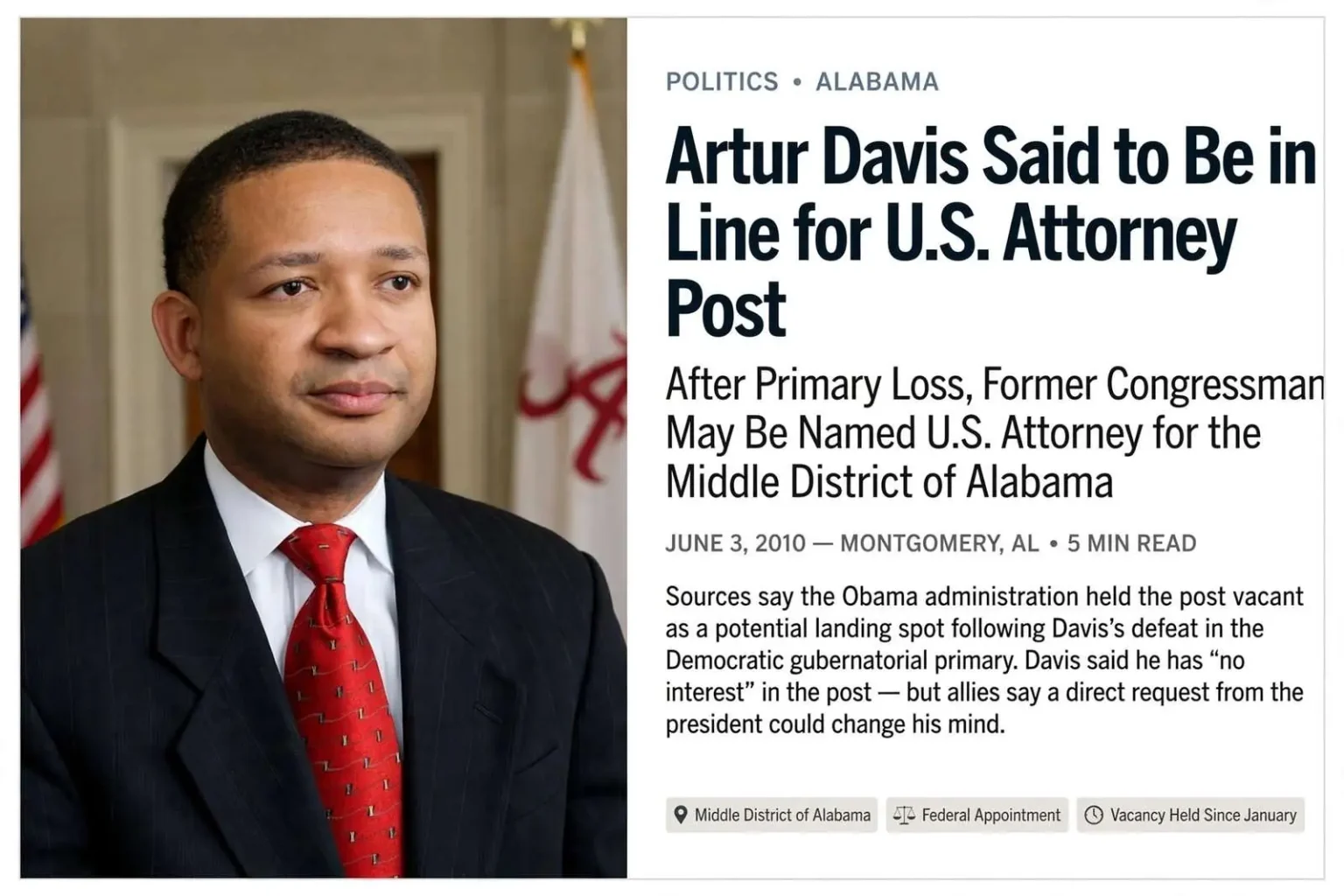
U.S. Rep. Artur Davis, days removed from a crushing defeat in Alabama’s Democratic gubernatorial primary, may be offered a consolation of considerable weight: appointment as U.S. Attorney for the Middle District of Alabama in Montgomery, according to several informed legal and Justice Department sources. The position, one of the most consequential law enforcement posts in the state, had sat unfilled longer than nearly anyone in Alabama legal circles expected, and the delay was now being explained in a way that few had anticipated.
The unusually slow pace of filling that high-profile position was being read, by people familiar with the process, as a deliberate calculation by the Obama administration — a contingency held open in the event of exactly the outcome that had just occurred. Federal judicial nominations routinely move slowly, but sources said the Montgomery vacancy had lingered past the point where ordinary staff work could explain it, and that the administration had kept the file open rather than closing it in favor of another candidate.
A presidential appointment to a U.S. Attorney’s office carries a lifetime’s worth of consequence in Alabama legal circles. The post commands federal prosecutors who handle public corruption cases, major drug conspiracies and civil rights prosecutions across a multi-count district, and its occupant is routinely mentioned as a candidate for judgeships and statewide office. For a congressman whose electoral path had just closed, the offer of such an office would represent both an honor and a very public verdict on his political future.
A post held in reserve
Sources described the appointment as likely to be Davis’s to accept or decline. Davis himself had said publicly that he had “no interest” in the position, a formulation that left room for the kind of reconsideration that often follows a devastating electoral loss. But those who know him said that if the president personally asked him to take it, the congressman would almost certainly agree — a distinction between declining a job and declining a president that few politicians of his standing have been willing to make.
Montgomery lawyer George Beck, the prospective appointee who had been under consideration, remained in what one source called the holding tank of a slow-moving nomination process. Beck’s candidacy had been well received in Alabama legal circles, yet the White House had declined to move his paperwork forward, an omission that only made sense if the administration intended to preserve its alternatives until the Alabama political calendar resolved itself.
The sequencing illustrated an often-overlooked feature of federal appointments: they are one of the few levers a president can use to shape state politics from Washington. A seat left vacant can be filled with a loyalist, a neutral figure or a consolation for an ally defeated in a primary, and the administration controls the timing. In Alabama’s case, the calendar of the June 1 primary meant that anyone paying attention knew within weeks which candidates would need landing places.
How Davis lost
State Agriculture Commissioner Ron Sparks defeated Davis decisively on June 1, ending a candidacy that would have made Davis the first black governor in Alabama history. The result was not close, and it upended the assumptions of a campaign that had entered the year with national attention, considerable fundraising and a strategy designed to change the arithmetic of Alabama Democratic politics rather than work within it.
Davis had built his campaign on a strategy of bypassing the state’s traditional Democratic power brokers — the Alabama Democratic Conference and the New South Coalition — in the belief that a broader, more moderate appeal would serve him better in a general election. The two organizations had for decades functioned as gatekeepers for black Democratic votes in Alabama, endorsing candidates in primaries and delivering organized support in the communities where Democratic margins are made. Bypassing them was a wager that a new coalition could be assembled without their blessing.
He also voted against the federal health care overhaul, a vote that drew fierce criticism from the party’s base. Davis, who had managed the floor debate for the Obama administration’s 2008 campaign in Congress, cast the vote as a matter of principle and of positioning for a general electorate wary of the new law. Within the Alabama Democratic primary electorate, it read differently: as a repudiation of the national party by its most prominent Alabama officeholder at the precise moment his own base was being asked to deliver for him.
The combination produced a backlash. Both organizations endorsed Sparks, whose campaign framed him as the authentic Democrat in the race and Davis as a politician calculating his way toward a general election that might never come. Primary politics rewards the voters who actually show up, and in a low-turnout Alabama Democratic primary, the voters who show up are heavily influenced by the organizations Davis had chosen to run without.
Black voters, whose support Davis had counted on as a floor, did not deliver the margins his campaign expected. The strategy of independence, which polled well among commentators and promised a post-racial coalition, collapsed in the precincts where elections are actually won. Sparks carried the black belt counties and the urban neighborhoods that Davis needed to dominate, and the margin of the loss made clear that no candidate for statewide office in Alabama’s Democratic Party can win while at war with its organizational leadership.
The defeat was severe enough that Davis said afterward it had ended his political ambitions. In a concession statement that drew attention far beyond Alabama, he acknowledged the loss in unvarnished terms, saying the voters had rendered their judgment and that he would not seek office again. For a politician who had been mentioned for years as a future senator or governor, the statement read as an abrupt end to a career that had seemed to many observers destined for higher office.
Davis had represented the Birmingham-based 7th District in Congress since 2003, the district drawn to give Alabama’s black communities an opportunity to elect a representative of their choice. He had been one of the state’s most visible Democrats, a frequent presence on national television and a co-chair of Barack Obama’s 2008 campaign in Alabama, and his ascent had been watched as a possible template for a new generation of Southern black politicians who could compete beyond the districts that elected them.
Why the job would matter
The office of U.S. Attorney for the Middle District covers Montgomery and a swath of central Alabama, and its reach extends into every county courthouse in the district. Federal prosecutors there handle cases that state and local authorities cannot or will not bring: public corruption among county commissioners and state legislators, large-scale narcotics trafficking, fraud against federal programs, and civil rights violations. The occupant of the office sets priorities that shape public life across the region for years after an appointment is made.
In Alabama, the U.S. Attorney’s offices have historically carried particular weight in the arena of public corruption. The state’s long history of corruption prosecutions at every level of government has made the federal courthouse in Montgomery a place where political careers end, and the decisions about which investigations to pursue are among the most politically sensitive calls any appointee can make. A U.S. Attorney who once served in the state’s congressional delegation would arrive with both deep knowledge of the state’s political landscape and a long list of people watching how that knowledge was used.
The timing of the decision also mattered to the business of the district. The office had been operating under interim leadership while the nomination lingered, and career prosecutors had continued the docket of investigations and prosecutions without a Senate-confirmed chief. Long vacancies are common in the early years of a new administration, but in a district whose docket includes elected officials under investigation, an extended interim period carries its own costs, both in momentum and in public perception of whether sensitive matters are being handled with full authority.
Any such appointment would also be parsed for what it signaled about the relationship between the White House and the Alabama Democratic Party’s remaining leadership. Davis had run against that leadership; rewarding him with a federal post would demonstrate that the administration valued its own allies over the state party’s gatekeepers. Activists on both sides of that dispute would read the decision as a precedent for how insurgent candidacies — and their defeats — were treated by Washington in the years to come.
For Davis, the arithmetic of the offer was stark. Accepting would mean trading a political identity, built over eight years in Congress and a statewide campaign, for an executive branch post that forbids the very campaigning he had spent his adult life mastering. Declining would mean holding to the statement that his ambitions had ended, and banking on a future in private practice or a later reopening of the political door that no one could promise. The administration, for its part, had only to make the call — and the slow-moving file on George Beck suggested it had not yet decided whether to.