Political Insiders Hand In Their Predictions Before the June 1 Primary
Days before Alabama's June 1 primaries, a panel of lawyers, lobbyists, former officeholders and consultants offered their forecasts on the governor's race, two district attorney contests and the fight over the state's political future.
With Alabama’s party primaries three days away, a season of unusually bitter campaigning was drawing to a close, and the region’s political class was ready to guess how it would end. By any measure it had been a punishing cycle: a governor’s race with no incumbent for the first time in many years, an attorney general’s contest in which a crowd of ambitious lawyers circled a weakened officeholder, and — locally — the wreckage of the Stephen Nodine case looming over district attorney races on both sides of Mobile Bay.
A group of political observers from around the Mobile Bay area, most of whom asked that their forecasts be published under initials rather than names, offered their reading of the returns to come. The reliance on initials said its own thing about the moment: the campaign had been bitter enough that even veterans of backroom politics preferred not to attach their names to guesses about it, knowing winners keep lists.
The teachers’ union against Bradley Byrne
Several panelists framed the Republican gubernatorial primary as a proxy war over the Alabama Education Association and its longtime leaders, Paul Hubbert and Joe Reed.
“Every election is said to be a watershed. This one may actually be one in several regards,” said an attorney identified as HDC. He noted that the AEA had dominated education policy in Alabama for more than 30 years and had turned its resources against Bradley Byrne with unusual force, including full-page newspaper advertising seeking to tie Byrne to BP through work his law firm had done for another oil company years earlier.
“If Byrne wins, the AEA could be facing eight tough years,” he said. “And real education reform could be in the offing.”
The stakes were legible to anyone who had followed Montgomery. Byrne had run the state’s two-year college system through its worst scandal in a generation, removing employees and banning them from state GOP politics, and had made school accountability the spine of his campaign. Hubbert and Reed had spent three decades turning the AEA into the most effective political organization in the state, capable of punishing allies and enemies alike in both parties. A Byrne victory would place the two forces on a collision course over tenure, charter schools and the education budget itself.
The BP advertising was an artifact of timing. The Deepwater Horizon blowup had sent oil toward Alabama’s beaches just as the primary entered its final weeks, and any candidate with ties to the oil industry — even routine legal work for a different company years before — was suddenly fair game. The AEA’s full-page ads pushed that line hard, testing whether an environmental catastrophe could be converted into a campaign weapon in a Republican primary.
Artur Davis and the Democratic establishment
The same observer saw a comparable test on the Democratic side, where U.S. Rep. Artur Davis had bypassed the Alabama Democratic Conference and the New South Coalition in his bid to become the state’s first black governor. Both organizations endorsed Agriculture Commissioner Ron Sparks instead.
“If the African American community goes strongly for Davis, despite the endorsements, this could undermine the two over time,” he said, drawing a comparison to the collapse of the Nonpartisan Voters League after its candidates were routed in 1978.
The comparison carried weight for anyone who knew Alabama political history. The Nonpartisan Voters League had once been a powerhouse of black political organization in the state, and its collapse after the 1978 rout taught a generation of strategists that endorsement structures survive only as long as their candidates win. Davis had calculated that a new coalition of young voters, unaffiliated voters and black professionals could carry him without the blessing of the old guard; the old guard, in the form of the ADC and the New South Coalition, had calculated the opposite.
Ed Kahalley Sr., a longtime Mobile Democrat who asked that his name be used, took the opposite view.
“Artur Davis will lose the primary, because a majority of Democrats will accept the reality that he cannot win in November,” he said, adding that Davis had misjudged the older generation of black leaders whose work made his own career possible.
Kahalley’s argument was the electability case in its bluntest form: a Davis nomination, whatever its historic weight, would hand Republicans a foil they could beat, and Democratic voters primed by years of losing would choose the safer name. It was also a reading of generational fault lines inside Alabama’s black politics — the tension between the figures who had built the endorsement machinery and the younger officeholders who no longer needed their permission to run.
The local races
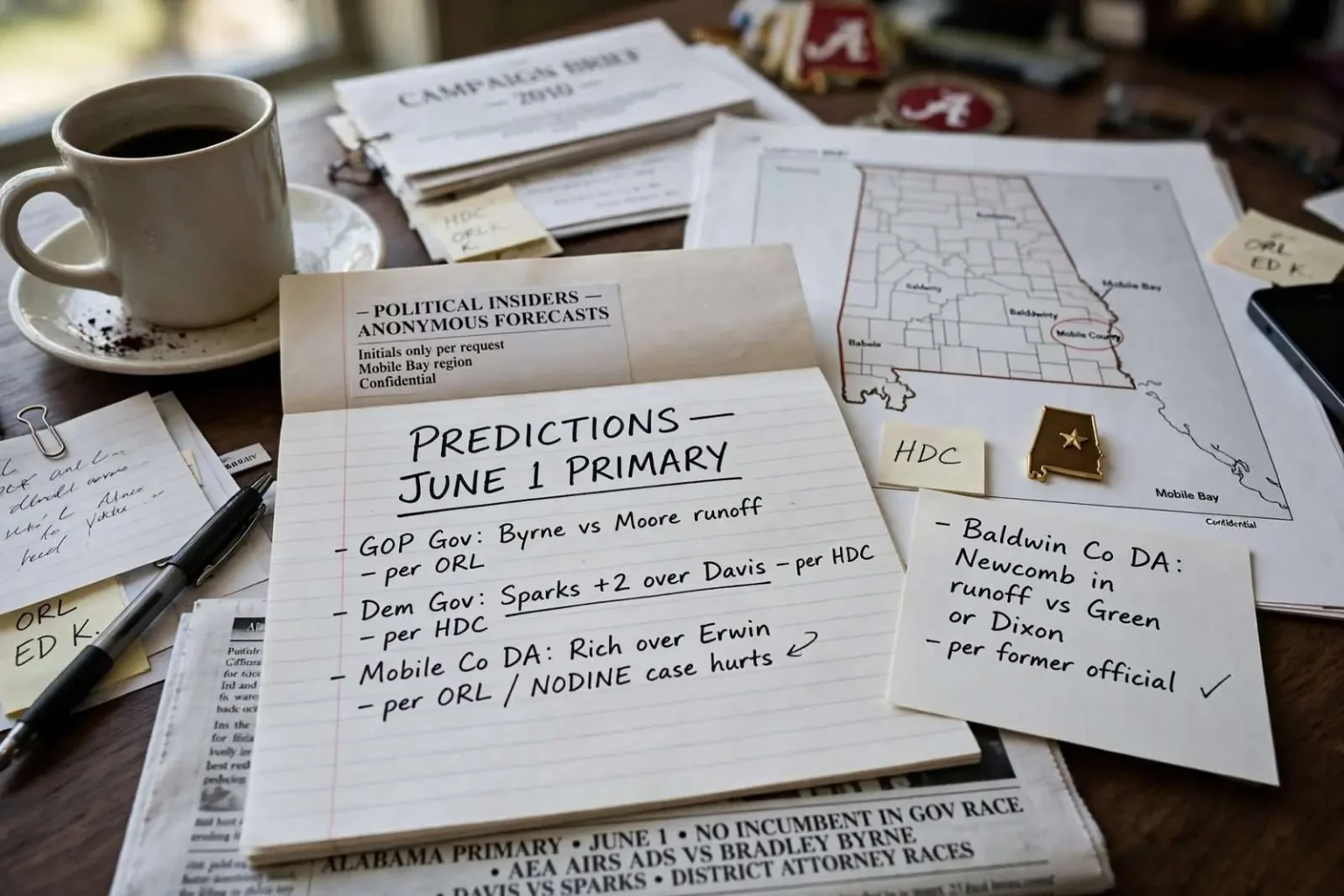
Forecasts for Mobile County district attorney split, though most respondents leaned toward Ashley Rich over Mark Erwin.
“DA race, I don’t have a clue, but handling of Stephen probably hurt Mark,” said a Republican lawyer writing as ORL.
The remark captured the shadow the Nodine case cast across the ballot. The county commissioner’s arrest and the collapse of the murder case against him had consumed the local courthouse for months, and every official who had touched the matter — investigators, prosecutors, judges — was being measured by voters for it. In a district attorney’s race, the incumbent’s office and its decisions were inseparable from the case’s tangled aftermath.
In Baldwin County, incumbent District Attorney Judy Newcomb faced three challengers.
“In Baldwin, the Nodine arrest has been the parachute Newcomb needed, but I think either David Green or Hallie Dixon will squeak into a run-off,” said a former public official.
The observation made the same point from the other side of the Bay: an incumbent who might have been vulnerable on her record had been rescued by a case that reorganized the entire race around her opponents’ associations with the defense. With three challengers splitting the anti-incumbent vote, the arithmetic pointed toward a runoff no matter which two candidates emerged on top.
A former lawmaker predicted a Republican gubernatorial runoff between Byrne and Roy Moore, a Sparks win by two points in the Democratic primary, and a Ralph Buffkin victory in the county commission opening.
Each prediction mapped a different strain of the cycle. A Byrne-Moore runoff would pit the establishment’s reformer against the most polarizing name in Alabama politics, a contest the party’s business wing had dreaded and its religious conservative base had hoped for. A narrow Sparks win would vindicate the Democratic old guard’s endorsements over Davis’s insurgency. And Buffkin’s race was a local test of whether the shifting partisan currents reached down to the county commission.
Grumbling from the sidelines
Not every response was a prediction. One developer wanted to know “how much of the $6,000 plane ticket can be refunded to the taxpayers” if Baldwin County Commissioners Skip Gruber, Wayne Gruenloh or David Ed Bishop woke up on June 2 as lame ducks with bags packed for a trade trip to China — a jab at a junket that had drawn criticism as oil came ashore on the Gulf Coast.
The complaint joined a running theme of the cycle: the collision between official business and catastrophe. With tar balls reaching Baldwin County’s beaches and the tourism economy holding its breath, a county trade mission abroad struck many residents as tone-deaf, and the commissioner trip became shorthand for an officialdom perceived as operating on a different clock than the crisis on the coast.
Others simply asked for relief. After months of television spots, robocalls, mailers and dueling press conferences, one common sentiment ran through the responses: whatever the result, let it be over.
That exhaustion was itself a political fact. Alabama’s primary campaigns had run longer and louder than usual, amplified by an open governor’s chair that drew a crowded field on each side, and by an attorney general’s race in which the incumbent’s troubles invited a wide roster of challengers. Negative advertising had saturated the airwaves from both directions, and by the final weekend even the political professionals admitted to wanting the thing decided.
Context for later readers
The June 1, 2010 primaries were the opening round of a cycle that would run through a July 13 runoff and a November general election. Alabama had not yet seen a Republican legislative majority, and the question of whether one was coming hung over nearly every race on the ballot.
The stakes were structural, not just personal. A Republican legislative majority would redraw the balance of power that had defined Montgomery since Reconstruction, handing the GOP control of committee chairs, the redistricting pencil and the agenda for the first time in modern history. Every legislative race on the June ballot, however local its texture, was a brick in that wall.
The governor’s race carried its own long tail. Whoever won would inherit the education fights the AEA war foreshadowed, an oil spill recovery effort whose scale no one yet knew, and a state budget picture darkened by the recession. The panelists’ initials-and-anonymity hedging reflected how much was unresolved; three days before the vote, even the professionals declined to promise how it would come out.
What the forecasts shared, from the initials on the page to the named voices, was the sense of a state at an inflection point — the old endorsement structures tested from inside, the education lobby’s supremacy challenged directly, and the coast’s disaster threading itself through every race it touched. The voters would begin answering on Tuesday, and the full answers were still months and two more elections away.