Semmes Voters to Decide Whether to Become Mobile County’s 11th City
Residents of the west Mobile County community of Semmes were set to decide at the polls whether to incorporate as the county's 11th municipality, with organizers predicting a lopsided margin in favor.
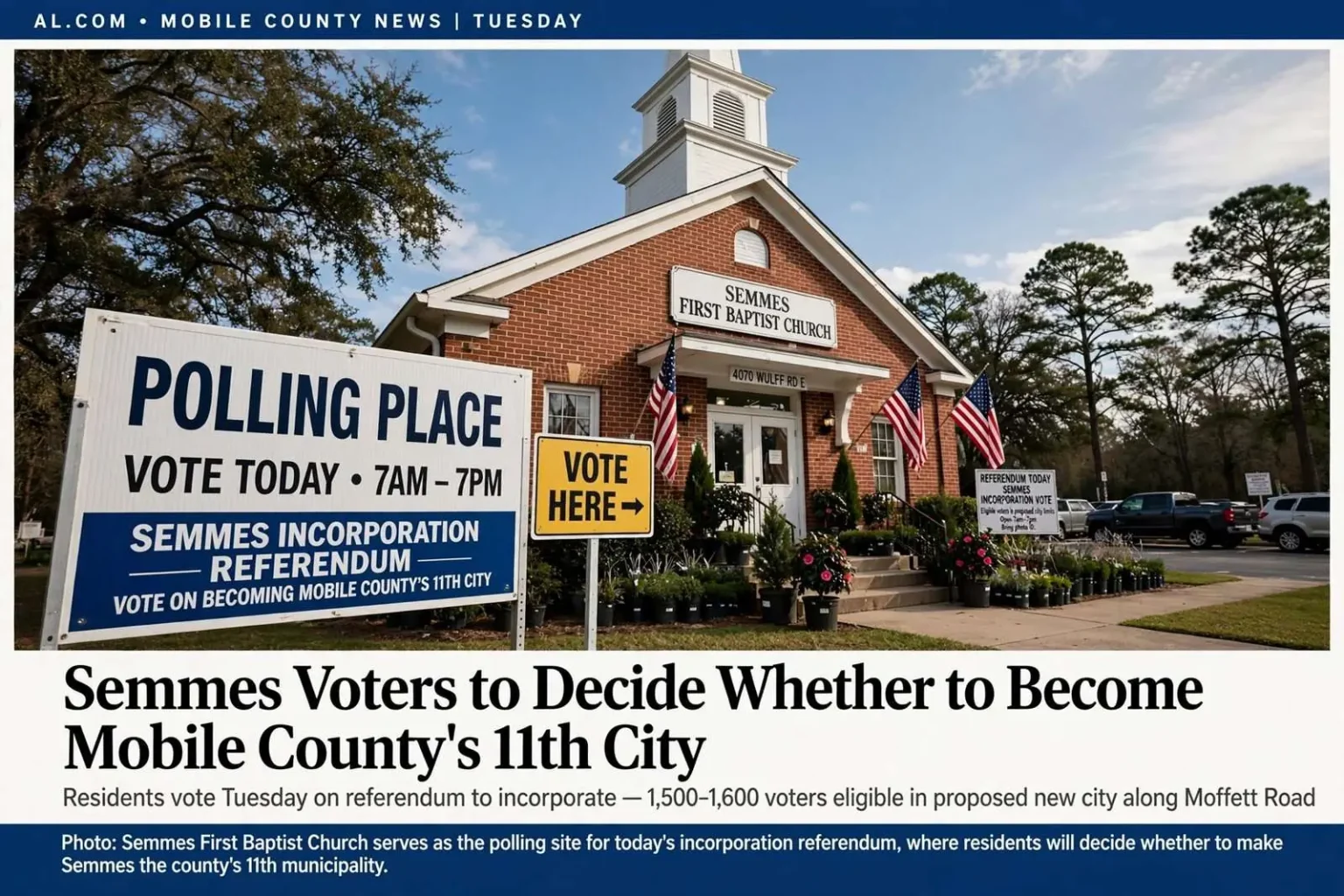
Residents of Semmes were set to go to the polls Tuesday to decide a question that had stirred the west Mobile County community for months: whether to incorporate as a self-governing city, the county’s 11th municipality. The vote would determine whether the community along Moffett Road, long an unincorporated stretch of Mobile County with its own identity and its own institutions, would take on a mayor, a council and the full apparatus of municipal government.
Incorporation is one of the more consequential steps a community can take under Alabama law. It converts an unincorporated area, governed from the county courthouse, into a municipality with the power to levy taxes, pass ordinances, control planning and zoning, and provide services under its own name. For Semmes, a community best known far beyond Mobile County for its nurseries and its history as a garden center of the Gulf Coast, the question was whether that formal machinery would serve the place or change it.
Organizers predict an easy win
Some leaders of the incorporation drive expected the measure to pass by a better than two-to-one margin. Judy Hale of the Semmes Incorporation Committee said she anticipated a favorable vote of 70 to 80 percent. Although the process of reaching the referendum had been exacting, Hale said, the response had been overwhelming among residents who wanted to live inside a Semmes governed by its own residents.
She noted that some Semmes residents had received anti-incorporation “robo calls,” though their source remained unidentified. The calls, which arrived in the closing days before the vote, became a topic of conversation in the community, but organizers said they did not see evidence that the opposition effort had slowed the momentum of the drive. The unusual part, Hale suggested, was not that opposition existed but that it stayed anonymous while the pro-incorporation side worked openly through petitions and public meetings.
The confidence of the organizers reflected months of door-to-door work. Getting an incorporation question onto a ballot in Alabama requires petitions signed by a qualifying share of the affected residents, a defined set of corporate boundaries, and compliance with statutory steps overseen by the probate judge. Communities that have attempted the process, in Mobile County and elsewhere in the state, have sometimes spent years on it; several earlier efforts to incorporate Semmes or parts of it had failed to reach this stage.
How the vote would work
The referendum was scheduled to take place at the Semmes First Baptist Church, at 4070 Wulff Road East, with polls open from 7 a.m. to 7 p.m., according to Mobile County Probate Judge Don Davis. Semmes representatives had posted the deposit required to cover the cost of the election, a requirement that falls on the petitioners rather than the county and that serves as an early test of an incorporation committee’s seriousness.
The proposed municipality took in roughly 1,500 to 1,600 registered voters. Its corporate limits encompassed most, if not all, of the Semmes First Baptist Church precinct, along with parts of three other precincts: the River of Life Church precinct, the Azalea City Church of Christ precinct and the Semmes Community Center precinct. The patchwork of precinct lines meant that election officials had to reconcile four polling places against a boundary map drawn by the petitioners, a task that fell to the probate court and the county’s election staff.
Judge Davis pointed to a quirk in the incorporation election. A person registered to vote anywhere in Mobile County who had also lived within the proposed municipal territory for the three months preceding the election could take part. “For example, you could be registered to vote at the E.R. Dickson School poll, but if you have lived in the proposed municipal limits for the three months preceding the election you could properly vote,” he explained. In practical terms, a newcomer to the Semmes area who had moved in from elsewhere in the county — a Mobile city precinct, a Tillman’s Corner address, anywhere — could vote in the referendum, because the three-month residency rule applied to the territory rather than to the registration record.
The rule mattered in a community that had been growing. West Mobile County had seen steady residential development pushing west along Moffett Road, U.S. Highway 98, toward the Mississippi line, and many of the newest residents of the proposed city limits would have been registered in precincts well outside them. A map of Semmes with the proposed corporate boundaries was available for viewing at the probate court offices in downtown Mobile, where residents could check whether their street fell inside the lines before voting day.
What incorporation would mean
For Semmes, incorporation represented a chance at local self-rule, the power to elect a mayor and council, set ordinances and shape the community’s future rather than remain an unincorporated area of Mobile County. Supporters framed the vote as a matter of local control and identity for a growing community along Moffett Road. An incorporated Semmes could adopt zoning to protect its nursery land and residential neighborhoods, apply for municipal grants, contract for its own police protection, and speak to county and state government with one voice instead of a collection of civic clubs.
The decision carried consequences beyond Semmes’ borders. The City of Mobile stood to lose about $2 million annually in tax revenues that it had collected from the Semmes area under the rules governing places within Mobile’s police jurisdiction. Under Alabama law, cities may levy certain taxes inside their police jurisdiction — the band of territory extending beyond the corporate limits — while the unincorporated area within it receives little of the direct benefit. A new city of Semmes would keep such revenue for its own use, a shift that helped explain why the question mattered to officials well beyond the proposed town limits.
That fiscal dimension is a familiar one across Alabama. When communities such as Daphne, Spanish Fort or Foley incorporated in earlier decades, the revenues that had flowed to a larger neighbor under the police-jurisdiction rules stayed at home, and the larger city adjusted. For Mobile, a loss of about $2 million a year is significant money in a general fund, and it explains why the election drew attention in city hall even though no Mobile resident could vote in it — only residents of the proposed limits, under the three-month residency rule, could take part.
The path to the ballot had not been simple. Incorporation drives require petitions, boundary decisions and careful compliance with state law, and Hale acknowledged that the effort had demanded persistence. The boundary map itself was a negotiation: drawing the lines too tightly would leave out residents who wanted in, while drawing them too broadly could bring in areas that did not want city taxes or city ordinances. The committee’s final map took in the core of the Semmes community and the surrounding subdivisions along the Moffett Road corridor.
The community’s case for its own name rested on more than growth. Semmes carries a history unusual for a place of its size: settled in the nineteenth century around its nurseries, it supplied plants to gardens across the South and became known as a nursery town long before strip development reached west Mobile County. Residents who backed incorporation spoke of protecting that identity — of making sure that decisions about the community’s roads, zoning and character would be made by people who lived there rather than at the county courthouse or in another city’s council chamber.
Opposition, to the extent it surfaced, tended to concern what incorporation would cost. A new small city must find revenue for its own government, and residents worried about new municipal taxes layered on the county’s. Supporters answered that the revenue already being collected in the area — including the roughly $2 million that had been going to Mobile — would simply remain in Semmes, providing a base budget without any new levy.
Residents with questions about the election were directed to Mobile County elections coordinator Roxanne Dyess, whose office handled the mechanics of precinct assignments and eligibility questions that arose from the unusual voting rules. Whatever the result, the vote marked a milestone for a community that had spent months debating its own future, and it set the stage for a decision that would determine whether Semmes governed itself or remained part of the county’s unincorporated expanse.
If the measure passed as organizers expected, the work would only begin. A new municipality must elect its first mayor and council, adopt a budget, contract for services and hire staff, all while the incorporation committee’s volunteers hand off to an official government. Judge Davis’s office would certify the result, and the 11th municipality of Mobile County would take its place alongside Mobile, Prichard, Chickasaw, Saraland, Satsuma, Creola, Mount Vernon, Bayou La Batre, Dauphin Island and Fairhope’s neighbor across the bay — a roster that the west Mobile County community had, until election day, watched grow without ever joining it.