The State Drops Its 4% Sales Tax This Weekend — Here’s Every Price Cap Shoppers Need to Know Before Friday
Alabama's 21st annual back-to-school sales tax holiday runs from 12:01 a.m. Friday through midnight Sunday, lifting the state's 4% sales tax on clothing, computers, school supplies and books within specific price limits.
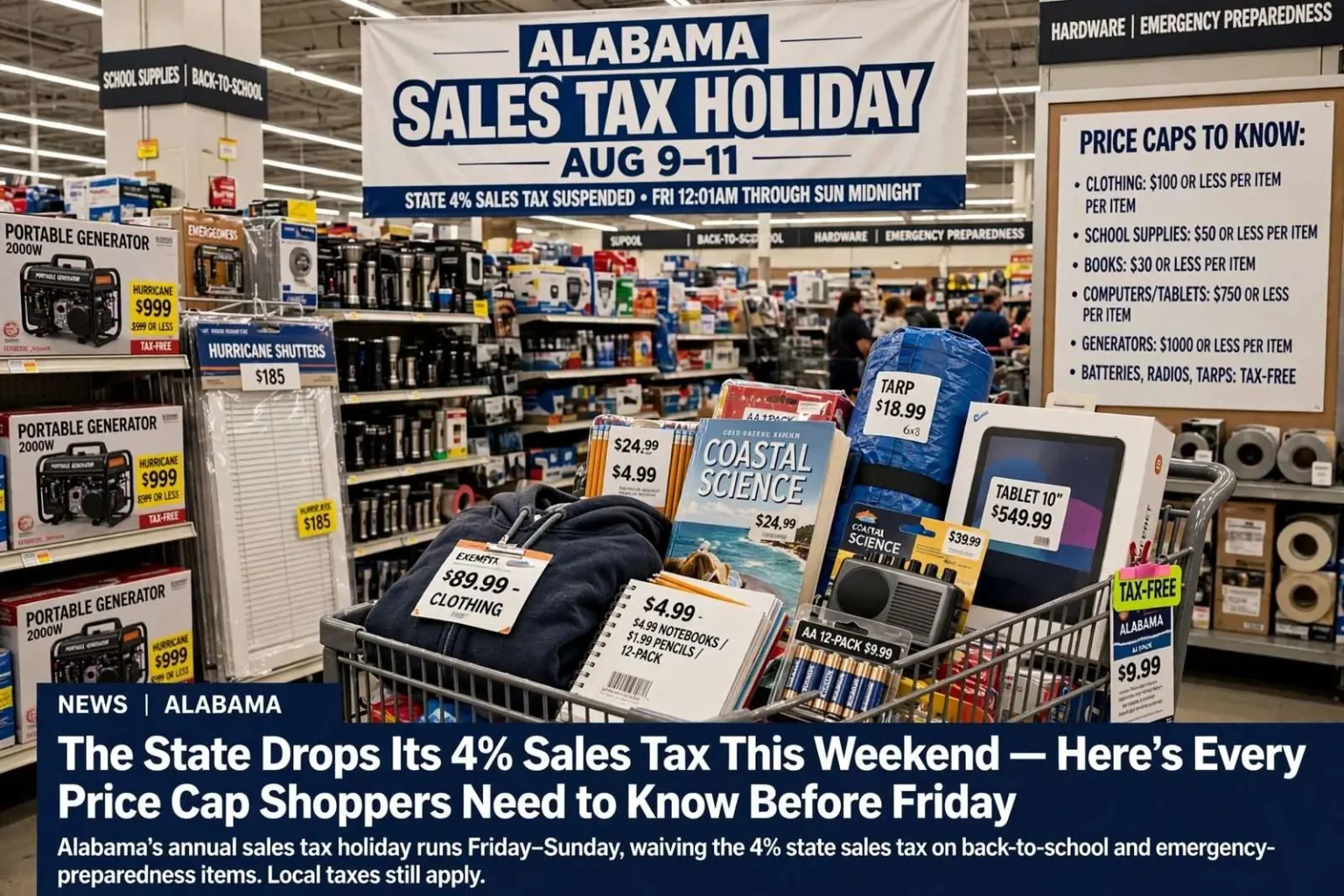
Alabama’s annual sales tax holiday weekend begins Friday, suspending the state’s 4 percent state sales tax on a wide list of back-to-school and emergency-preparedness items, and shoppers across coastal Alabama are starting to plan their runs through the big-box stores and local retailers that depend on the surge.
The tax-free weekend, which runs from 12:01 a.m. Friday through midnight Sunday, exempts qualifying items from the state portion of the sales tax. Cities and counties may still levy their own sales taxes on top of the state rate, so the actual savings depend on where a shopper makes the purchase. Mobile’s combined sales tax is 10 percent, of which 4 percent is the state portion that drops during the holiday. Daphne, Spanish Fort and the rest of Baldwin County add another 1 percent above Mobile’s rate, and individual municipalities may add their own.
What is exempt
The exemption applies to clothing priced at $100 or less per item, school supplies priced at $50 or less per item, books priced at $30 or less per item, and computers, tablets and related accessories priced at $750 or less per item. The thresholds are per item, not per purchase, so a shopper buying a $90 shirt and a $120 pair of shoes pays tax only on the shoes.
The holiday also covers a long list of emergency-preparedness items, which the legislature added in years when hurricane seasons were expected to be active. That category includes portable generators priced at $1,000 or less, hurricane shutters priced at $200 or less, and a series of smaller supplies including batteries, weather radios and tarps. The emergency-preparedness carve-out has become one of the more popular elements of the holiday in coastal Alabama, where hurricane readiness is a familiar part of the annual routine.
What is not exempt
The exemption has clear limits. Items sold as part of a bundled package lose their exemption if the bundled price exceeds the threshold, even if the individual components would qualify. Rentals, leases and repairs are not exempt. Items sold to businesses for business use are also not exempt, regardless of the price.
Shoppers should also be aware that the exemption applies to the state portion of the sales tax only. Local sales taxes, including the city and county portions that push the total rate above 9 percent in many coastal Alabama jurisdictions, still apply. The result is that a shopper in Mobile who buys a $90 shirt during the holiday pays 6 percent in local sales tax rather than the usual 10 percent, and a shopper in Daphne pays 7 percent rather than 11 percent.
What retailers expect
Retailers across Mobile and Baldwin counties prepare for the tax-free weekend as one of their larger shopping events of the year, alongside the post-Thanksgiving Black Friday weekend and the Christmas shopping season. Big-box retailers often extend hours, and local retailers coordinate sidewalk sales and other promotions around the weekend. Many school supply drives are timed to coincide with the holiday, so that donated goods can be purchased tax-free.
Stores along the Schillinger Road, Airport Boulevard and Cottage Hill Road corridors in Mobile expect some of the heaviest traffic. In Baldwin County, the U.S. Highway 98 commercial corridor through Daphne and Spanish Fort, along with the Highway 59 stretch through Foley and Gulf Shores, typically sees the largest weekend crowds. Smaller downtown districts in Fairhope, Foley and Bayou La Batre also benefit from the weekend, particularly for clothing and book purchases.
How to make the most of it
Shoppers who want to maximize the exemption should start by making a list of the items they plan to buy and checking each against the price thresholds. Items that fall just over the threshold are often discounted by retailers during the holiday, which can bring them under the cap and qualify them for the exemption. Shoppers should also pay attention to bundled promotions, which can push the per-item price above the threshold and disqualify the entire bundle.
For families with school-aged children, the weekend is the traditional time to buy uniforms, shoes, backpacks and classroom supplies before the start of the new academic year. Many public schools in Mobile and Baldwin counties open their doors in early to mid-August, which gives families a narrow window between the holiday and the first day of class. The combination of those deadlines and the savings has made the tax-free weekend a fixture of the back-to-school season.
What it means for hurricane prep
The emergency-preparedness portion of the holiday is most useful for coastal residents who need to refresh their supplies after a season’s wear and tear. Portable batteries, weather radios, tarps, bungee cords, coolers and similar items can be bought tax-free at most hardware and big-box retailers, even if the shopper is not in immediate market for a generator or hurricane shutters.
The National Hurricane Center’s August outlook for the Atlantic basin is a useful reference point for coastal residents planning their purchases. Even in years when the forecast is mild, the basic supplies are useful for power outages that follow summer thunderstorms, which are common across the Gulf Coast.
Retailers are required to participate in the exemption, and they may not charge sales tax on qualifying items during the holiday window. Shoppers who are charged tax on a qualifying item can request a refund at the point of sale, and the Alabama Department of Revenue maintains a hotline for retailers who have questions about which items qualify.
Why the holiday exists
Alabama’s sales tax holiday began in 2006 and has been renewed by the legislature every year since. The original purpose was to provide a small measure of relief to families facing the back-to-school shopping bill, and the holiday has become a familiar enough part of the August calendar that many families plan major purchases around it. Retailers support the holiday because it pulls sales forward into a weekend that is otherwise a relatively slow shopping period. The combined effect is a small but reliable boost to the state’s retail economy at one of the slower points in the calendar year.
Coastal Alabama shopping calendar
For coastal Alabama shoppers, the sales tax holiday falls during a busy stretch of the year that also includes the back-to-school rush, the opening of football season and the early planning for hurricane season. Retailers in Mobile and Baldwin counties have learned to plan their promotions around all three, and the tax-free weekend often marks the unofficial start of the fall shopping season.
Local merchants in the historic districts of Fairhope, Foley, Daphne and downtown Mobile have observed that the tax-free weekend brings a meaningful share of their annual August revenue. Some stores use the weekend as an opportunity to clear summer inventory before the fall merchandise arrives. Others schedule special events, book signings and trunk shows to take advantage of the foot traffic. The combined effect is that the weekend is one of the more active shopping periods of the year for retailers of all sizes.
What shoppers should bring
Most retailers will apply the exemption automatically at the register, but shoppers who want to be sure of the savings should bring a list of the items they plan to buy and review the per-item thresholds before they go. A $90 shirt and a $75 pair of shoes are both exempt, but a $90 shirt and a $105 pair of shoes are not, and the second item will be taxed at the full local rate.
For families who plan to spread their shopping across several stores, the per-item rule applies separately at each store, which means a shopper can buy exempt items at one retailer and still buy additional exempt items at another without running into the per-purchase thresholds. The rule also applies across multiple transactions at the same store, which means a shopper who returns the next day for a second purchase is still eligible for the exemption.
The bottom line
Across the coastal Alabama region, the tax-free weekend is one of the more useful pieces of the state tax code for working families. The savings on a single back-to-school shop are not enormous, but they add up across a year’s worth of school clothing and supplies, and they make the weekend a familiar feature of the August calendar. For retailers, the weekend is an opportunity to clear inventory and bring in customers, and the sales lift is enough that even stores that do not typically offer discounts find ways to participate.
The bottom line for shoppers is that the holiday is one of the simplest and most reliable ways to save a meaningful amount on the back-to-school bill, and it has become a familiar enough part of the August calendar that most retailers in the Mobile-Baldwin region now treat it as a standard weekend on the retail calendar.