Baldwin County Declines to Take On Removal of Flood Debris From State Waterways
Facing a cleanup estimated at up to $10 million, the Baldwin County Commission voted 4-0 to decline the state's request that it remove flood debris from rivers such as the Fish and Bon Secour.
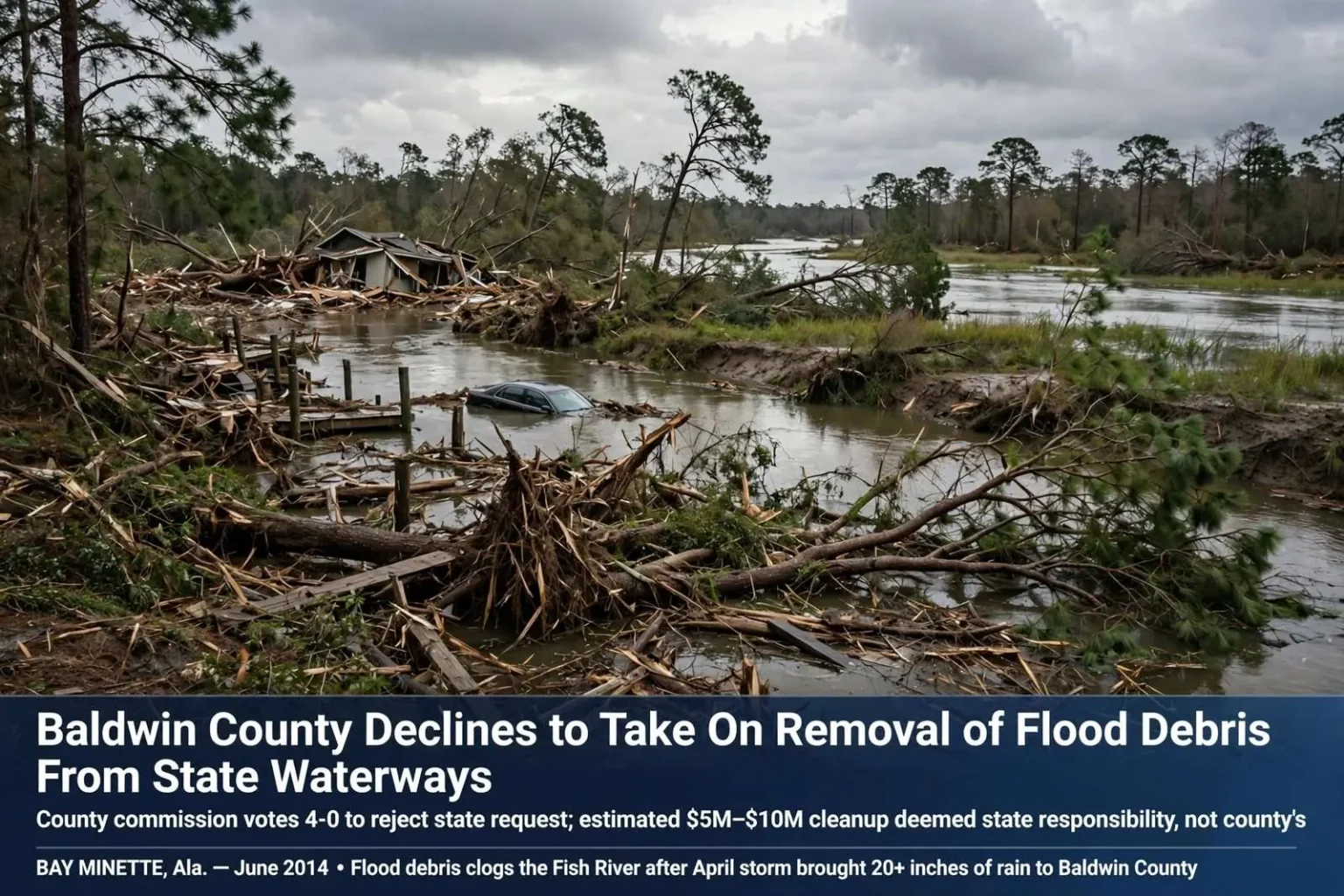
BAY MINETTE, Ala. — The Baldwin County Commission decided in June 2014 to turn down a request from the state that the county take responsibility for removing debris deposited in state waterways by a devastating April flood. The commission voted 4-0 to notify the Alabama Department of Conservation and Natural Resources by letter that it would not take on the removal work, ending weeks of back-and-forth over who should shoulder a job estimated to cost millions of dollars.
The dispute grew out of the extraordinary rains that swept the central Gulf Coast in late April, swelling rivers and bays across Baldwin County and leaving a tangle of downed trees, shattered docks and stranded property in the waterways that thread the county on their way to Mobile Bay and the Gulf. Who would clear that mess became a running negotiation between Bay Minette and Montgomery, and in the end the county chose to walk away from the assignment entirely.
A costly, months-long undertaking
Baldwin County Engineer Cal Markert estimated that the debris removal would have cost between $5 million and $10 million and would have taken four to six months to complete. The county, he said, would have had to hire a contractor to carry out the work — a process involving bid documents, project management and months of oversight on the water, well outside the routine road-and-bridge duties that occupy the county’s engineering department.
Markert said the affected waterways included the Fish, Bon Secour, Magnolia, Styx and Blackwater rivers, with vegetative debris posing the main problem. Those streams drain much of central and southern Baldwin County, and floodwaters had pushed entire tree canopies into their channels, choking navigation and raising concerns for the properties that line their banks. In the Fish River, he noted, the flood had left behind a house and a car — the kind of debris that requires more than a chain saw crew to pull from the water.
The scale matters for understanding the commission’s decision. A $5 million to $10 million project would rank among the larger single contracts the county had ever let, and it would land on a county budget already carrying its own repair bills from the same storm. An undertaking measured in months of marine contractor time is not a chore the county picks up casually, and the commissioners made clear they did not intend to.
Commissioners balk at the responsibility
Several commissioners made clear they did not believe the cleanup was the county’s job. “I’m not even in favor of us managing this,” Commissioner Frank Burt Jr. said. “It’s an awesome responsibility and no reason that we, little old Baldwin County, should handle the state’s responsibility.”
Commissioner Tucker Dorsey agreed. “We always want to keep our place as nice and dolled up as we can,” he said. “This is not our responsibility.” The two statements captured the board’s mood: sympathy for the waterways and the people who use them, paired with a firm line that state-owned waters are the state’s obligation, not the county’s.
The rivers in question are state waters, managed by the Department of Conservation and Natural Resources, and their upkeep has never been a line item in Baldwin County’s budget. County crews maintain county roads and county property; a riverbed scoured by floodwater falls to the state that owns it. The commissioners’ position was less a refusal to help than a refusal to be drafted into work they believed belonged to Montgomery.
Money at the center of the impasse
Money was at the center of the impasse. The state had proposed that the county recoup part of its costs by seeking a 75 percent reimbursement from the Federal Emergency Management Agency and a 12.5 percent reimbursement from the state Department of Conservation and Natural Resources. The commission, which discussed the proposal during a work session the previous week, disliked the prospect of not being made whole. The county attorney countered with a plan that called for 75 percent from FEMA and 25 percent from the state department.
The arithmetic explains the friction. Under the state’s proposal, Baldwin County would have fronted the full multimillion-dollar contract and then absorbed the remaining 12.5 percent — a figure that, on a $10 million project, would mean a seven-figure gap between what the county spent and what it recovered. The county’s counterproposal would have shifted that entire share to the state. Neither side moved, and the commissioners concluded that the cleanest resolution was to decline the work altogether.
That is the recurring structure of federal disaster reimbursement: a large share from FEMA, a smaller share from the state, and a local match that local governments fund up front and hope to account for precisely. In the weeks after a flood, when repair invoices pile up faster than reimbursements arrive, the local share is rarely a trivial matter — and for a county staring at a potential seven-figure shortfall on work it did not believe it owned in the first place, the answer was no.
The state moves to plan B
Jeff Byard, coordinating officer for the Alabama Emergency Management Agency, said that with Baldwin County declining to participate, the state would go through its own contracting process to find someone to do the work. He stressed there was no ill will between the county and the state.
“A lot of times counties, local governments know their areas better than the state,” Byard said. “All disasters begin locally. We wanted to explore that avenue. It was no negative in the fact that they didn’t do it, so we will move on to plan B and start getting the debris out.” His framing reflected standard emergency management doctrine: response and recovery are built from the ground up, with local governments handling what they can and the state stepping in for what they cannot. The state had hoped Baldwin County would take the lead; with the county stepping back, the state would simply take the job it had always owned.
For riverfront residents and the fishing guides, kayakers and waterfront businesses that depend on open channels, the practical question was timing. A state-run contract would still take months to bid, award and execute, meaning debris that went into the rivers in April would still be coming out well into the rest of the year. What changed with the commission’s vote was not whether the work would happen, but which government’s signature would be on the contract.
The storm that left the mess behind
The debris was a legacy of an extraordinary storm. More than 20 inches of rain fell in Baldwin County on April 28-30, with 10 to 15 inches falling on April 29 and 30 alone, triggering flash flooding and river flooding across the region. Rainfall totals like those fall in a category few Gulf Coast drainage systems are built to handle, and the county’s rivers responded exactly as such rivers do — overtopping banks, tearing at shorelines and dragging timber, docks and everything else loose into the current.
The damage reached well beyond the water. Roads flooded and washed out across the county, homes took water in the low-lying areas near the rivers, and emergency crews worked for days on rescues and road closures. The debris lodged in the Fish, Bon Secour, Magnolia, Styx and Blackwater rivers was only the most persistent reminder of the event — visible for months after the water receded, and immovable without heavy equipment and a contract to pay for it.
Storms of this size reshape the policy conversation that follows them. Every flash flood on the central Gulf Coast renews the same questions about drainage, development along the rivers and how recovery costs should be divided among property owners, municipalities, counties, the state and the federal government. The June vote on debris removal was one small answer in that larger, recurring argument.
What the decision means going forward
For Baldwin County, the vote drew a bright line about local responsibility. The county will repair its own roads and bridges, and it will pursue every available dollar for its own recovery — but it will not act as the state’s contractor on state waters, even with federal reimbursement on the table. Commissioners signaled that any future request of similar shape would get the same scrutiny that this one received in the work session and in open meeting.
For the state, the decision returns the work to the government that owns the waterways, with the Alabama Emergency Management Agency coordinating a contract through its own process. Byard’s emphasis on “plan B” made the transition sound routine, and in procedural terms it was: the state retains the authority, and now it would exercise it directly rather than through the county.
The episode offers a snapshot of how recovery actually works on the Alabama coast — a cascade of cost shares, jurisdictional boundaries and intergovernmental negotiations conducted under public pressure in the months after a flood. The rivers will be cleared, as Byard promised. The open question that Baldwin County settled, at least for this storm, was simply that the clearing would be done on the state’s account rather than the county’s.