Newcomb to Endorse Green in Baldwin County District Attorney Runoff
Baldwin County District Attorney Judy Newcomb, eliminated in the primary, prepared to back David Green over her former chief assistant Hallie Dixon in the July 13 Republican runoff.
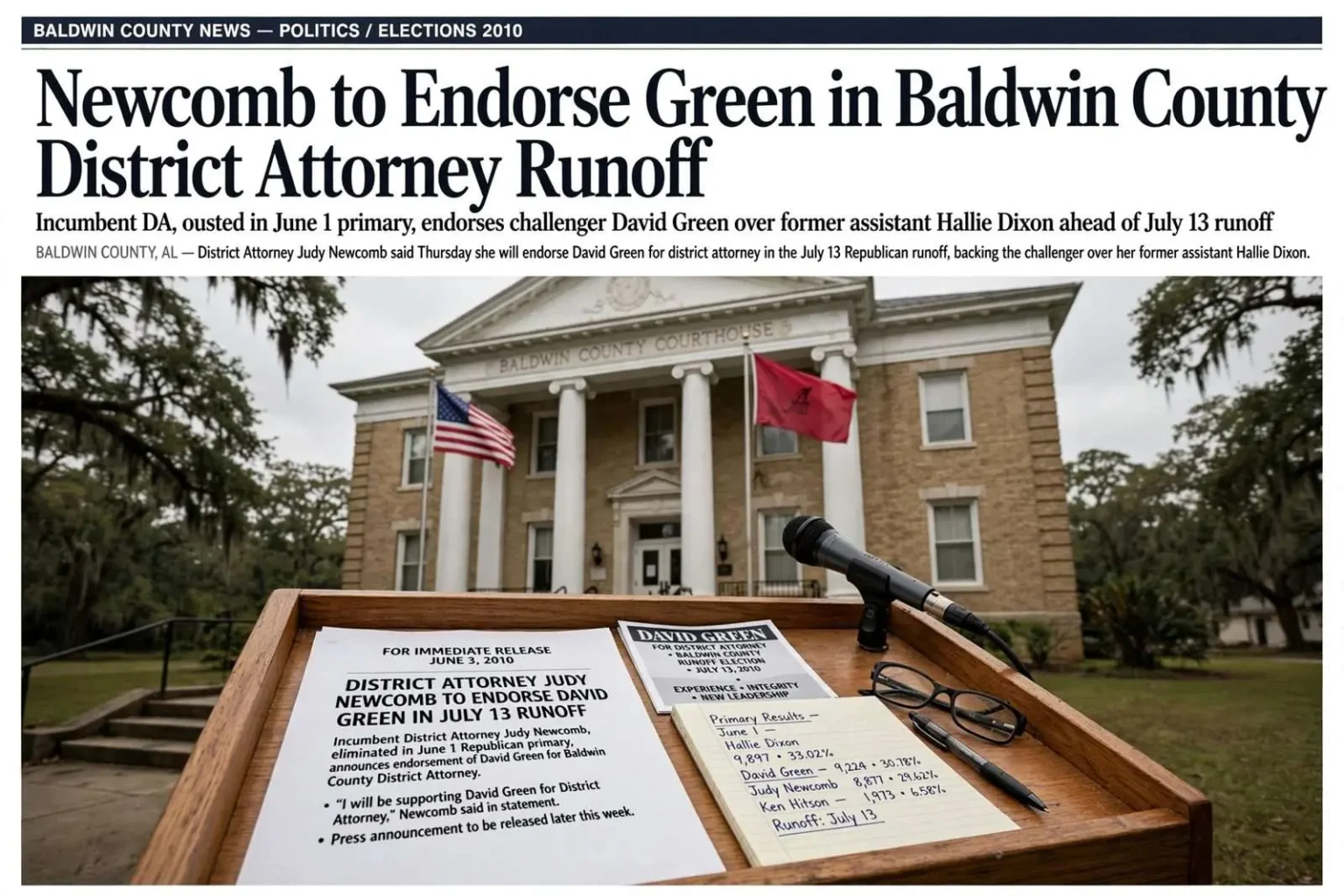
Baldwin County District Attorney Judy Newcomb, knocked out of her own re-election bid in the June 1 Republican primary, was expected to publicly endorse David Green over Hallie Dixon in the July 13 runoff for the office she has held.
“I will be supporting David Green for District Attorney,” Newcomb said. “I will explain the many reasons for my decision later this week.”
The endorsement of an incumbent leaving office carries more weight than an ordinary political nod in a district attorney’s race. The office Newcomb held — the chief prosecutor for all of Baldwin County — is among the most powerful local positions on the Alabama Gulf Coast, and her decision about who should inherit it was a judgment from the one person who best knew the work, the caseload and the candidates.
How the Primary Finished
Newcomb finished third in a four-way race, missing the runoff by roughly 350 votes. Unofficial results: Hallie Dixon — 9,897 votes, 33.02 percent. David Green — 9,224 votes, 30.78 percent. Judy Newcomb — 8,877 votes, 29.62 percent. Ken Hitson — 1,973 votes, 6.58 percent.
The arithmetic told a remarkable story: an incumbent district attorney had been driven to third place in her own primary, and the margin separating the top three was barely 1,000 votes combined. In a county growing as fast as Baldwin, where tens of thousands of new residents had arrived over the previous decade without ties to the local courthouse establishment, the result reflected an electorate far less bound by incumbency than the county’s political leadership had assumed.
Dixon had served as an assistant under Newcomb until a falling-out sent her to the Alabama Attorney General’s office for a period. That history gave the endorsement its edge: Newcomb was throwing her support not to the woman who had worked for her, but to the challenger who had not.
The split between a former boss and a former assistant is the rawest dynamic a prosecutor’s race can have, and it framed the runoff in personal terms. Voters in the July 13 runoff would be deciding not just a policy contest but a dispute inside the office itself — between Dixon’s argument that her years in the building made her the ready-made successor, and Green’s case that the office needed an outside hand.
Hitson had not immediately responded to a request for comment and was reported to be returning later in the week from a family holiday. Green said he was optimistic Hitson would also back him.
Hitson’s votes were no small prize. A candidate pulling nearly 2,000 votes in a primary could, in a runoff decided by margins of a few hundred, tip the balance if his supporters followed him. Both campaigns spent the days after the primary courting the fourth-place finisher’s voters, the least bound of any bloc in the race.
Green Describes the Call
Green said Newcomb telephoned him after the election.
“She was very professional. She congratulated me on running an excellent campaign,” Green said. “She paid me a wonderful compliment when you consider we had been competing so intensely with one and other. She said she was supportive of me and I took that as testament to me of the type of campaign that we’ve run. She said she would offer her support to me in any way that I felt would be helpful. It was unsolicited and I’m very appreciative.”
Asked about rumors of a quid pro quo — a job in the office in exchange for the endorsement — Green was flat.
“Nope, there was zero discussion of that,” he said. “She never brought it up. I never brought it up. It never entered my mind and I doubt that it entered hers.”
The denial mattered because the speculation was already circulating. In a district attorney’s race, the obvious currency of an endorsement is a place in the incoming administration, and runoff opponents had every incentive to suggest a deal. Green’s flat response, denying any discussion at all, was aimed at shutting the storyline down before it could define the final weeks of the campaign.
Green said his runoff strategy would not change.
“I’ll do the same things I’ve always done: Be myself, don’t compromise my integrity, campaign positively,” he said.
Dixon Presses Her Experience
Dixon said she was not surprised by the endorsement, but noted that it appeared to conflict with Newcomb’s own prior argument that felony prosecution experience was essential to leading the district attorney’s office.
“Regardless, our message remains the same: I am the only candidate with the qualifications to serve this county as its chief prosecutor,” Dixon said. “My campaign will continue to be based on qualifications, hard work and commitment, with total transparency and a promise that we will not play ‘politics’ with an Office so critical to our safety and security. We led the ticket by earning our votes with our message and our work ethic.”
The experience argument was the backbone of Dixon’s campaign, and the endorsement forced her to address it head-on: her response framed Newcomb’s nod as politics, and her own top-of-ticket finish as proof of independent strength. Leading the four-way primary gave her a credible claim to momentum that an endorsement from a third-place finisher could not erase.
The Sheriff Stays Out
Baldwin County Sheriff Hoss Mack, freshly re-elected, said he would not weigh in.
“No, I will not make an endorsement in this race,” Mack said. “I personally know both candidates and they each have respected backgrounds. I will work with either of them, whomever gets elected, and I am excited about that prospect.”
Mack had defeated challenger Orlando Bethel by a wide margin.
The sheriff’s neutrality was its own kind of signal. As the county’s top law enforcement officer, Mack worked daily with the district attorney’s office on felony prosecutions, and his endorsement would have carried real weight with the law-and-order electorate that turns out in a Baldwin County Republican runoff. Declining to choose — while praising both candidates — preserved his working relationship with whoever won and kept the sheriff’s office out of a contest between a former assistant district attorney and an outside challenger.
Why the Runoff Mattered
The Baldwin County district attorney’s office prosecutes felonies across one of Alabama’s fastest-growing counties, and in the summer of 2010 it was also the office handling the murder case against former Mobile County Commissioner Stephen Nodine — a prosecution that had loomed over the primary campaign from the day charges were filed.
The Nodine case gave the 2010 race a background unlike any other in Alabama that year. Nodine, a prominent and combative figure in Mobile County politics, stood accused in the death of his longtime mistress outside a Gulf Shores townhouse in May, a case that had dominated Gulf Coast news for weeks and touched both counties — the crime in Baldwin, the defendant and his political history in Mobile. Whichever candidate won the runoff would inherit a prosecution under intense public scrutiny, with defense challenges already being previewed and the eyes of two counties on the result.
The stakes extended beyond the courthouse. Baldwin County’s explosive growth — subdivisions spreading down U.S. 98, the beach communities rebuilding after Hurricane Ivan, tens of thousands of new voters with no memory of earlier courthouse administrations — had made its Republican primary the decisive election in county government, and the district attorney’s office was among the prizes. The July 13 runoff between Dixon and Green would determine, one way or another, who led that office into the decade ahead.
Dixon and Green would face voters on July 13.
Newcomb’s own exit from the race closed a chapter in a career that had made her one of the region’s best-known prosecutors. Whoever succeeded her would take over an office that had been identified with her administration, from its staffing to its charging decisions, and the runoff therefore doubled as a referendum on her tenure — with Dixon, her former assistant, positioned as the heir, and Green positioned as the change. Her endorsement of Green rather than Dixon was, in that light, less a footnote than a verdict on the succession fight her own primary defeat had opened.
The runoff calendar compressed everything. Between the June 1 primary and the July 13 vote were six weeks in which the campaigns would court the county’s civic clubs, fishing rodeos and church gatherings, the traditional circuit of a Baldwin County summer, while the endorsement news rippled through the same networks that had produced the primary’s close finish. With Newcomb’s roughly 8,900 voters available to whichever candidate could claim her mantle, and Hitson’s nearly 2,000 still uncommitted, the race’s second act promised to be as hard-fought as the first.