Daphne Weighs Ban on E-Cigarettes in Some City Buildings After Complaints
After complaints about vaping at the civic center, Daphne's ordinance committee began reviewing changes that could bar e-cigarettes from some indoor city facilities in the summer of 2014.
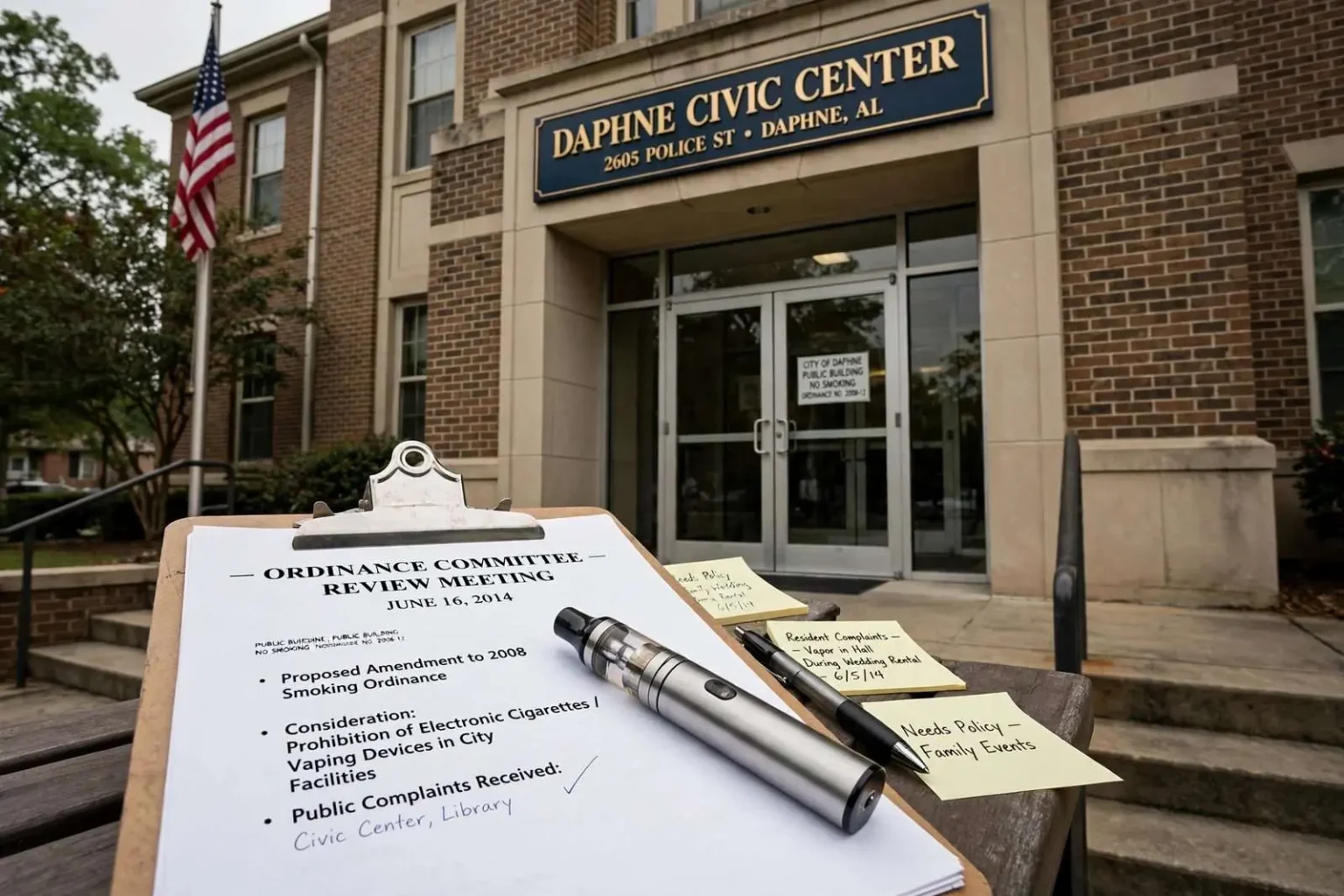
Daphne officials moved in June 2014 to consider restricting the use of electronic cigarettes inside some of the city’s public buildings, responding to a series of complaints from residents who encountered the devices at municipal venues such as the civic center. The city’s ordinance committee began reviewing proposed changes to Daphne’s 2008 smoking ordinance, a step that placed the Eastern Shore community alongside a growing number of Baldwin County municipalities weighing how to treat the increasingly popular devices.
The review put Daphne at the front edge of a regulatory question that was spreading across the country faster than most local codes could absorb. The city’s smoking ordinance, written years before vaping devices reached store shelves in any number, simply had nothing to say about battery-powered products that produce a cloud of flavored vapor rather than tobacco smoke. City leaders were left to decide whether those devices belonged in the same legal category as cigarettes — and, if so, where the line should be drawn.
Part of a Broader Baldwin County Trend
The Daphne review came as the question of vaping in public spaces became a recurring theme across the county. The Foley City Council had approved a far more sweeping measure that Monday, banning e-cigarettes and similar devices in all public facilities and workplaces. In Orange Beach, a comparable prohibition was under consideration, though officials there postponed a vote until later in the year.
Together, the three cities illustrated the range of approaches available to local governments confronting the same product. Foley chose a comprehensive ban that extended to private workplaces, effectively moving e-cigarettes into the state’s existing framework for smoking restrictions. Orange Beach, a resort city whose public spaces fill with visitors in summer, wanted a prohibition but took more time weighing the details. Daphne, the largest of the three, started with the narrowest possible question: what happens inside the city’s own buildings?
For Daphne, the discussion was narrower. Council President Randy Fry said any ban would be limited to indoor city facilities, such as the civic center, where the city had fielded complaints during events.
The civic center hosts a packed calendar — weddings, reunions, trade shows, recitals and civic meetings — and it was exactly the kind of venue where vapor clouds produced friction. Renters who booked a hall for an evening expect a clean, family-friendly environment; when users exhaled plumes of cotton-candy-scented vapor across the room, staff found themselves mediating disputes the 2008 ordinance gave them no authority to resolve. Complaints to city hall accumulated, and the ordinance committee took up the question.
What the Devices Are
The majority of the targeted products use a battery to heat a nicotine-infused liquid, usually flavored, producing a vapor that is inhaled. Their rapid rise in popularity had outpaced local rules written years earlier, when the devices were far less common on the Eastern Shore.
By 2014, the products had migrated from specialty vape shops to gas station counters and mall kiosks across Baldwin County, sold in a bewildering range of sizes, from cigarette-shaped disposables to pocket-sized devices with refillable tanks. The flavor catalogs — fruit, candy, dessert and beverage names aimed at adult users — became one of the flashpoints of the national debate, along with the unresolved question of whether the vapor posed risks to bystanders. Public health authorities had not settled the science, and that uncertainty was precisely why so many city councils chose caution: in the absence of definitive answers, they treated the devices like the cigarettes they most resembled.
A Shifting Regulatory Backdrop
The local debate unfolded against a changing national and state picture. The Food and Drug Administration had announced plans to begin regulating e-cigarettes and similar products as tobacco for the first time. The year before, the Alabama Legislature had enacted a law prohibiting the sale of e-cigarettes and other alternative smoking devices to anyone under the age of 19. Those developments gave city leaders reason to revisit an ordinance that predated the devices entirely.
Alabama’s age-of-sale law mattered locally because it put the state on record treating the products alongside traditional tobacco, even as it left the question of public use to local governments. Municipal ordinances in Alabama typically work within the framework the state sets for smoking, and a city council extending its smoking ordinance to vapor devices was, in effect, closing a gap the Legislature had not addressed. The FDA’s proposed rules — which would eventually bring manufacturing, marketing and sales of the products under federal tobacco authority — signaled that regulation was coming from Washington, but not on a timeline that answered Daphne’s immediate complaints.
Fry told colleagues during Monday’s meeting that the proposed changes were still being reviewed by counsel and were not yet ready to be brought before the full council. The pause reflected more than caution; it reflected the definitional problem at the heart of every vaping ordinance of the era. Drafting that sweeps too broadly can capture devices that contain no nicotine at all; drafting too narrowly can exempt the next product variation before the ink is dry. Cities across the country spent years amending and re-amending their definitions, and Daphne’s legal review was aimed at avoiding that cycle.
The Mayor Pushes for a Broader Policy
After the meeting, Mayor Dane Haygood said he was concerned that the proposal, as drafted, was not comprehensive enough because it would not extend to outdoor parks, where residents had also raised questions about the devices. “Some of those could be addressed in our park rules and some other ways, but we have incidents at our library and at our civic center,” Haygood said. “So we’ve got to establish what the policy is across the board.”
The mayor’s concern identified the gap between an ordinance and a policy. An ordinance limited to city buildings would leave Daphne’s parks — including its bayfront green spaces, athletic fields and playgrounds, which draw families throughout the year — governed only by whatever rules the parks department could post. Haygood’s suggestion that some situations could be handled through park rules and other administrative tools pointed toward a layered approach: an ordinance for indoor facilities, department rules for outdoor recreation space, and a consistent expectation communicated to renters, leagues and event organizers.
His references to the library underscored the breadth of the city’s facilities. Daphne’s public library is one of the busiest on the Eastern Shore, and like civic centers, libraries increasingly found themselves in the position of regulating behavior their governing documents never anticipated. A standard that applied across the board, as the mayor put it, would spare each department from writing its own improvised policy.
Where the Question Stood
For the moment, the matter remained with the ordinance committee, with officials signaling that a citywide standard, rather than a piecemeal set of rules, was the goal as Daphne worked to catch its regulations up to a fast-changing product.
The episode was a case study in how local government absorbs novelty. A product enters the market, spreads faster than the lawbooks, generates complaints at the front desk, and eventually forces a council to decide — not with perfect information, but with enough of it to act. Daphne’s leaders, deliberately or not, were following the pattern Foley had set and Orange Beach was weighing, and the conversation in the ordinance committee foreshadowed the decisions dozens of Alabama cities would face as vaping moved from curiosity to fixture.
The underlying tension, residents and officials agreed, was the unknown. In 2014 neither users nor bystanders had reliable answers about the long-term effects of inhaling flavored vapor, and municipalities were effectively running a public experiment on their own public buildings. Councils could wait for the science and the federal rules to settle, or they could act on the complaints in front of them. Daphne’s ordinance committee chose the second path, drafting restrictions that could be refined later as better information arrived.
The experience of nearby communities also shaped expectations for enforcement. Foley’s comprehensive ban made e-cigarettes subject to the same enforcement machinery the city already used for smoking violations — a warning first, and escalation only when refused. Municipal officials across Baldwin County talked to one another, and neighboring cities’ choices served as practical previews: how staff handled complaints, how renters reacted, and whether the restrictions actually reduced the friction that prompted them.
For the businesses selling the devices in Daphne, the distinction between use and sale was the important line. The city’s discussion targeted where vaping happens, not whether vape shops could operate; the state’s age law already governed who could buy. Store owners in the era generally accepted indoor bans as an accommodation while bracing for restrictions that reached further, and the council’s narrow start suggested local rules would stop short of touching the retail side.
What the episode made plain was that Daphne’s 2008 ordinance — drafted for a world of cigarettes, cigars and chewing tobacco — had become a document with a hole in it, and the city intended to close that hole deliberately rather than wait for the state or federal government to close it for them. The final shape of the standard remained with the ordinance committee, where the balance between the mayor’s citywide ambition and the council’s narrower draft would be worked out paragraph by paragraph.