
Baldwin GOP Chairman Tells Daphne Councilman to Drop the Elephant; Palumbo Refuses
Baldwin County Republican Chairman Matt Simpson demanded that Daphne Councilman Gus Palumbo stop using the GOP elephant logo in his campaign. Palumbo refused, calling it 'desperate politics.'
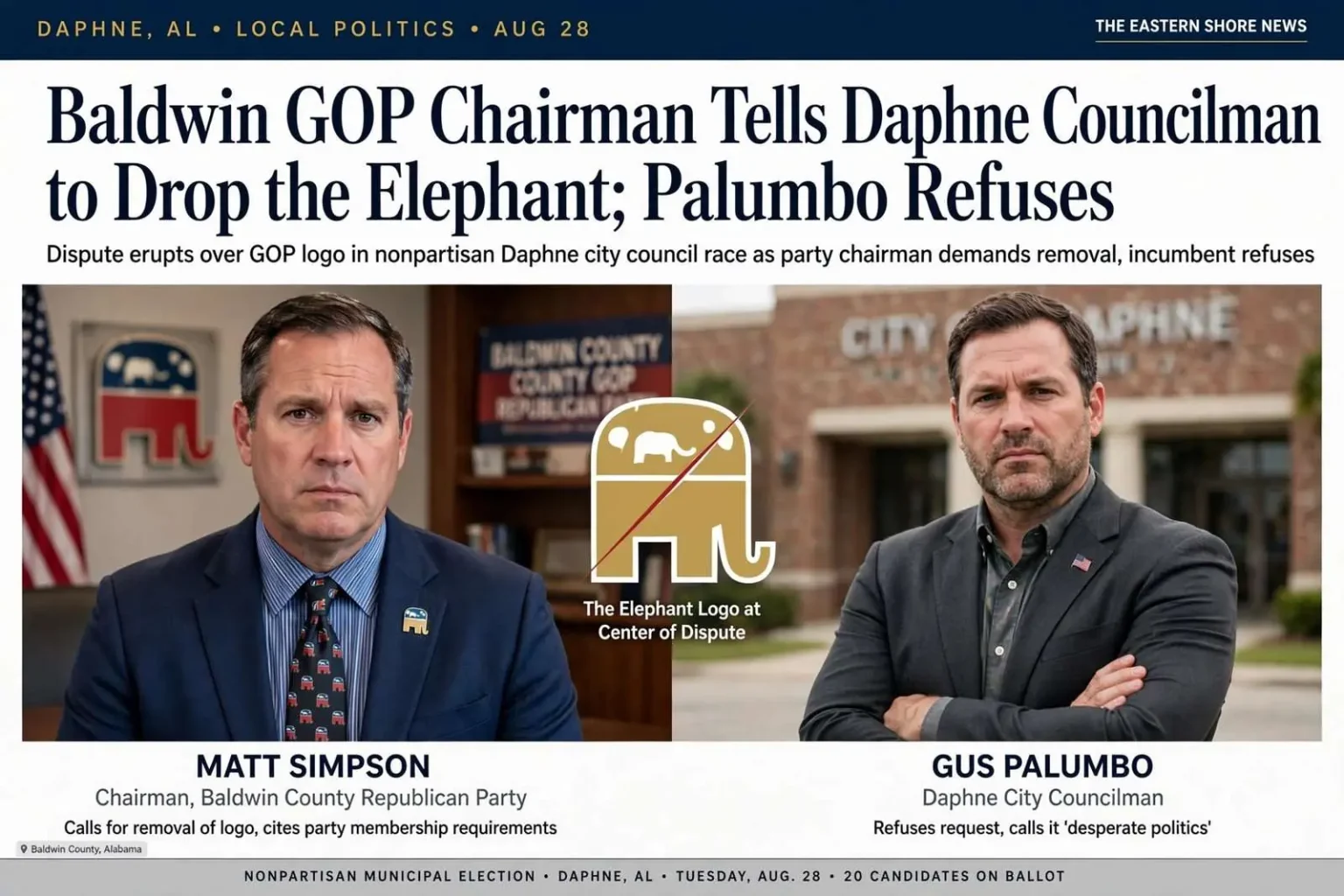
A symbol became the subject of a sharp exchange in Daphne’s municipal campaign, as the chairman of the Baldwin County Republican Party demanded that a sitting city councilman stop using the party’s elephant logo on his campaign material. The councilman flatly refused. The dispute had all the elements of a modern local political fight — a party brand, an incumbent’s identity, an opponent’s allies — playing out in a race where, by law, no party affiliation would actually appear on the ballot.
The Chairman’s Complaint
Matt Simpson, chairman of the Baldwin County Republican Party, called on Daphne City Councilman Gus Palumbo to remove the GOP elephant logo from his campaign material. According to Simpson, it was “disingenuous and misleading” for Palumbo to use the logo because he was not, and never had been, a dues-paying member of the Republican Party.
The objection cut to a familiar tension in local races: the value of a party brand and who has the right to claim it. In a heavily Republican county, the elephant carried weight with voters, and Simpson’s argument was that the symbol should belong to those formally affiliated with the party organization — a membership question, in his framing, rather than a matter of personal ideology.
For a party organization, the fight is about more than one councilman’s mailers. County parties spend decades building the credibility of their endorsement, and the local Republican label in Baldwin County functions as a kind of certification for candidates. A logo borrowed without membership, in the party’s view, collects the benefit of that credibility without the dues, the meetings or the grassroots work behind it.
Incumbency shapes every local dispute of this kind. A sitting councilman has a record to run on — votes, projects, constituent work — while a challenger needs to change the subject from experience to identity. A fight over party credentials does exactly that: it invites voters to weigh who is the “real” Republican rather than who has been showing up at council meetings, and each side naturally prefers the contest it thinks it can win.
Palumbo’s decision to refuse publicly, rather than quietly replacing the logo, was its own calculation. Compliance would have ended the news cycle but conceded the premise — that the party organization gets to approve his imagery. By refusing and naming the dispute as campaign maneuvering, he converted a compliance question into a character question, with himself cast as the target of an outside operation.
Palumbo Pushes Back
Palumbo was unmoved. He called the request “desperate politics,” characterizing it as an attempt to breathe life into the campaign of his council opponent, Dane Haygood, a member of the Baldwin County Republican Executive Committee. In Palumbo’s telling, the demand had less to do with principle than with the maneuvering of a rival’s allies.
The counterattack reframed the entire dispute. What Simpson presented as a matter of party property, Palumbo presented as evidence of coordination — a party chairman doing the oppo work of a candidate allied with the organization. That framing let Palumbo wear the demand as a backhanded compliment: the incumbent under attack, the outsider machinery rattled enough to reach for procedural complaints.
The clash left voters to sort out the competing claims — whether the use of the logo amounted to a genuine misrepresentation or a pretext deployed in the heat of a contest. Both narratives could be true at once, which is what made the fight durable: the elephant really is a valuable brand, and disputes over it really are a standard instrument of competitive campaigns.
A Nonpartisan Race with Partisan Overtones
The irony was that Daphne’s municipal elections, set for Tuesday, Aug. 28, were nonpartisan by law. Candidates ran without party labels on the ballot, yet the pull of party identity remained strong enough that a logo could spark a public dispute. The episode illustrated how, even in officially nonpartisan city elections, the machinery and symbolism of the major parties often lingered just beneath the surface.
Alabama’s municipal elections are nonpartisan by statute, a design meant to keep city government focused on potholes, zoning and budgets rather than national ideology. But no statute can scrub party identity from voters’ minds — or from campaign strategy. In practice, candidates in nonpartisan races signal their affiliations through endorsements, appearances and imagery, and voters decode those signals just as reliably as a ballot label.
For a fast-growing Eastern Shore city, the flap over the elephant offered a glimpse into the competitive dynamics of its council races, where personal reputations, party ties and local loyalties all mixed together. Daphne’s growth has turned its council seats into genuinely contested offices, drawing candidates with professional campaigns, organized fundraising and the attention of county-level political organizations.
Twenty local candidates were in the running for municipal office in Daphne, and forums were scheduled to let residents hear directly from those seeking to represent them. A field that size guarantees crowded stages and thin margins between candidates — which is precisely the environment where a dispute over a logo can dominate a news cycle that might otherwise have passed the incumbents without incident.
Baldwin County’s political organizations also operate with unusual continuity for their level. Executive committee seats, county chairmanships and municipal committees are held by figures who stay in place across election cycles, giving the party institutional memory and standing relationships with every officeholder in the county. A chairman who calls out a councilman is speaking from that standing — and a councilman who pushes back is doing so from an electorate that votes on him alone.
The Weight of a Party Brand in Baldwin County
It is difficult to overstate how thoroughly Republican Baldwin County’s politics run. The county has been a Republican stronghold for generations, and local Republican identification is less a partisan choice than a civic default — which is exactly why a symbol like the elephant carries market value in a city council race. Candidates who would never appear on a ballot with a party label still want voters to know where they stand, and voters still want to know.
Party organizations have responded to that reality by guarding the brand. The claim Simpson asserted — that party imagery belongs to members, not to whichever candidate finds it useful — is an argument over property as much as politics. If any candidate can borrow the elephant, the thinking goes, the elephant stops meaning anything; if only members can use it, membership itself becomes worth more.
The counter-argument is just as established: in a nonpartisan race, the party has no official standing at all. Palumbo’s position implied that a candidate’s ideology is his own to communicate, and that a chairman has no more claim to police an individual’s campaign imagery than to endorse — or veto — a candidate outright.
Municipal council races in a city of Daphne’s size are won on thin margins and low turnout, where a few hundred motivated voters can decide the outcome. That arithmetic explains why organizational politics penetrates so deeply: party networks supply volunteers, yard signs and turnout infrastructure that money alone cannot buy, and candidates outside those networks have to build the equivalent from scratch.
The scheduled candidate forums offered voters the substance side of the ledger — answers on growth, traffic, infrastructure and the costs of a city expanding quickly. Whether the logo dispute had any effect on how voters weighed those answers was, as with most campaign symbolism, unknowable; the campaigns themselves could only wager that it helped more than it hurt.
Symbolism and Substance
Disputes over logos and endorsements rarely decide elections on their own, but they can sharpen the contrast between candidates and shape the story a campaign tells about itself. In refusing to drop the elephant, Palumbo signaled he would not cede the terrain of Republican identity to his opponent; in demanding its removal, Simpson sought to define who could legitimately wear the party’s colors.
Campaigns use moments like this deliberately. A symbol fight costs nothing, generates coverage, and forces an opponent to respond on the attacker’s chosen ground. The risk is symmetric: voters who see the dispute as petty can punish whoever appears to have started it, which is why both sides spent the exchange talking about principle — brand ownership on one side, desperate politics on the other.
The episode also showcased the texture of Eastern Shore politics, where the same relatively small pool of activists, committee members and civic figures circulates through county and municipal politics alike. An opponent’s position on a party executive committee, and a chairman’s involvement in a council race, are visible to everyone precisely because the political community is small enough that everyone knows everyone.
As Daphne voters prepared to head to the polls, the small skirmish over a party symbol stood as a reminder that in local politics, image and affiliation can become flashpoints, even in a race where no party name would appear beside a candidate’s on Election Day. The ballots would list only names — but by the time voters reached the booth, the elephant had already had its say.