Spanish Fort Mayor Expected to Step Aside, Clearing a Path for Mike McMillan
With Mayor Joe Bonner not expected to seek re-election, Spanish Fort City Councilman Mike McMillan confirmed his own run for mayor, backed by the endorsements of three former mayors.
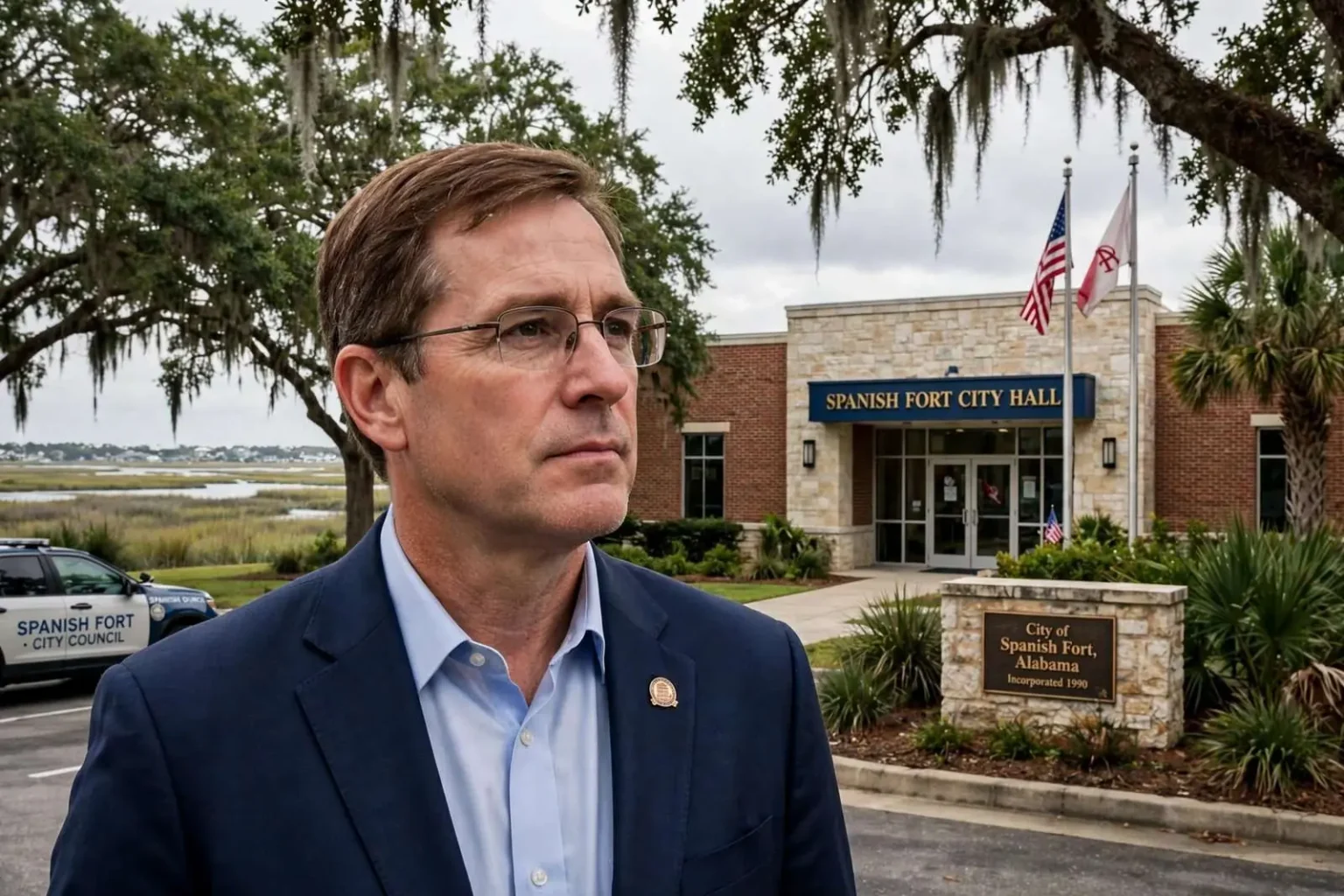
SPANISH FORT, Ala. — The shape of this year’s municipal election in Spanish Fort came into sharper focus as Mayor Joe Bonner signaled he was not expected to seek re-election, and instead was expected to throw his support behind City Councilman Mike McMillan. McMillan, for his part, confirmed that he planned to run for the office, setting the Eastern Shore city up for a transition in leadership at a moment when its rapid growth has made city hall’s decisions more consequential than ever.
The quiet handoff — an incumbent stepping aside and clearing the field for a designated successor — is a familiar ritual in small Alabama cities, where municipal races are nonpartisan, low-spending and often decided by a few thousand votes. With no other contenders announced, McMillan’s path to the mayor’s office appeared open, provided the field stayed as it was through qualifying.
A candidate with a long civic resume
McMillan brought to the race a lengthy record of local service. A member of the Spanish Fort City Council for eight years, he had served as chairman pro tempore for the previous four, a role that functions much like a council president and places the holder at the center of budget deliberations and day-to-day governance when the mayor is away.
His service extended well beyond the council chamber. He had been vice chairman of the Spanish Fort Planning Commission and vice chairman of the North Baldwin United Way. At the time of his announcement he served on the D’Olive Watershed Committee and on the Industrial Development Board for the five-county area of southwest Alabama, among other boards, and he was a member of the Baldwin County Republican Executive Committee.
That breadth of involvement matters in a city like Spanish Fort, where growth pressures cut across every agency at once. The D’Olive Watershed Committee, in particular, has been the focal point for the community’s struggle with stormwater — the erosive runoff from hillside development that funnels down D’Olive Creek into Mobile Bay, carving gullies and silting the bay’s northern shoreline. A mayor who has sat in those watershed meetings arrives at city hall with the erosion problem already on his desk and in his vocabulary.
Backed by his predecessors
McMillan’s bid carried notable institutional weight. Bonner and two predecessors as mayor of Spanish Fort were expected to publicly endorse him. “Spanish Fort has been fortunate to have had three outstanding mayors,” McMillan said. “All three have endorsed me for this position and I am extremely grateful and honored by this.”
The endorsements stitched together the city’s modern political history. Spanish Fort incorporated in 1990, and its subsequent mayors presided over the transformation of a small community on the bluffs above Mobile Bay into one of the fastest-growing cities in Alabama — a run of growth that included major retail development along the Interstate 10 corridor, thousands of new rooftops and a expanding school population. Continuity among the mayors who managed that era, and their shared judgment about a successor, carried obvious weight with voters who have watched the city change around them.
As the field took shape, no other contenders had announced plans to run for mayor. In a city of Spanish Fort’s size, that early consolidation all but framed the election as a referendum on McMillan and the direction the endorsed leadership wanted to continue.
Priorities for a growing city
McMillan laid out a set of priorities for the fast-growing Eastern Shore community. Chief among them was moving forward with a proposed community center, complete with facilities to house the city’s administrative offices and judicial needs, along with amenities he described as long overdue — a senior citizens center and a needed library.
The community center proposal speaks to a common growing pain. Cities that incorporated as small towns often reach a point where city hall is a converted suite of offices, court is held in cramped quarters, and residents drive to Daphne or Mobile for library services. Spanish Fort’s population growth, which multiplied the demand on its administrative staff, court docket and recreational programs, has left the city with facilities sized for a much smaller community. McMillan’s proposal bundled those needs into a single civic project, an approach other Baldwin County cities have used to combine government offices with public gathering space.
He also emphasized continued funding of schools, arguing that “communities are defined by their education excellence.” The city’s schools, part of the Baldwin County system, have absorbed the wave of families moving into Spanish Fort’s subdivisions, and school quality is widely understood on the Eastern Shore as the engine of residential growth — better schools draw more families, which increases property values and sales tax revenue, which in turn fund the city. Keeping schools strong is both a promise to parents and an economic development strategy.
And he pointed to the Causeway as a unique opportunity, not only to enhance the beauty of the gateway into the city but also to develop the area in ways that take advantage of its setting. The Causeway — the low stretch of U.S. 98 that runs along the northern rim of Mobile Bay, linking Spanish Fort with downtown Mobile — is one of the region’s most scenic corridors, lined with marsh, bay access points and a scattering of longtime seafood restaurants and bait shops. For years the cities and counties that share the corridor have debated how to balance development pressure against the wetlands and viewsheds that make the route a genuine gateway rather than just a commute.
McMillan’s framing of the Causeway as both a beauty project and a development opportunity reflected the tension every Eastern Shore leader manages: Spanish Fort’s tax base depends on continued growth, while the natural features that draw newcomers — the bay, the creeks, the live oaks — are the same ones growth threatens. His years on the watershed committee and the planning commission were, in effect, an apprenticeship in exactly that balancing act.
What the transition means for the Eastern Shore
Municipal elections in Alabama are conducted without party labels, but the endorsements in this race carried clear practical weight. In a city where a few thousand ballots decide the mayor’s race, the backing of three men who have held the office amounts to a transfer of the networks — donors, volunteers, church and civic groups — that actually turn out votes on Election Day. Challengers in similar races across Baldwin County have found that a unified establishment endorsement is a difficult wall to climb.
The race is being watched across Baldwin County because Spanish Fort’s trajectory has become the county’s story in miniature. In a few decades the city has grown from a small bluff-top community into a retail and residential hub, anchored by the shopping centers at Interstate 10 and Alabama 181, with subdivisions spreading north toward U.S. 31 and east along the state highway corridors. Each new roofline brings the same trio of questions to city hall: where the next sewer capacity comes from, how the roads absorb the traffic, and whether the city’s stormwater systems can keep hillsides from washing into the bay.
Bonner’s decision not to seek re-election closes a chapter for a mayor who guided the city through much of that expansion. In Alabama’s municipal system, mayors are elected citywide to four-year terms and serve as chief executive and chief financial officer of the city, chair the council meetings and hold the veto pen over the budget — a broad set of responsibilities in a city adding infrastructure as quickly as Spanish Fort has.
McMillan’s eight years on the council give him a record voters can examine directly: the budgets he voted on, the development approvals he cast votes for and the stormwater ordinances the city adopted during his tenure as chairman pro tempore. In small-city politics, that record usually forms the core of the campaign, alongside the personal relationships a councilman builds with residents through years of civic board work such as United Way and the industrial development board.
The Industrial Development Board seat points to another thread of his candidacy. Southwest Alabama’s five-county economic development region competes for industry against the rest of the Gulf South, and Baldwin County has been among the fastest-growing counties in the state for years. A mayor who has worked the industrial recruitment side understands that new commercial and industrial development is what keeps residential property taxes low — a selling point that matters to the retirees and young families who have fueled the city’s housing boom.
With Bonner stepping aside, the three mayors’ endorsement and the absence of announced rivals, the election shapes up as a vote of confidence in the city’s existing direction. McMillan, if elected, will inherit a city with momentum — and with the full in-box of a community that grew faster than its civic buildings, its watershed and its Causeway could comfortably absorb. His answer, in essence, is that the city should build the community center, fund the schools and polish the gateway, and trust the institutions that got it here to manage the rest.