Consultants, Strategists and a Defection: Mobile’s Mayoral Campaigns Staff Up
By March 2005, Mobile's mayoral candidates were assembling professional campaign teams, and one veteran local adman crossed the aisle from John Peavy's camp to Ann Bedsole's.
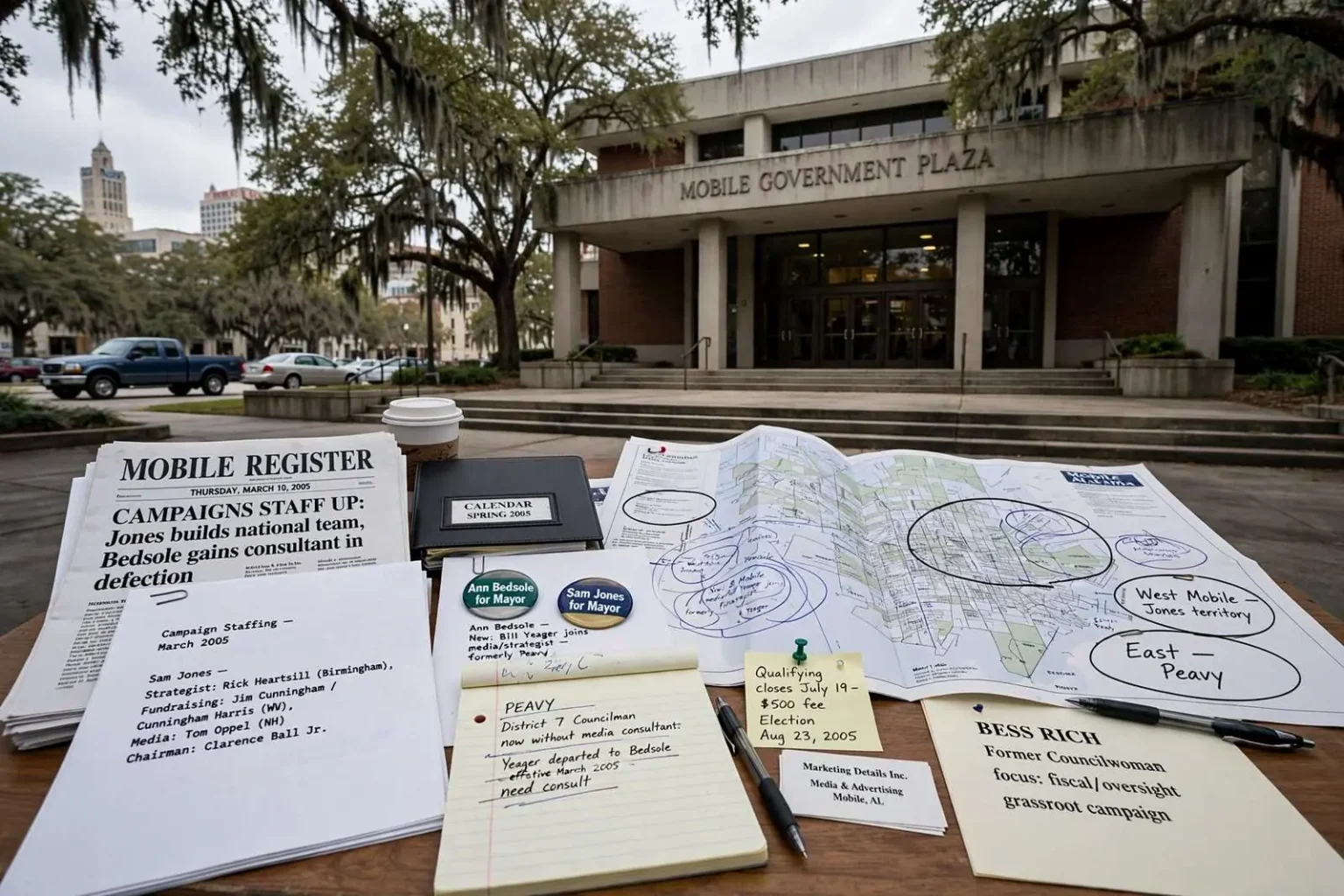
MOBILE — The campaigns to succeed Mayor Mike Dow moved in early March 2005 from the stage of rumor and speculation into the more concrete business of hiring: strategists, media consultants, fundraisers and chairmen. The staffing decisions offered the first real look at how each candidate intended to fight for City Hall in that August’s municipal election. The field to replace the four-term mayor, who had announced he would not seek re-election, included Mobile County Commissioner Sam Jones, former state Sen. Ann Bedsole, District 7 City Councilman John Peavy and former City Councilwoman Bess Rich.
Dow’s decision not to seek a fifth term had set off the widest-open race for Mobile’s top office in a generation. He had first won the mayor’s office in 1989 and had presided over the city through a period of downtown renewal and industrial recruitment that reshaped how the city saw itself. With no incumbent in the race, the contest for the city’s strongest office immediately drew in figures from across Mobile’s political map: a county commissioner with deep west Mobile roots, a former state senator with decades of public service behind her, a sitting councilman from the eastern district, and a former councilwoman known for her attention to fiscal detail.
Mobile’s mayor-council form of government concentrates real power in the mayor’s office, which is why the campaign attracted professional political help of a kind the city had rarely seen. The mayor proposes the budget, directs city departments, and serves as the city’s face in economic development negotiations — and the person elected that August would inherit a city in the middle of its biggest run of development announcements in decades.
Jones assembles a national team
Sam Jones, who had represented District 1 on the Mobile County Commission for nearly 18 years, assembled a roster that reached well beyond the county line: Rick Heartsill of Birmingham as political strategist and lead spokesman. Heartsill had once served as administrative assistant to then-U.S. Rep. H.L. “Sonny” Callahan. Jim Cunningham of the West Virginia-based firm Cunningham Harris as fundraising consultant. The firm had worked campaigns around the country and in Alabama, including the successful state Senate campaign of Gary Tanner. Tom Oppel of New Hampshire as media consultant, overseeing advertising. Clarence Ball Jr., a health care executive who also chaired the five-member Mobile Housing Board commission, as campaign chairman.
The structure was textbook. Heartsill would run the message and the day-to-day strategy; Cunningham would build the finance operation; Oppel would handle the advertising that would define the candidates on television; and Ball, a respected figure in the city’s business and civic circles, would lend institutional weight as chairman. Few Mobile campaigns had ever divided the labor so deliberately, and the out-of-town addresses on the letterhead — Birmingham, West Virginia, New Hampshire — said something about the stakes as Jones’s camp sized them up.
Heartsill’s hiring carried a wrinkle worth noting. His former boss, Callahan — a 30-year veteran of state and federal office — had signed on as campaign chairman for Ann Bedsole, placing the retired congressman and his onetime aide in opposing camps. Callahan’s endorsement had been among the most coveted prizes in the race, and the sight of the old congressman and his former assistant working opposite sides of the same contest became an early storyline of the campaign.
Yeager crosses over to Bedsole
The sharpest personnel news of the week was a defection. Bill Yeager, a veteran local adman and political consultant with the firm Timbes and Yeager, agreed to serve the Bedsole campaign as media consultant and strategist. Yeager had previously been aligned with John Peavy, the District 7 councilman and mayoral hopeful. His move to Bedsole — whose fundraising strength was already the subject of nervous conversation in rival camps — was read by observers as a signal about where the professional class of Mobile political operatives believed the race was headed.
Yeager was no newcomer. His long client list had included both Dow and Callahan, making him one of the more experienced hands in a city where the pool of seasoned campaign talent was shallow. Consultants of his generation in Mobile had learned their trade in a small market, running a handful of municipal and legislative races where budgets were modest and a well-placed billboard could matter as much as a television buy. Signing on with a campaign expected to spend at levels never before seen in a Mobile mayor’s race marked a step up in scale, and everyone in the small world of local politics understood the arithmetic of the move.
Marketing Details Inc., a local media group with a longstanding relationship with Bedsole and her civic endeavors, was also enlisted to assist her campaign. The firm brought previous political experience from the sheriff’s campaign of Kyle Callaghan in Mobile County and Randy McKinney’s state Senate campaign in Baldwin County. Its presence gave the Bedsole operation both an established local hand and a production capability, allowing the campaign to move quickly on advertising without waiting on outside vendors.
For Peavy, the loss of Yeager was a blow that went beyond one hire. A councilman campaigning citywide for the first time needed experienced professional help to introduce himself to voters in the city’s western districts, and the consultant market in Mobile was thin enough that the best hands were now committed elsewhere. The defection also carried a message to potential donors and endorsers watching the race take shape.
What the hiring said about the race
Taken together, the staffing announcements confirmed what veterans of local politics had been predicting: the 2005 race would be the most professionalized, and the most expensive, municipal contest Mobile had seen. Estimates circulating that spring put likely total spending above $1.5 million, surpassing the roughly $1.2 million record set in 1989, the year Dow first won the office.
The imported consultants were themselves a departure. For much of the city’s modern history, mayoral campaigns had been run by local business figures and volunteers. Bringing in a Birmingham strategist, a West Virginia fundraising firm and a New Hampshire media consultant marked a shift toward the polished, poll-driven style of campaigning that had already taken hold in statewide and federal races.
The change reflected in part the growth of the city itself and the reach of its television market. A mayor’s race in Mobile was fought not just in neighborhoods but on broadcast stations whose signal carried into Baldwin County and the Mississippi line, and reaching voters across that footprint required the kind of media operation that statewide campaigns took for granted. Polling, message testing and disciplined advertising schedules — once reserved for governor’s and congressional races — were becoming the expected machinery of a serious municipal campaign.
The professionalization also raised the practical stakes for the candidates themselves. A campaign that hires a fundraiser is committing to a schedule of events and calls that never stops; a campaign that hires a media consultant is committing to raise the money that pays for the airtime. Each hire signaled that its candidate intended to stay in the race through the August vote rather than fold early, and each raised the bar for any contender who had planned to run a leaner operation.
The field’s makeup gave each campaign a natural geographic and political base. Jones, as a county commissioner, carried name recognition across western and central Mobile. Bedsole, whose service in the Statehouse had made her known well beyond her district, brought an established network of donors and civic contacts. Peavy’s council district gave him a strong starting point east of the river, and Rich’s record on the council had built her a following among voters who prized her scrutiny of city spending. How each camp converted that base into a citywide coalition was precisely what the new professional machinery was being paid to manage.
The calendar ahead
Qualifying for the Aug. 23, 2005 municipal election was to close on July 19, with a $500 fee for mayoral candidates and $125 for City Council candidates. The modest qualifying fees meant the real financial test would come in fundraising, not paperwork, and the expected entries and exits between March and July would keep the shape of the field in flux for months.
Mobile’s municipal elections are nonpartisan, so the race would be decided without party labels — a feature that traditionally forced candidates to build coalitions across racial, neighborhood and economic lines rather than rely on a partisan base. The August election date also meant the campaign would run through the summer, when turnout would be low and a candidate’s ability to identify and turn out committed voters would matter as much as raw name recognition. All of it favored the campaign with the sharper organization — which was exactly the argument each camp was making with the hires it announced in March.
By the time the qualifying books closed, the question would no longer be who was running for mayor of Mobile, but whose team had executed better — the judgment that, in a city on the move, the candidates had already begun making with the people they chose to run their campaigns.