When Could You Wear White? Mobile’s Forgotten Straw Hat Day and the Rules of a Southern Spring
Long before Memorial Day became the national starting gun for white shoes, Mobile mayors proclaimed Straw Hat Day just before Easter. The city archives still hold the proclamations.
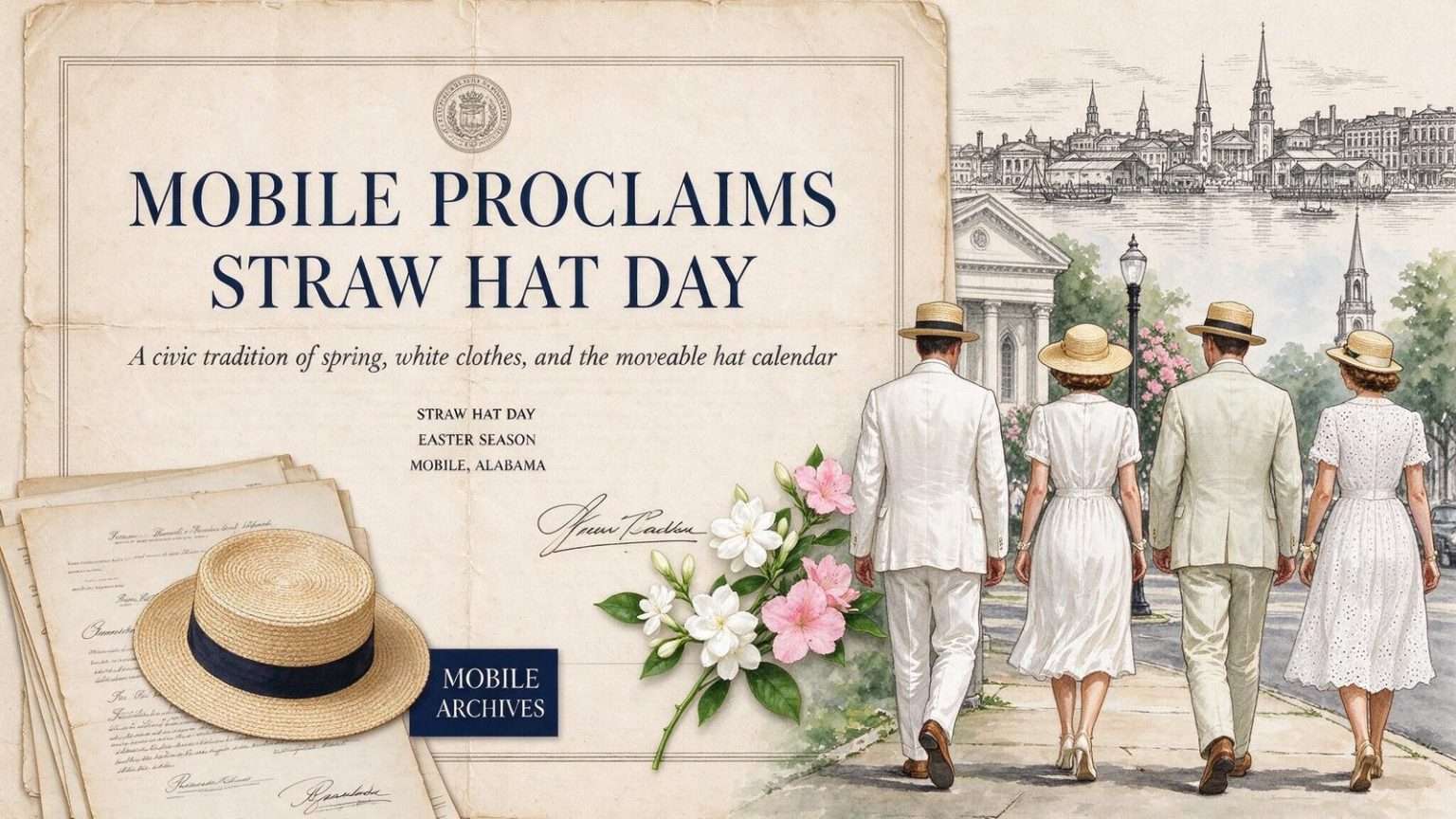
Ask a room full of Southerners when it becomes acceptable to wear white shoes, white linen and a straw hat, and you will start an argument. Most fashion guides say Memorial Day. Along the Gulf Coast, an older tradition says Easter — and Mobile’s own city archives contain the paperwork to prove the local custom was once official.
The debate sounds trivial to outsiders, but in a region where summer lasts half the year and spring often arrives while other states are still shoveling snow, the question of when to change wardrobes was once serious business. Closet calendars mattered to families who dressed up for church on Easter morning, packed courthouse steps in July heat, and judged strangers on the street by the hat on their heads. In Mobile, the custom was not left to gossip columns or department store advertising. It was written down, signed by the mayor, and filed downtown.
A mayor’s proclamation, not a magazine rule
From at least 1931 until roughly 1960, the mayors of Mobile issued an annual proclamation setting “Straw Hat Day,” the moment the city’s men were expected to retire their felt hats and take up straw. It was not a fixed calendar date. It was a moveable feast, typically landing on Maundy Thursday or Good Friday, timed so the city could turn out in fresh finery for Easter.
That scheduling choice says a great deal about the city itself. Mobile has celebrated Mardi Gras since well before the Civil War, and its civic calendar has always run on the church year as much as the secular one. Ash Wednesday, Lent, Palm Sunday and Easter structured the season the way they structured the parades and balls that still fill downtown streets each winter. Choosing the holiest week of spring for a wardrobe change fit a city where French, Spanish, Creole and Protestant traditions had been braided together for two centuries.
The proclamations read like small prose poems. They recite in multiple “whereases” that Mobile is “a veritable flower garden with the air scented with street perfume and the streets lined with the riotous coloring of floral displays,” that “our birds are singing everywhere and their songs are the harbingers of new life and springtime.” They note the date of the Mobile Bears’ opening game and declare that the proper hat for a baseball game is “a STRAW hat” — pointedly, not a cap.
The Mobile Bears reference anchors the proclamations in the city’s daily life. The Bears were Mobile’s long-standing minor league franchise, and opening day at their ballpark was a civic occasion that drew men who had dressed for it. Baseball in the first half of the twentieth century was played in suits and hats as often as not, and the proclamations treated the ballpark as a place where a felt hat would be as out of season as a winter coat.
All citizens, the documents say, and not just men, were “urged to put away their winter chapeaux and to replace them with sparkling new STRAW HATS.” The language is capital-letter formal, the kind of civic flourish Southern mayors of the era used for proclamations honoring visiting dignitaries and fire-prevention weeks. Applying it to hats suggests the day carried genuine civic weight.
Why the tradition needed a mayor at all
Why the tradition needed a mayor at all is a fair question. One clue survives in a Mobile newspaper item from March 7, 1931, reporting that “the first straw hat of 1931 appeared on Royal and Dauphin streets yesterday, far ahead of the official advent of spring,” worn by “a stylishly dressed man, who did not seem embarrassed by eyes that stared and comments made as he passed along the avenues.”
Royal and Dauphin were then, as now, the commercial heart of downtown Mobile, where bankers, merchants and lawyers traded glances daily. A man who appeared there a month before Easter in straw was making a public statement, and the newspaper treated it as news precisely because the custom still governed the street. Perhaps the confusion of that season prompted the city’s men to demand an official start date. If the first reckless wearer could show up in early March, the cautious majority wanted to know when it was safe to follow — and a proclamation gave them a defensible answer.
Easter, not Memorial Day
The distinction matters to traditionalists. Memorial Day was established after the Civil War as a remembrance for Union soldiers, and in Alabama it long shared the calendar with Confederate Memorial Day in April. Federal workers took one holiday; state workers took the other. It is not hard to see why a fashion custom in the Deep South would not have been dated from the Northern observance.
The historical layering runs deep. Decoration Day began in the North as a tribute to Union dead, and for decades it remained a regional observance before spreading nationally. Alabama, meanwhile, observed its own Confederate Memorial Day in late April, a state holiday that still appears on the official calendar. Two separate remembrance days meant two separate “season openers,” and Gulf Coast families followed whichever one governed their own household’s loyalties and paychecks.
The practical argument is simpler still. The South gets hot earlier. By late April, Mobile regularly records temperatures that other cities do not see until June; by Memorial Day, the Gulf Coast is already deep into a humidity that makes felt hats and wool suits punishing. Easter weekend, when children were dressed in new white linen if their parents could manage it, made a more natural threshold than the last Monday in May.
Easter also carried the economic logic of the spring wardrobe. New clothes for Easter Sunday were a point of family pride in an era when many households bought garments twice a year, once for winter and once for summer. Putting on the summer hat was the capstone of that annual shopping ritual, and merchants along Royal Street, Dauphin Street and Government Street geared their window displays to it. A moveable official date let shopkeepers coordinate their stock with the calendar of the church rather than the calendar of Washington.
Everyone agrees on the ending date — Labor Day — which is precisely why the beginning date is where the fights happen. The close of the season was set by a national holiday of working people, uncontroversial on either side of the old sectional divide. The opening was where regional identity, church calendars and simple climate all collided.
The exceptions
Even in its strictest form, the rule came with escape hatches. There was the resort exception: at a Southern resort, white clothes and straw hats were acceptable in any season. Whether Mobile, Point Clear or Fairhope qualifies is a matter of local pride and endless dispute; the snowbirds who winter here in shorts and windbreakers, it should be said, do not settle the question.
Point Clear, at the southern tip of the Eastern Shore, built its reputation on grand bay-front hotels that drew vacationers from across the Southeast, and resort towns everywhere claimed a license to ignore the calendar. Fairhope, the single-tax colony founded on the bluff above the bay, prided itself on being apart from ordinary rules in matters of politics, art and apparently dress. Whether either counted as a “resort” in the strict sense of the etiquette books was exactly the sort of argument Mobile residents were happy to conduct at length.
There was the yacht exception, which held that whites were always in order on the water, weather permitting — though a canoe, a duck skiff or a fishing boat with an outboard does not qualify anyone for the privilege. The distinction separated the yacht clubs and pleasure fleets of Mobile Bay from the working watermen of the shoreline, who had their own practical dress code built around sun, salt spray and long days over the oyster reefs.
And there was, in Mobile and New Orleans alike, the Mardi Gras exception, under which women simply beat Easter to the punch by 40 days or more, appearing in light dresses and straw hats well before Lent had run its course. Carnival season turned the normal order upside down every winter, and the women’s organizations that filled the streets and ballrooms between Twelfth Night and Fat Tuesday dressed for celebration, not for the thermometer. Nobody in either city seriously proposed policing the length of a Mardi Gras gown against a hat calendar.
Sport Shirt Day and Felt Hat Day
The proclamations did not stop with straw. About a month after Labor Day, Southern cities flipped the calendar back with “Felt Hat Day,” the mirror-image observance that returned wool and felt to respectable heads as autumn cooled. The two days bracketed the Southern summer the way brackets mark an opening and closing quotation: everything between them was officially warm-weather attire, and everything outside was not.
And in the years after World War II, a “Coats Off” campaign promoted by the Junior Chamber of Commerce produced mayoral orders declaring that beginning around July 1 and running to the first day of fall, “the proper, modest and polite attire for gentlemen in the city” was “a neat, lightweight sports shirt instead of coat and necktie for all occasions from sunrise to sunset.”
The Coats Off campaign reflected a national push by junior chambers of commerce — the Jaycees — to humanize the Southern business day. Downtown merchants believed, with reason, that men in shirtsleeves shopped more freely and stayed downtown longer than men trudging in wool. Mobile’s version formalized what the war years had already begun: millions of servicemen had spent summers in khakis and cotton, and they were not eager to return to Victorian formality the moment their discharge papers arrived.
Air conditioning did that tradition in, along with the hat customs generally. As cooled offices, stores, theaters and automobiles spread through the city in the 1950s and 1960s, the climate-controlled day no longer required a wardrobe calendar at all. A man could commute in a coat to an office kept at a fixed temperature year-round, and the felt hat’s practical justification evaporated with it.
The proclamations trail off around 1960, when fashionable young men decided that fashionable young men did not wear hats at all. The hatless revolution arrived first on college campuses and then in the business districts, accelerated by the Kennedy presidency, whose bare-headed, square-crowned silhouette defined the new decade. If no one wears a hat, there is no need to declare a day for changing it.
A rule with ragged edges
The edges have only gotten more ragged since. Horse owners in the winner’s circle in New Orleans turn up in white suits in early spring. Fashion-minded young women wear white boots in January on the theory that a deliberate misstep is its own kind of style. Whether white rubber boots on a Bayou La Batre shrimp boat count as edgy is left to the reader.
Bayou La Batre, the shrimp-processing town down the western shore of Mobile County, has long dressed for function rather than fashion, and the rubber boots on its boats are working gear that outlasts any etiquette manual. The image of those boots entering a discussion of white-linen seasonality captures exactly how far the old rule has drifted from the life of the Gulf Coast.
What is not in dispute is that Mobile once took the question seriously enough to put it in writing, over the mayor’s signature, in a document filed away downtown — a reminder that a city’s small rituals leave a paper trail, even when the rituals themselves are gone.