Former Restaurateur Rick Gambino Enters the Fairhope Mayor’s Race
Rick Gambino, whose family restaurant was once among Fairhope's largest employers, announced his candidacy for mayor in May 2008, pledging fiscal conservatism and a promise to keep Fairhope, Fairhope.
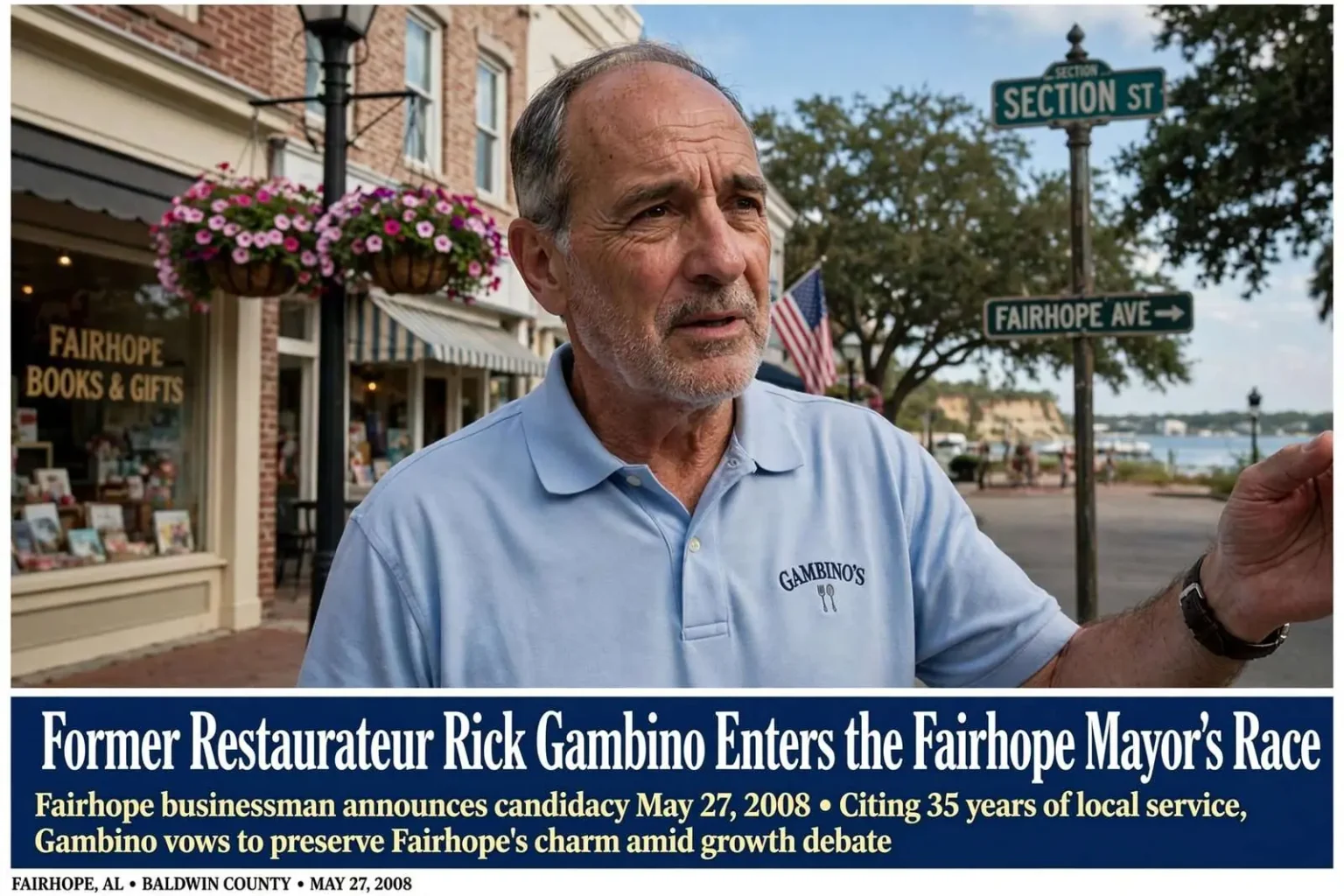
Fairhope businessman Rick Gambino, whose family restaurant was for years one of the best-known addresses on the Eastern Shore, announced his candidacy for mayor of Fairhope on May 27, 2008, entering a municipal race that was already drawing attention across Baldwin County.
His announcement leaned on a simple proposition: that a man who spent decades serving customers understands what it means to serve citizens.
“Fairhope has been good to me and my family for over 30 years,” Gambino said. “This is a chance for me to give something back to the city and citizens I love.”
Municipal elections in Alabama fall in August, and by late May the qualifying period had shaped a Fairhope race that residents were watching closely. The city of roughly 16,000 sat at the center of Baldwin County’s growth debate, and questions about zoning, infrastructure and the pace of development dominated local politics from the city council chambers to the pages of the Baldwin County press.
A Campaign Built on Keeping Things as They Are
The heart of the announcement was preservation. Gambino framed his candidacy around the anxiety, familiar to anyone who has watched a beloved small town grow quickly, that Fairhope’s particular character could be developed away.
“I am concerned about the future and want to make a difference, while keeping the charm and quaintness of Fairhope,” he said. “There is no other town like it. Fairhope is unique and I want to keep it that way.”
That instinct had real force in 2008. Baldwin County had spent the previous decade as one of the fastest-growing counties in Alabama, and Fairhope, with its bluff over Mobile Bay, its flower baskets and its independent shops, sat at the center of the argument about what growth was doing to the place.
The numbers behind the anxiety were unmistakable. Baldwin County’s population had climbed from roughly 110,000 in 1990 past 150,000 by the middle of the decade, with new rooftops multiplying along the Highway 98 and Highway 181 corridors north of Fairhope and across the county’s eastern shelf. Eastern Shore towns absorbed spillover from Mobile’s suburbs and from retirees drawn to the Bay, and every annexation, subdivision and commercial development became a referendum on what the town would look like in a generation.
Preservation politics ran deep in Fairhope’s history. The city was founded in 1894 as a single-tax colony by Midwestern idealists who believed land should belong to the community, and its founders’ influence still shows in the municipal bluff, the parks along the shoreline and the flower-lined streets that give downtown its character. The Fairhope Single Tax Corporation remains part of civic life, and generations of residents have measured proposed changes against the town’s unusual heritage — a history that makes “keeping the charm and quaintness” more than a slogan in a Fairhope campaign.
Gambino’s platform asked voters to connect that heritage with the way the city was run. His argument was that growth was inevitable but its management was not, and that a businessman’s discipline — budgets reviewed line by line, customer service treated as the standard, decisions made on evidence — was the tool Fairhope needed to steer development rather than chase it.
The Restaurant Years
Gambino had been in business in Fairhope for more than 35 years. He and his family ran Gambino’s, a popular restaurant that at one time counted among the city’s largest employers.
By 2008 he had moved into rental properties in Fairhope.
Gambino’s occupied a place in Eastern Shore life that went beyond the menu. For decades the restaurant served as a gathering spot for civic clubs, family celebrations, post-game dinners and business lunches — the kind of established local institution where a proprietor comes to know a town’s rhythms from the inside. A restaurant that ranks among a city’s largest employers also teaches management on a scale many small cities never see: scheduling, purchasing, payroll, health regulations and the daily discipline of keeping hundreds of customers satisfied.
He drew his governing philosophy directly from the dining room.
“We need a common sense, business-like approach to what we do for Fairhope citizens and businesses,” he said. “As restaurant owners, Gari and I quickly learned you must serve your customers. As mayor, I will work for and serve Fairhope citizens and the small unique businesses in Fairhope.”
The customer-service framing had a particular resonance in a town whose economy runs on small business. Fairhope’s downtown — bookstores, galleries, boutiques and restaurants along Section Street and the side streets that climb to the bluff — depends on independently owned shops that draw visitors from across the Bay and across the county. Those businesses, in Gambino’s telling, were the city’s real constituency, and municipal government’s job was to keep the regulations, parking, infrastructure and character that let them survive.
His own transition from restaurants to rental properties reflected that same stake in the town’s physical future. A landlord on Fairhope’s streets experiences the city’s growth pressures from a different angle — property values, maintenance, tenants, the balance between old buildings and new investment — and the move positioned him in the local economy’s real estate side just as growth debates were cresting.
The announcement placed him in a field of candidates for an office that had been held by Mayor Tim Kant since 2000, and the race’s contours took shape around the same questions Gambino raised: how fast the city should grow, how its infrastructure would keep pace, and how to protect the downtown core that made Fairhope a destination.
Gambino’s biography gave him a profile Fairhope voters knew. His family’s decades in the restaurant business meant generations of Eastern Shore residents had passed through his doors, and his business investments kept him tied to the city’s commercial life. In a small-city election, name recognition built over 35 years is a genuine asset, and his campaign leaned on it deliberately — the restaurateur running the city the way he ran the dining room.
The growth question that framed the 2008 race had concrete fronts that summer: developments proposed on the city’s edges, traffic on Section Street and Highway 98, pressure on schools and water systems from the county’s population surge, and the recurring argument over how much commercial growth downtown could absorb before it changed what made it distinctive.
Fairhope’s situation in 2008 carried a national backdrop as well. The housing slowdown that began in 2007 was already cooling Baldwin County’s construction boom, forcing growing towns to recalibrate revenue projections built on building permits and impact fees. A candidate preaching careful, business-like management of growth was, in that moment, speaking to a city that had watched its fastest expansion years run into a national correction — and to taxpayers wondering how municipal budgets would absorb the swing.
The Eastern Shore’s growth story was far from over, whatever the short-term cooling. Fairhope’s population continued climbing through the decade, pushed by the quality of its schools, its waterfront and its reputation as one of Alabama’s most livable towns. The candidates competing in 2008 were contesting, in effect, how that growth would be governed — at what pace, in what direction, and with what protections for the downtown and bluff that defined the city’s image.
Gambino’s candidacy added a business voice to that contest, drawing on the credibility of a family enterprise that had survived decades of competition on the Eastern Shore. His message — serve citizens the way a restaurant serves customers, keep the town’s charm while managing change — was pitched directly at the voters most anxious about the direction of the city.
The May 27 announcement opened his campaign’s summer, with qualifying, fundraising and the August election day ahead. Whatever the result, his entry ensured the race would be fought substantially on the ground he chose: the character of Fairhope, the fate of its small businesses and the question of who would steer a town that had outgrown its old rhythms but not its sense of itself.
Gambino’s emphasis on small, unique businesses also named a vulnerability Fairhope’s merchants had voiced for years. As chain development spread along the Highway 98 corridor, downtown shops depended on city decisions — parking, signage rules, facade standards, the pedestrian flow from the bluff to the shops — that could either preserve the district’s appeal or hollow it out. A mayor who had spent his career competing as an independent against larger operators cast himself as an advocate who understood that fight from inside it.
The family dimension of the candidacy ran through his announcement as well. Gambino spoke of the city’s generosity to his family across three decades — the restaurant years when Fairhope’s residents were, in effect, his customer base — and his promise to give something back framed the campaign as repayment rather than ambition. In a town where personal history counts heavily, that narrative gave voters a reason to trust the messenger before weighing the platform.
Baldwin County’s political landscape in 2008 made municipal races unusually consequential. Fast-growing cities were annexing land, extending water and sewer lines, and hiring police and fire staff to cover territory that had been farmland a decade earlier; the decisions those councils and mayors made would fix the shape of the county for decades. Fairhope’s race, watched across the county, was part of that larger negotiation between growth and identity playing out in every Eastern Shore municipality.
The campaign season that followed the announcement ran through the summer, with qualifying in early July and voting in August under Alabama’s municipal election calendar. For Fairhope’s voters, the choice presented itself in familiar terms — between managing growth aggressively, restraining it, and finding the balance in between — with each candidate’s biography offering the shorthand for how they would govern.