A Katrina Refugee Restaurant Finds a Second Life in a Paper Mill Town
A Mobile dining critic on the road found the Big Easy Grill in Bogalusa, Louisiana, a restaurant destroyed by Hurricane Katrina in St. Bernard Parish and rebuilt next to a Piggly Wiggly.
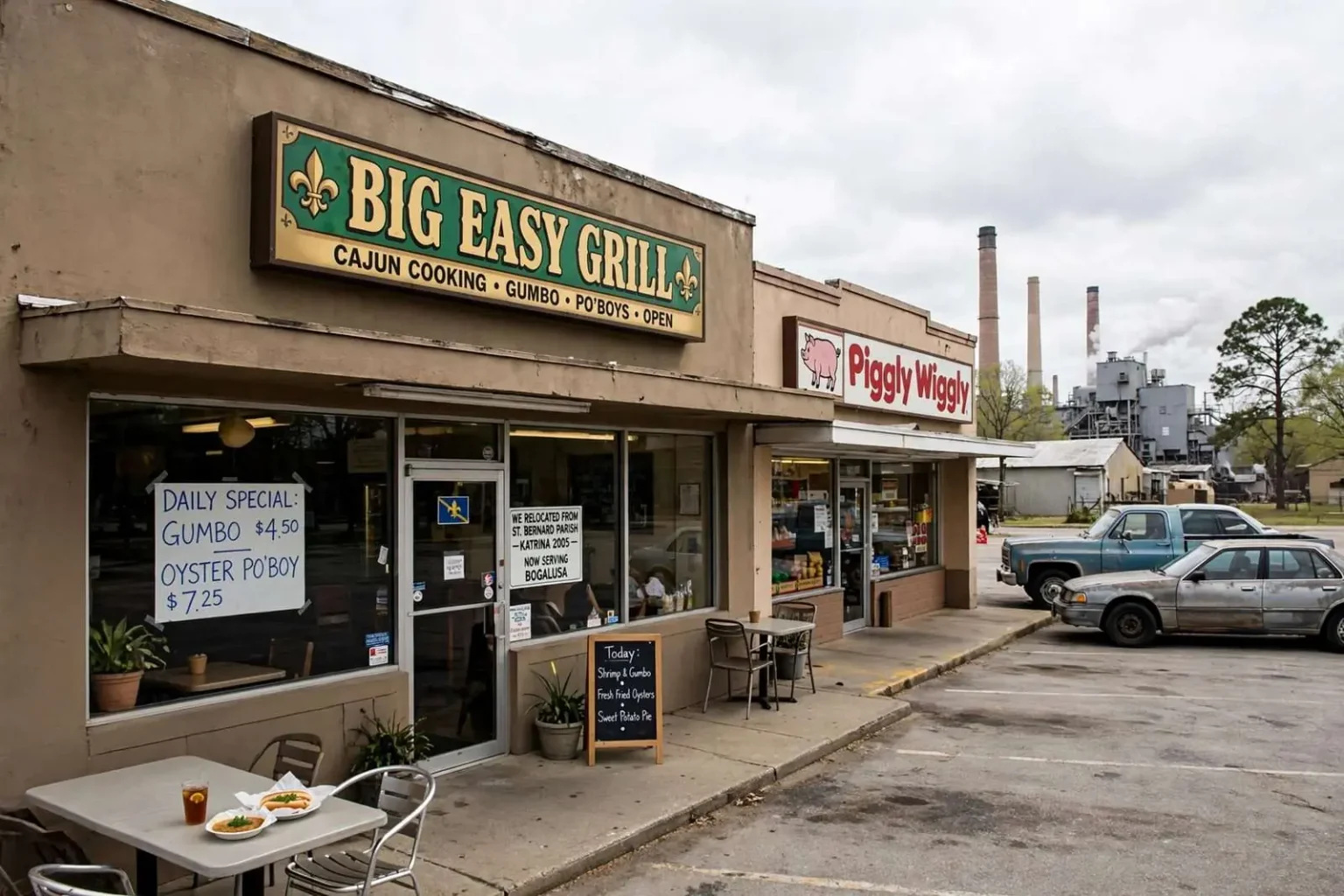
Nearly three years after Hurricane Katrina, the storm’s displacements were still rearranging the map of Gulf Coast cooking. In May 2008, a Mobile dining critic, traveling on other business, stopped for lunch in the small paper mill town of Bogalusa, Louisiana, and found one of those rearrangements sitting in a strip shopping center next door to the local Piggly Wiggly.
The restaurant was the Big Easy Grill. The critic, who wrote under a pen name and paid for his own meals, went in expecting little and came out with one of the more affectionate reviews he had filed.
The disguise was thorough enough that it deserves a word. Restaurant critics who review anonymously, pay full price and write under pen names do so for the same reason undercover reporters decline press badges: a meal comped by a publicist, or a table that arrives with the owner’s best intentions rather than a kitchen’s ordinary ones, tells a reader nothing. The Mobile critic’s reviews were trusted by his readers precisely because he walked in like anyone else — hungry, unannounced, and spending his own money — which made the verdict he delivered from Bogalusa carry real weight.
A restaurant that moved twice
Talking with the owner, he learned the establishment’s history. The Big Easy had originally operated in St. Bernard Parish, the community southeast of New Orleans that was among the most comprehensively destroyed places in the United States when Katrina’s surge came through in August 2005. The restaurant was lost with it.
St. Bernard Parish sits in a crescent along the Mississippi River and the lakes east of New Orleans, and when the flood defenses failed it filled with water virtually wall to wall — neighborhoods, storefronts, schools, churches, everything. The scale of the destruction there became one of the defining images of the storm: a whole parish where nearly every building was flooded, where residents who returned months later found their businesses gutted and their customer base scattered across half the country. A restaurant in that landscape did not merely lose its equipment. It lost its employees, its suppliers, its regulars and its reason for existing in that spot.
The owner relocated temporarily to the Covington area, north of Lake Pontchartrain, and then moved a little farther north still, to Bogalusa.
The route he took was the route tens of thousands of displaced Louisianans followed — across the Causeway or the twin spans to the Northshore parishes, where communities like Covington, Mandeville and Slidell absorbed an enormous share of the region’s refugees, and then onward for those who could not rebuild lives so close to the wreckage. Covington and its neighbors were themselves strained by the influx; the second move north was the act of a family still searching for footing.
The critic did not flatter the town. Bogalusa was not impressive, he wrote. It, too, had been battered by Katrina’s winds and was recovering slowly. There was little industry beyond the large paper mill in the middle of town. It was a blue collar place. Opening a restaurant there, he judged, took a gigantic leap of faith.
The description was fair. Bogalusa is a company town at its root, carved out of the Washington Parish pine forests in the early twentieth century to house a sawmill operation, and papermaking sustained it long after the virgin timber was gone. Katrina’s winds had torn through the town hard, and its recovery drew little of the attention that New Orleans received. A mill town’s restaurant economy is sturdy but not expansive — it supports the places people already know, and a stranger cooking New Orleans food was a genuine gamble.
The leap paid off
It turned out to be a good decision. The owner told him that the St. Bernard location had also carried video poker, a common revenue supplement in Louisiana. The Bogalusa restaurant had none, and still produced better income. Business was brisk. The restaurant had already built a strong local following.
That detail is the most quietly remarkable one in the review. Louisiana’s video poker law allows licensed restaurants to operate machines, and in many small-town establishments across the state the machines are not a supplement at all — they are the business, with the kitchen attached for the license. A restaurant that earns more without its machines than it did with them is a restaurant that is genuinely feeding people well enough that they come back and bring friends.
That detail is worth pausing on. It is easy to assume a displaced business survives on nostalgia or on the charity of a host town. What the owner described was something more durable: a community that had decided the food was worth showing up for.
Mill towns are unforgiving judges of a kitchen. Their residents eat out regularly, they know exactly what a plate should cost, and they have no patience for anything pretentious. A New Orleans-style place that lasted in Bogalusa had to win on flavor, portion and price alone. That it did — quickly enough to build a strong local following — says the cooking survived the displacement intact, and that the family running it knew exactly who they were cooking for.
The gumbo, and a high compliment
Having skipped breakfast, the critic arrived hungry and ordered a bowl of gumbo and an oyster po-boy.
The gumbo undid him. It was better, he wrote, than the gumbo he had recently praised at The French Loaf in Mobile, which he had called the finest he had found in his home city after years of searching. This one had a wonderful flavor and texture and was seasoned exactly to his taste. He could close his eyes, he said, and imagine he was again eating a bowl of his Aunt Tecy’s gumbo. From this critic, no higher compliment existed.
The comparison is the hinge of the review. The French Loaf, a Mobile bakery-and-lunch institution, had earned his recognition after years in which he had searched the city’s kitchens for a gumbo that measured up to the New Orleans standard — dark roux, proper texture, seasoning that arrived by intent rather than by luck. For a bowl served in a Washington Parish strip mall to beat it says everything about the diaspora’s culinary cargo. Katrina scattered thousands of New Orleans cooks across the Gulf Coast, and some of the best versions of the city’s food now lived in places where no one had thought to look for it.
The oyster po-boy was very good as well. The oysters were seasoned and fried just right. And the bread, at last, was what one should expect from a good po-boy, an important verdict from a man who had spent months lecturing Mobile kitchens on the difference between a proper New Orleans long loaf and an ordinary sub roll. It was, he wrote, a wonderful New Orleans oyster po-boy, served right there in little Bogalusa.
The bread point was one of the critic’s running obsessions, and for good reason. A po-boy lives or dies on the loaf — a French bread with a thin, crackling crust and a soft interior, dressed so the shreds of lettuce and tomato and the remoulade or melted butter can work into the bread without turning it to mush. Alabama’s sandwich breads, built for hoagies and subs, have thicker crusts and denser crumb, and he had spent months telling Mobile kitchens that no amount of good fried oysters could rescue a po-boy built on the wrong loaf. Bogalusa, forty miles from where the loaves were baked, got it right.
The only improvement he could imagine was a long-neck Barq’s, the root beer he had been hunting, unsuccessfully, across two states.
The Barq’s aside is a small window into how Gulf Coast food memory works. The root beer brand was born in Biloxi, Mississippi, in 1898, spread through New Orleans bottling operations, and the long-neck bottled version — served cold from an ice-filled cooler rather than poured from a fountain gun — became part of the landscape of south Louisiana lunch counters. By 2008 the bottled format had grown scarce in the region’s restaurants, and a man who could remember it from his own youth had apparently been checking coolers from Mobile to the parishes without luck. That a near-perfect meal still fell one bottle short tells the reader exactly how demanding and how sentimental this critic was, both at once.
Why a Mobile column went to Bogalusa
The critic acknowledged the unlikeliness of his recommendation. In the improbable event that your travels ever take you to Bogalusa, he told readers, head over to the Big Easy Grill, which offered a broad range of south Louisiana cooking beyond its po-boys.
The admission is part of the review’s charm. Mobile readers were not going to plan a lunch run two hours and a state line away, and the critic knew it. The column was really a dispatch from the storm’s long aftermath — proof of where the displaced had landed and what they had carried with them, delivered under the cover of a restaurant review because that is the form in which Gulf Coast readers would absorb it best.
The recommendation was not really the point. For Gulf Coast readers in 2008, the story underneath it was: that a family’s restaurant could be erased by a storm, moved twice, replanted in a mill town with no obvious market for it, and become a place people drove to on purpose. That story was being told, in different forms, in Bayou La Batre and Coden and Dauphin Island as well, and it was the story the region was still living.
Those Alabama places make the parallel precise. Bayou La Batre, the seafood village south of the city, had its docks, boats and processing houses wrecked by the same storm surge; Coden lost much of its waterfront; Dauphin Island’s west end was cut open and its homes scattered. Residents of all three spent the late 2000s rebuilding businesses that had been in families for generations, wondering the whole time whether the customers and the circumstances would ever come back. The Big Easy Grill’s owners were living the identical experience on the other side of Lake Pontchartrain, with the shop fronts and windswept mill town of Bogalusa standing in for the bayou’s debris fields.
Three years after the storm, the region’s recovery was no longer measured in blue tarps and FEMA trailers. It was measured in questions like this one: whether a gutted restaurant could reopen and thrive, whether the recipes survived, whether the community that lost its regulars could find new ones. A bowl of gumbo in Bogalusa answered yes — not the tidy institutional recovery of government reports, but the practical, stubborn recovery of families who cooked what they knew and trusted that people would eat.
The Big Easy Grill got a good review because the gumbo was good. But the reason the review reads the way it does, all these years later, is that the gumbo had survived.
That is the quiet thesis of the piece and the reason it still earns a reader’s attention out of context. Restaurants are among the most fragile of family businesses in the best of times, and Katrina had destroyed thousands of them outright. That one family could lose its building, relocate twice, land in a town of a few thousand people with no tourist traffic and no gambling revenue, and out-earn its own old location on the strength of cooking alone — that is the storm’s aftermath reduced to a single counter, a fryer and a roux cooked dark enough to taste like memory. The critic went to Bogalusa on other business and came home with the best gumbo he had eaten that year. His readers, wherever their own displacements had landed them, knew exactly what he was really saying.