Scores, Snobs and Robert Parker: A Mobile Wine Merchant on What Wine Writing Is For
As the Burgundy authority Clive Coates prepared to attack the wine press by name, a Mobile wine shop manager offered a more complicated defense of Robert Parker, and a warning about the tyranny of the score.
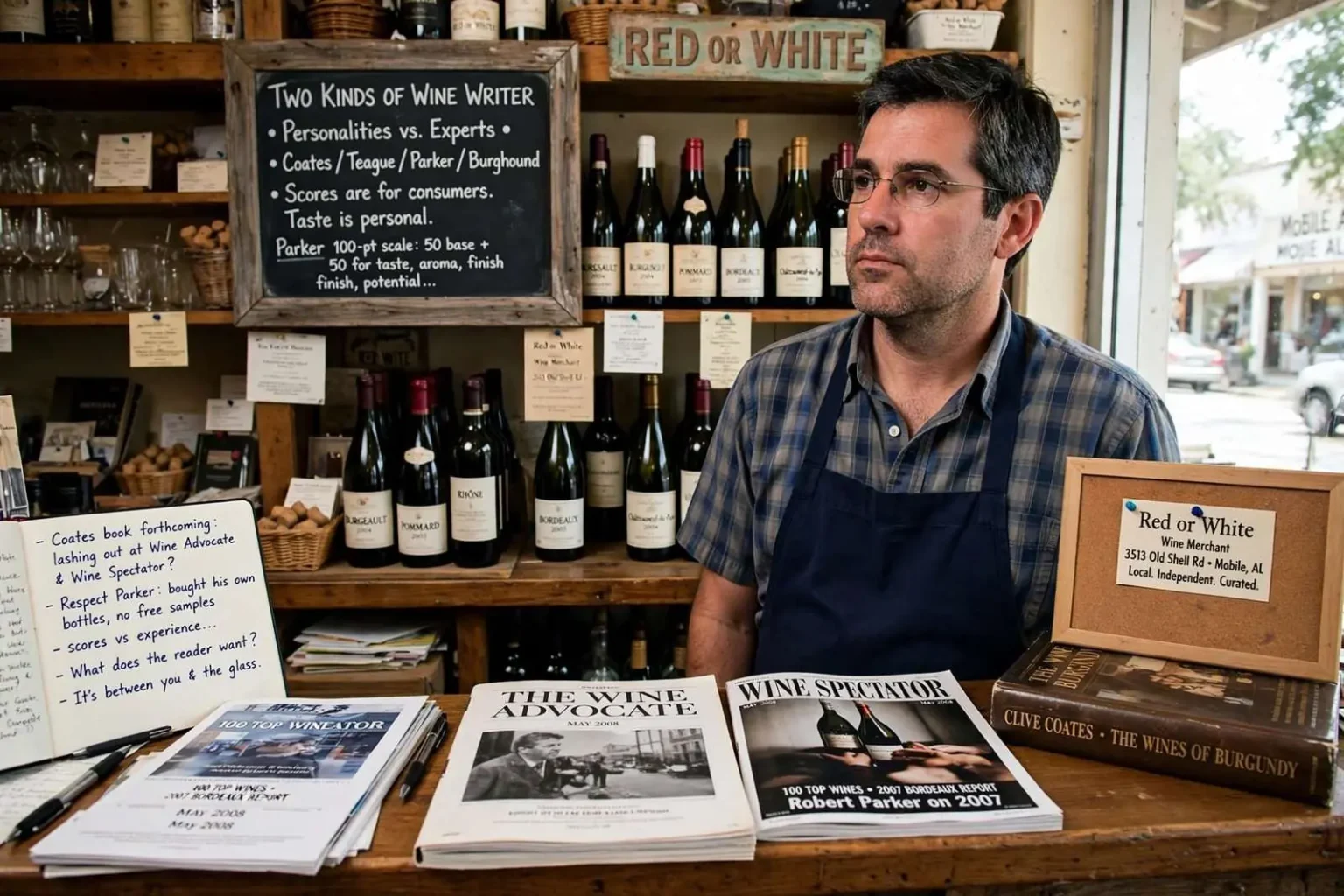
In May 2008, a wine shop on Old Shell Road in Mobile published a column that had nothing to do with what was on sale that week. It was about the people who tell us what to drink, and whether we should listen to them at all.
The occasion was a forthcoming book by Clive Coates, the English Master of Wine and the great chronicler of Burgundy. Word had reached the trade that in his introduction, Coates would lash out by name at The Wine Advocate and Wine Spectator.
The general manager of Red or White thought a scolding was probably deserved. He also thought it was beneath Coates to deliver it.
Two kinds of wine writer
Coates, he argued, had always stood outside the circle of industry wine writers. He was closer to the old idea of a travel writer, the sort who goes to a strange place, gives himself to that subculture, and returns with notes from within. Coates belonged to literature, not to business.
The complaint itself he found reasonable enough. The score-slingers were too close to the industry’s heart. They should spend more time knowing a wine and less time promoting or condemning it. And a critic who loves fruit bombs has no business rendering verdicts on complex Burgundies tasted five years before they settle into their grooves.
But this, he told Coates across the Atlantic, is not your period. That side of the wine world is hard-nosed business. As long as the consumer asks for scores, scores will be given, or sold.
An honest accounting of Robert Parker
The column’s most interesting turn was its defense of the man most often blamed for the whole system. Wine Spectator, in his telling, was easy to categorize. Since Marvin Shanken bought the publication in 1979, sales growth had been the intention and the result.
Robert Parker was harder. At about the same time, Parker was transforming a Baltimore journal into The Wine Advocate, a plain, print-only publication with no gloss whatsoever, packed front and back with intense reviews of vintages, regions, producers and wines. His up-in-your-face lawyer’s style gave consumers information they could trust, and the serious wine-loving public responded.
Two details, the merchant insisted, deserve respect. Parker’s 100-point score was created to help consumers determine value. And Parker refused free samples, buying the bottles he reviewed so that his verdicts belonged to the reader rather than the seller. He would not let an intimidating name sell a product for more than its worth.
Was that the posture of a cocky, Ralph Nader-admiring lawyer trying to get at the man? Perhaps. But did Parker volunteer to become the dictator of the wine trade? The merchant did not think so.
“Parker got lost in a world he helped create,” he wrote, “and became the monster he set out to attack. Now, the masses look for scores instead of names. But please remember Clive, this is not the way it started.”
Personalities and experts
He proposed a simple division. There are personality writers and there are expert writers, and the two camps will never agree. One accuses the other of being under-educated and offering easy answers to difficult questions. The other accuses the first of hiding behind an arrogant mask of pristine knowledge.
At the personality end he placed Coates, and more sharply Lettie Teague of Food & Wine, whose reviews read like colorful short story excerpts. At the expert end he placed Parker, and above all Allen Meadows, the Burghound, whose technical data can be about as exciting as legal documents.
Both, he said, had a place on his shelf. He read the personalities for pleasure and consulted the experts for clonal selections and vine training.
Even as he wrote, Parker was issuing hard words about the 2007 Bordeaux vintage, which the merchant hoped might push prices down. The two worlds relate differently to the consumer, he concluded: the experts are part of the market’s motion, while the personalities reflect on that motion. Neither really threatens the other.
The medium, and the speed
Then he turned to the thing he was doing himself. Publishing online had increased the speed of data and opinion beyond anyone’s fastest imaginations. Parker, Wine Spectator and Burghound were all burning up the computer speedway.
Gary Vaynerchuk, then broadcasting his morning wine videos from a New Jersey shop, was blending aggressive personality with rapid information and pushing the whole thing to another level. There were, he noted, more wine blogs than any mid-to-normal human should ever be exposed to.
He suspected Coates was annoyed by the speed. He admitted he was too. He wanted to say: slow down, think clearly, write as well. But he knew that advice was not really an option.
“You either play in the game or you watch the game. And the game is on.”
How the 100-point scale works
Parker launched his newsletter in 1978 as The Baltimore-Washington Wine Advocate while still practicing law, and later shortened the name to The Wine Advocate. The 100-point scale he popularized, and that Wine Spectator also uses, does not actually start at zero: every wine reviewed begins with 50 points, and the remaining 50 are awarded for color and appearance, aroma and bouquet, flavor and finish, and overall quality and potential to age.
The last word
What did any of it have to do with the bottle a reader had picked for that night? Nothing, he said, and he meant it as reassurance. A wine review, he argued, will never be the equal of a consumer report on a car. A seatbelt works the same for everyone. Fuel efficiency does not vary by taste.
But no critic can promise that you will detect tobacco beneath the cassis, or that a soft tannic grab will please you as it pleased him. “What I can promise you,” he wrote, “is that nothing can replace what happens between you and that glass of wine.”
The reviews, in the end, only give us something to talk about when we talk about wine. They will never be wine.