Suspended Judge’s Bid to Halt Ethics Case Rejected in a Single Handwritten Word
Clarke County Circuit Judge Stuart DuBose asked the Court of the Judiciary to pause proceedings while investigators kept working. The chief judge scrawled 'Denied' across the motion and signed it.
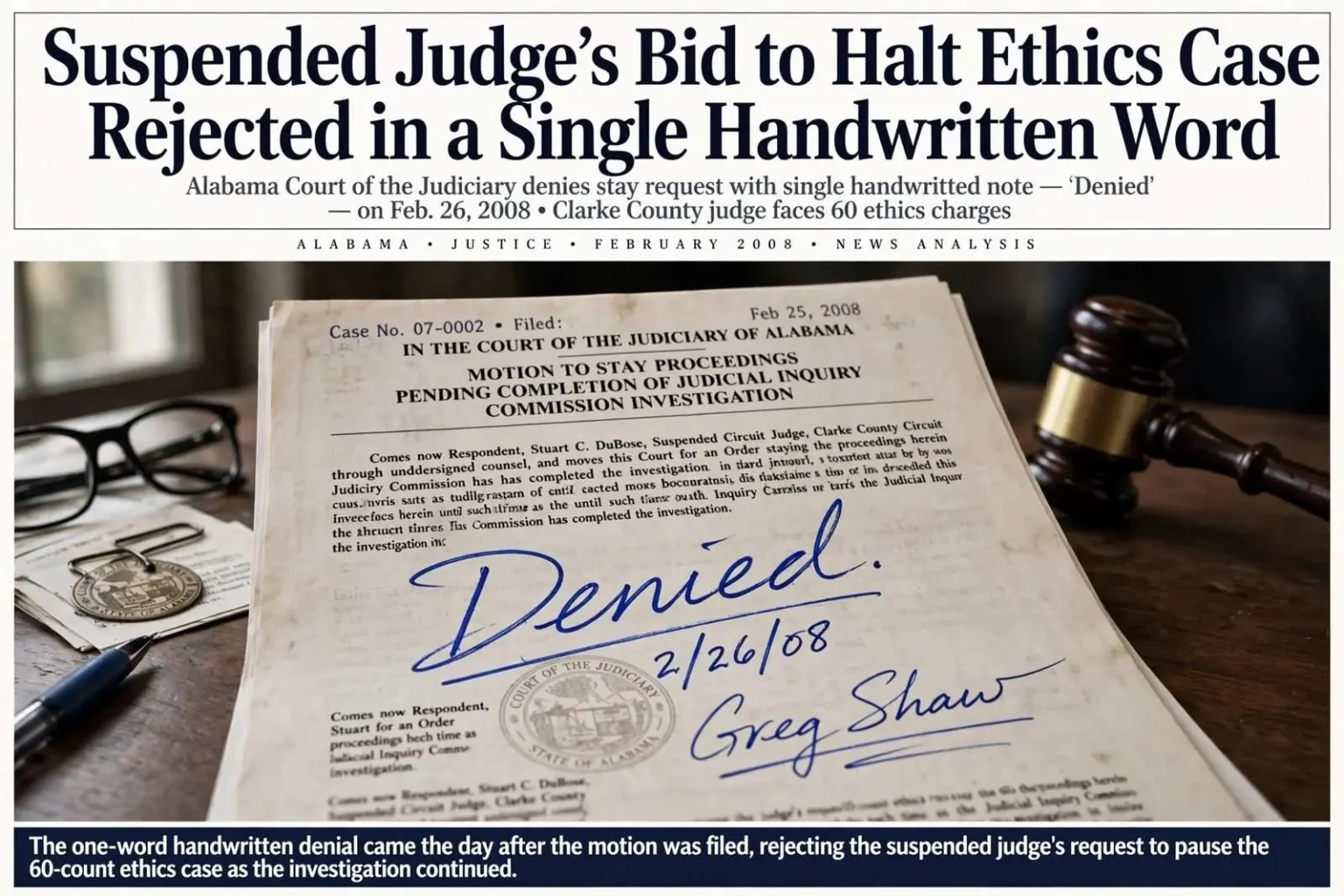
Suspended Clarke County Circuit Judge Stuart C. DuBose asked the Alabama Court of the Judiciary in February 2008 to put the ethics case against him on hold. The answer came back the next day, written by hand across the face of his own motion: “Denied.”
The brisk response, delivered without a hearing or an opinion, set the tone for a case that would run through the remainder of the year and end with DuBose’s removal from the bench. It also offered an unusually plain illustration of how the state’s judicial discipline system works — and how little room it leaves for delay once charges have been filed.
The request
DuBose faced a 113-page complaint containing 60 charges of unethical conduct brought by the Alabama Judicial Inquiry Commission. Through his attorneys — one from Calera, one from Birmingham — he sought a stay of the proceedings “until such time as the Judicial Inquiry Commission has completed the investigation” of the allegations against him.
The motion rested on a letter DuBose had received on Feb. 21 from the commission’s executive director, which stated that the investigation remained ongoing. It would be highly prejudicial, his lawyers argued, for the judge to prepare an answer or participate in trial proceedings while the commission was still investigating and, in their words, apparently seeking new witnesses and additional allegations.
The argument had a certain logic. A defendant ordinarily expects to know the full scope of the case before mounting a defense, and a complaint that might still grow is a moving target.
Under Alabama’s court system, the Judicial Inquiry Commission investigates complaints against judges and, when it finds grounds, files formal charges with the Court of the Judiciary, which acts as the trial tribunal. The division of labor means a judge can face an investigation that is technically unfinished even after a charging document has been filed, the very circumstance DuBose’s motion sought to exploit.
In ordinary criminal or civil litigation, a stay pending investigation is a request judges weigh against the interest of the other parties in reaching a resolution. In judicial discipline, the calculus differs: the tribunal’s mandate is to protect the public and the integrity of the courts, and delay in a case involving a sitting — even a suspended — judge cuts against that mandate. DuBose’s lawyers knew the odds when they filed, but the request cost them little and preserved the argument for the record.
The response
The motion was filed on a Monday and rejected on Tuesday. Court of the Judiciary Chief Judge Greg Shaw wrote “Denied” on the original document, dated it and signed it. There was no accompanying opinion.
DuBose had previously been granted an extension until March 12 to file his answer to the charges. That deadline stood.
Shaw, a judge on the Alabama Supreme Court serving as the court’s chief judge in disciplinary matters, dispensed with the motion in the tersest way the rules allow. Handwritten dispositions on the face of a motion are rare in published court records, and the brevity signaled that the tribunal saw no basis for pausing a case that was already moving toward trial.
For the commission’s lawyers, the ruling preserved momentum. For DuBose’s defense team, it meant preparing an answer to 60 charges while the possibility of amended allegations still hung over the case — the moving-target problem their motion had described, now fully theirs to manage.
How the case got here
DuBose, a Democrat, won the 1st Judicial Circuit judgeship in 2006 after a bitterly contested primary against a fellow Jackson attorney. He had no Republican opposition in the general election, but he arrived at the courthouse trailing unresolved grievances from his private law practice — including a bar disciplinary matter over the preparation of a will for a wealthy man he had never met, and a dispute over the handling of an estate.
Those disputes produced an unusual jurisdictional tangle. The Alabama State Bar disciplines lawyers; the Court of the Judiciary disciplines judges. Once DuBose was sworn in, the question of who had authority over conduct committed while he was still in private practice became genuinely unclear, and the Alabama Supreme Court and the bar spent months sorting it out.
The June 2006 race that put DuBose on the bench was remembered in Jackson and the surrounding towns as one of the harder-fought local contests in years. Two lawyers from the same small county seat, each with allies and grievances accumulated over years of practice, competed for a judgeship that carries statewide authority and a six-year term. Whoever won would inherit a docket spread across three county courthouses and the expectations that come with a black robe in a small community.
Meanwhile, his conduct on the bench generated a fresh set of complaints, which the Judicial Inquiry Commission investigated and, in early 2008, reduced to the 60-count charging document that led to his automatic suspension with pay.
The 1st Judicial Circuit covers Choctaw, Clarke and Washington counties, a stretch of southwest Alabama where circuit judges ride a multi-county circuit in the tradition of Alabama’s rural courts. A vacancy on that circuit, even a suspended one, is felt in every courthouse in the three counties at once, because the same judge’s docket serves them all.
What came next
The Court of the Judiciary is Alabama’s tribunal for judicial misconduct, composed of judges, lawyers and lay members. It has the power to censure a judge, suspend one, or remove one from office permanently.
A former district attorney from Dothan was assigned as a supernumerary prosecutor to try the case. The appointment of an outside prosecutor is standard practice in judicial discipline proceedings, giving the tribunal an independent presenter of the charges rather than leaving the commission’s staff to argue the case it had investigated.
DuBose remained suspended with pay while the case proceeded. His answer, filed in March, would take an unusual turn — asserting that he had been suffering from diminished capacity throughout the period covered by the charges — and the case would consume the remainder of the year before ending in his removal from the bench.
The diminished-capacity defense is a rare one in judicial discipline cases, and it promised to make the proceedings unlike the ordinary misconduct trial. Rather than contesting individual counts, the defense would ask the tribunal to weigh the judge’s state of mind across the entire span of the alleged conduct, opening questions about medical evidence and the standard of responsibility the court would apply.
For the counties of the 1st Circuit — Choctaw, Clarke and Washington — the practical effect of the February ruling was simply that the arrangement continued: a suspended judge drawing his salary, and a rotating cast of borrowed judges keeping his courtrooms open.
Borrowed judges are a familiar feature of Alabama’s rural circuits. When a sitting judge is suspended, ill or otherwise unable to serve, the state’s administrative office of courts sends retired and sitting judges from other districts to fill the docket, often traveling from county to county on a schedule. The practice keeps cases moving, but it is expensive and impersonal, and litigants in the 1st Circuit spent most of a year with judges who had no permanent stake in their communities.
The salary question rankled as well. Automatic suspension with pay is the rule when a judge faces formal charges, preserving the presumption of innocence while removing the judge from the bench. For residents of the three counties, though, the arithmetic was hard to miss: the circuit was paying full price for a judge it never saw, plus travel costs for the judges covering his docket.
The timeline that followed the February ruling moved quickly by the standards of judicial discipline. Answers were filed in March, the supernumerary prosecutor prepared the state’s case, and the tribunal convened to hear evidence over the course of the year. By the time it ended in removal, the dispute that began with a handwritten “Denied” on a Monday motion had wound through nearly every stage the state’s system for disciplining judges allows.
Removal from the bench is the Court of the Judiciary’s most severe sanction, reserved for conduct the tribunal finds incompatible with continued service. A censure leaves a judge in office; a suspension is temporary; removal ends the judgeship outright. The outcome of DuBose’s case placed it at the far end of that spectrum, closing a dispute that had begun with bar grievances in private practice, deepened on the campaign trail in 2006, and finished in a hearing room in Montgomery.
The case also became a fixture of conversation in the small towns of the circuit, where a judge’s troubles are not distant news but local history unfolding in public. Courthouse regulars followed the filings, and the image of a chief judge scribbling a one-word denial on a motion became part of the lore of a year in which the circuit’s business carried on, as it always does, one borrowed judge at a time.
For Clarke County and its neighbors in the circuit, the end of the case meant the beginning of a new question: who would hold the judgeship next, and how soon the circuit’s voters would have a judge of their own on the bench again.