Roy Moore Brings Chief Justice Campaign to Mobile and Orange Beach
Republican chief justice nominee Roy Moore scheduled a Mobile breakfast address and an Orange Beach fundraiser, bringing his bid to return to the Alabama Supreme Court to the coast.
Roy Moore, the Republican nominee for chief justice of the Alabama Supreme Court, was set to carry his campaign to the Mobile Bay area with both a public breakfast appearance and a coastal fundraiser, giving southwest Alabama voters a close look at a candidate seeking to reclaim the state’s highest judicial office. The two appearances — one free and open, one by invitation and ticket — represented the twin tracks of any statewide campaign: meeting the voters and financing the effort to reach the rest of them.
For a nominee whose name was already among the most recognized in Alabama politics, the appearances were less about introduction than reinforcement. Moore needed to convert statewide name recognition into votes in a region that had supported him before, while giving local Republicans the chance to see, in person, the candidate at the center of the state’s most consequential judicial race.
Breakfast on the Causeway
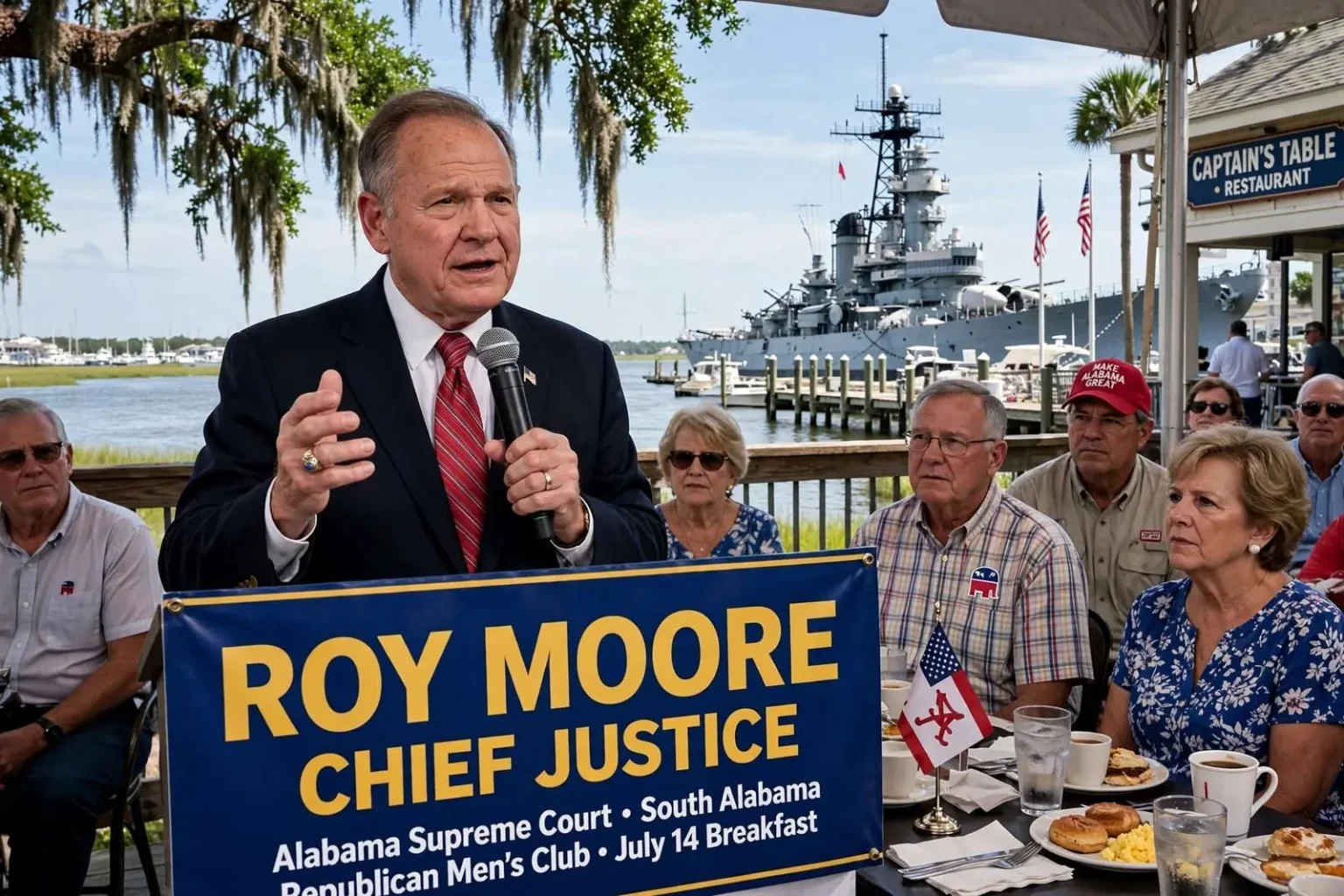
Moore was scheduled to headline the South Alabama Republican Men’s Club monthly breakfast meeting on Saturday, July 14, at 8 a.m. at John Word’s Captain’s Table Restaurant near the USS Alabama Battleship Park on the Causeway in Mobile. Organizers noted that women were welcome to attend, and directed those seeking more information to George E. Williams, senior vice chairman of the Alabama Republican Party.
The venue itself is a fixture of Mobile civic life. Captain’s Table, overlooking the Mobile River beside the mothballed battleship that anchors the park, has long hosted the club’s meetings, where candidates for everything from county commission to statewide office take the microphone in front of a reliable core of the area’s Republican activists. A July appearance there, in the heart of campaign season, put Moore in front of exactly the audience most likely to volunteer, donate and carry his banner through their neighborhoods.
The Causeway location carries its own symbolism for south Alabama. The route across Mobile Bay — the old Bankhead Tunnel approach and the long, low causeway linking Mobile to Baldwin County — is where the region’s two halves meet, and civic organizations on either side draw their membership from both. For a candidate making a coastal swing, it is a natural halfway point.
A Long and Contested Record
Moore arrived on the coast with one of the most familiar and polarizing resumes in Alabama politics. He and his wife, Kayla, have four children. He graduated from the United States Military Academy at West Point in 1969 and earned his law degree from the University of Alabama School of Law in 1977. Between those milestones he served in the Army as a company commander with the Military Police Corps in Vietnam, an experience he frequently cited on the campaign trail as formative to his views on duty and constitutional order.
His legal career began in Etowah County, where he became the county’s first full-time deputy district attorney, serving from 1977 to 1982. In 1984 he opened a private practice in Gadsden, and in 1992 he became a judge of the Sixteenth Judicial Circuit of Alabama, serving there until his election as chief justice in 2000. The circuit judgeship made his name in legal circles; the chief justice race made it a statewide phenomenon, aided by the very controversies that later removed him from office.
Removed, and Running Again
In 2003, Moore was removed from the office of chief justice in a controversy over the installation of a monument to the Ten Commandments in the state judicial building in Montgomery. The granite monument, which Moore had commissioned and installed overnight in the rotunda, set off a federal lawsuit over the Establishment Clause, a federal court order to remove it, and ultimately proceedings that ended his first tenure as the state’s top judicial officer. Supporters cast the fight as a defense of religious acknowledgment in public life; opponents and much of the legal establishment regarded it as a justice defying federal law from his own courtroom building.
In the years since, he had lectured throughout the United States on American history and what he described as the right to acknowledge God, and he served as president of the Foundation for Moral Law in Montgomery, the organization founded around the issues his removal raised. The episode made Moore a national figure in conservative politics and gave his eventual return to the ballot a storyline no other candidate in the race could claim.
His return as the party’s nominee set up an attempt to win back the very post from which he had been removed — a reversal without precedent in modern Alabama judicial politics. The office itself, chief justice of the Alabama Supreme Court, carries administrative authority over the state’s entire judicial system, a statewide election, and a term of six years; it is one of the few judicial positions in America whose occupant is personally a political figure of the first rank.
The race also carried implications beyond Alabama’s borders. To national observers, Moore’s nomination was the latest evidence of the divide between the state’s legal establishment and its conservative grassroots; to Alabama Republicans, it posed the more practical question of what a chief justice owes the courts he administers. The coastal appearances gave the nominee a chance to answer both audiences with the same material — biography, military service, and the constitutional arguments that had defined his career — before the fall campaign put the question to the whole state.
A Fundraiser on the Shore
Beyond the Mobile breakfast, Moore’s coastal swing included a fundraiser in Baldwin County. Dean Young, an unsuccessful GOP congressional candidate, and his wife, Jan, planned to host a meet-and-greet and fundraiser for Moore at their Orange Beach home on Tuesday, June 26, from 6:30 to 8 p.m. Young, a Baldwin County Republican activist and developer whose own congressional campaign had made him a familiar figure along the Eastern Shore, brought to the event the kind of committed local network that turns a candidate’s visit into a working fundraising stop.
Orange Beach in late June is a different campaign environment from a Mobile civic club breakfast. The beach communities are home to Baldwin County’s fastest-growing precincts — voters who have moved to the coast from across the country, many of them registering Republican in a county that has been a party stronghold for a generation. A meet-and-greet in a private home there reaches donors and influencers, and the money raised along the coast funds the advertising that reaches everyone else.
The pairing of a free public breakfast in Mobile with a private evening reception in Orange Beach reflected the twin tasks facing any statewide candidate on the coast: rallying the faithful and raising the money to compete. Public appearances build the volunteer base and generate the local coverage; private events generate the campaign funds that buy television time in the Mobile-Pensacola market, which reaches voters on both sides of the bay.
Why the Coast Mattered to the Race
Southwest Alabama’s weight in statewide elections is difficult to overstate. Mobile and Baldwin counties together cast one of the largest blocs of Republican primary and general election votes in the state, and the two counties’ coastal media market carries a candidate’s message into hundreds of thousands of living rooms. Candidates who skip the region do so at their peril; those who work it carefully, as Moore’s calendar showed, treat Mobile County and Baldwin County as distinct audiences with distinct civic habits — club politics on one side of the bay, resort and development circles on the other.
For the men’s club and its guests, the July gathering promised a marquee speaker whose history guaranteed a full room. For Moore, the Mobile Bay area offered a receptive audience as he pressed a campaign built on a record that supporters and critics alike knew well. With the general election still months away, the appearances placed southwest Alabama squarely on the map of a high-profile judicial contest, and gave local Republicans an early chance to size up a nominee whose name had been at the center of Alabama’s political debates for more than a decade.
Local party organizations like the South Alabama Republican Men’s Club occupy an outsized place in that machinery. Their monthly meetings are where statewide candidates appear first, where volunteers sign up, and where the county organizations that turn out Election Day votes are recruited. A nominee who fills the breakfast room and the fundraiser house within the same week leaves the coast with both halves of a working campaign — the people and the money — already committed.
Whether a candidate so well known needed to campaign at all was itself part of the conversation among local Republicans. Moore’s camp argued that name recognition without fresh appearances fades into caricature, and that voters deserved to hear from the man himself in the places where they vote — a breakfast room on the Causeway, a living room in Orange Beach, and the long stretch of coastal Alabama between them.