Absentee Requests Sag Again in Mobile County, Pointing to Low Turnout on Election Day
Mobile County's probate judge reported 2,824 absentee ballot requests and about 1,200 returns days before the November 2006 election, figures he said pointed to a low turnout.
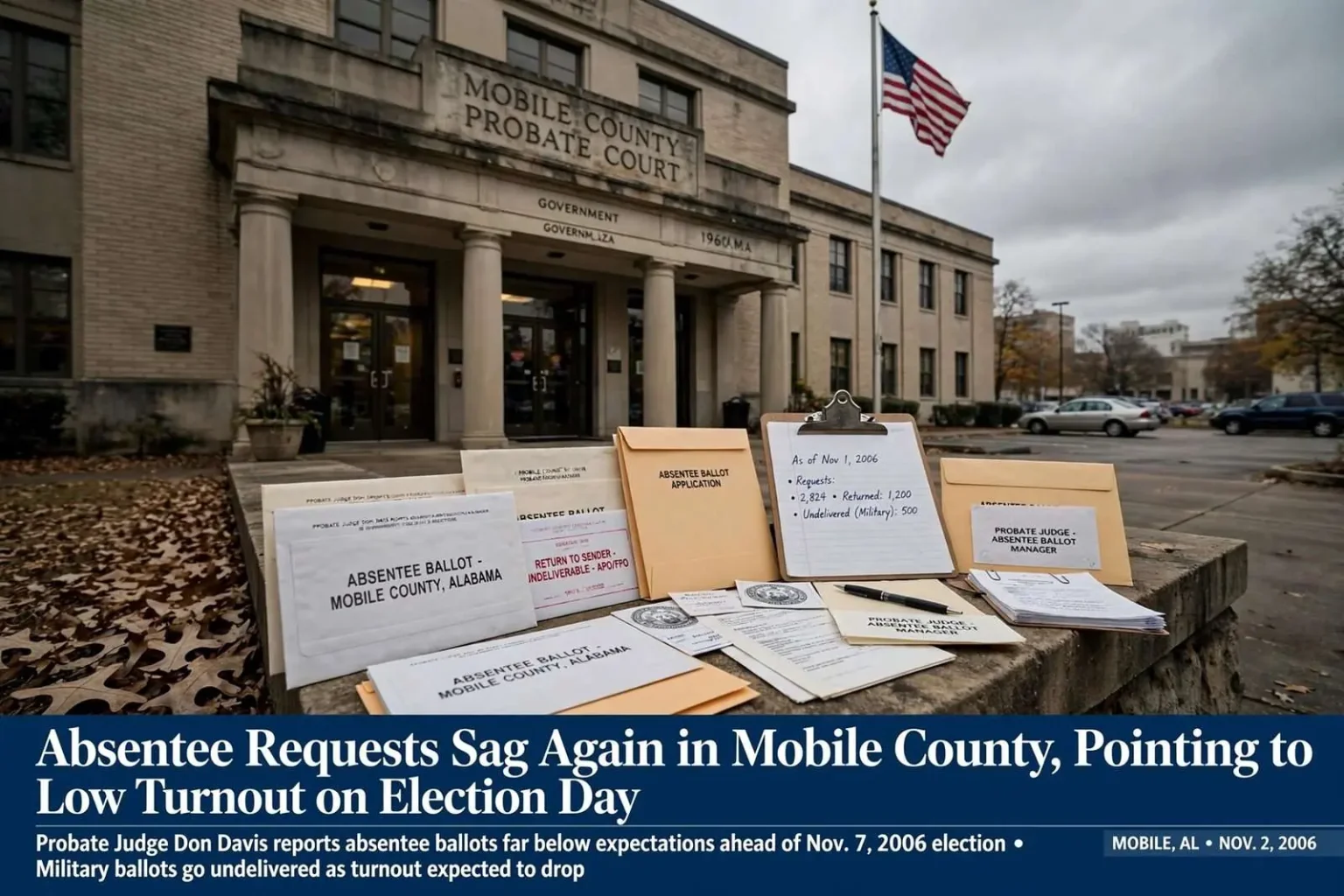
Mobile County Probate Judge Don Davis offered a discouraging forecast for voter participation days before the November 2006 general election, reporting absentee ballot figures that he said were significantly below expectations. Davis, whose office oversees elections in Alabama’s second-most-populous county, had been tracking the absentee numbers closely in the final week of the campaign, and what he saw pointed unmistakably toward a quiet Election Day.
Davis had said the previous week that requests for absentee ballots were sluggish. He then reported that the pace had picked up, an encouraging sign that turnout on Tuesday, Nov. 7 might not be as low as once feared. But a further update swung the pendulum back the other way.
The numbers “As I indicated to you some days ago, there was a pick up in absentee ballot requests,” Davis said. “That has slowed down.”
As of the close of business on Wednesday, Nov. 1, the county’s Absentee Ballot Manager had received 2,824 requests for absentee ballots. Of those, roughly 500 related to active duty members of the military or their dependents. Ballot materials were sent to those voters, but the materials were returned undelivered, a reflection of how difficult it was in 2006 to reach service members and their families who had moved, deployed or been reassigned. Approximately 1,200 absentee ballots had been returned as of the same date.
“These figures are significantly less than expected and indicate that there will be low voter turnout on Tuesday,” Davis said.
Why Absentee Numbers Were Read as a Signal
Absentee returns have long served election officials as an early indicator, and not merely because they are the only votes that can be counted before the polls open. Voters motivated enough to request a ballot, complete it and return it are, as a class, more engaged than average. When their numbers lag, officials tend to assume that the broader electorate is even less stirred. In a county of Mobile’s size, fewer than 3,000 absentee requests was a thin figure. It suggested an electorate that was not being pulled to the polls by any single contest.
The mechanics matter, too. Alabama’s absentee process requires a voter to apply in person or by mail with an excuse — travel, work, illness, military service or being out of the county on Election Day among them — and the application, ballot and affidavit envelope all must be completed and notarized or witnessed. A slow trickle of those applications by early November means the most reliable voters had largely made their plans, and no one else was planning to vote at all.
The Election in Question
The 2006 general election in Alabama was not short of consequential races. Gov. Bob Riley faced Democrat Lucy Baxley. The lieutenant governor’s race pitted Republican Luther Strange against Democrat Jim Folsom. Legislative seats, judgeships and school board positions were all on the ballot, including a state Senate contest and a Mobile County school board race that had drawn late money and sharp attention.
Locally, Mobile County voters were also weighing in on constitutional amendments and local measures, and down the ballot the county’s legislative delegation seats — stretching from downtown Mobile to the growing suburbs along Schillinger Road and in West Mobile — carried real consequences for how the county would be represented in Montgomery. But none of the contests had generated the kind of high-spending, saturation-level campaign that pulls infrequent voters to the polls in a presidential year.
Yet a midterm election without a presidential contest at the top of the ticket has a persistent habit of producing modest turnout, and 2006 in Mobile County appeared to be running true to form. That mattered a great deal to campaigns. Low turnout tends to reward organization, incumbency and the ability to get committed supporters physically to the polls, and it tends to punish challengers relying on a broad but shallow appeal.
The Military Ballot Problem
Perhaps the most striking figure in Davis’s report was the 500 undelivered ballots sent to service members and their dependents. In the fifth year of a war being fought largely by deployed and frequently relocated units, roughly one in six absentee ballots issued in Mobile County never reached the voter it was intended for. The problem was national, not local, and Congress would revisit military and overseas voting rules repeatedly in the years that followed, tightening deadlines for mailing ballots and eventually pushing states toward electronic delivery.
Mobile County’s experience reflected a nationwide gap. With the Gulf Coast’s heavy concentration of military families — sailors and civilians tied to the region’s shipbuilding industry, along with soldiers, airmen and Marines with ties to installations across the Southeast — the county routinely issues a large share of its absentee ballots to voters in uniform. When those voters are stationed overseas or deployed at sea, the ballot has to travel through APO and FPO mail systems, and a forwarding address that is out of date by a few weeks can leave a ballot circling with nowhere to land.
The reforms that followed — most notably the federal MOVE Act passed in 2009, which required states to send absentee ballots to overseas voters at least 45 days before a federal election — addressed part of the problem by giving ballots time to make the round trip. In 2006, though, the practical reality was that a substantial share of the county’s uniformed voters were effectively disenfranchised by the postal system.
What It Meant on Nov. 7
Election officials rarely make predictions, and probate judges in Alabama, who oversee elections at the county level, are ordinarily careful people. When one of them says flatly that the numbers indicate low turnout, campaigns listen.
For candidates in Mobile County heading into the final weekend, the message was clear enough: the electorate would be small, and the votes would go to whoever could find and move their own people. Persuasion was largely finished. What remained was arithmetic — the poll watchers assigned to each precinct, the rides offered to elderly supporters, the phone banks that could confirm which neighbors had actually voted. In a low-turnout election, those ground-game details decide races that would be lost in a larger electorate.
Low-turnout elections also shift the weight of individual votes. A county commission seat, a school board district or a legislative primary can be decided by a few hundred ballots when only a fraction of registered voters show up, which is why organized interests and single-issue campaigns often find midterm years an efficient place to spend their energy. The 2006 absentee numbers suggested Mobile County would be exactly that kind of year — one where the votes that mattered most belonged to the people who, unlike the 500 whose ballots never arrived, were actually there to cast them.
The Absentee Numbers in Context
To understand how thin those figures were, it helps to look at what a busier year looks like. In presidential election years, Mobile County routinely processes absentee requests in numbers several times higher than the 2006 tally, and the Absentee Ballot Manager’s office — the small division of the probate court that handles applications, witness forms and the security of returned ballots — becomes one of the busiest rooms in Government Plaza in the weeks before Election Day. The office also serves as the first line of scrutiny for the absentee process itself, checking signatures, verifying witnesses and flagging ballots that arrive without the required affidavits.
Absentee voting also carries a particular history in Mobile County politics. Because the ballots are cast early and counted separately, and because the applications pass through a single county office, absentee numbers are watched closely by campaigns and party organizations alike, both as a turnout barometer and as a proxy for which candidates have effective organizations among voters who need help getting to the ballot at all — nursing home residents, shut-ins and, every election cycle, members of the military. A weak absentee showing for a candidate who was expected to rely on such voters is one more signal that an organization is not performing.
Davis’s update, delivered in the final days before the election, thus did more than forecast low turnout. It told every campaign in the county that the election would be decided at the precinct level, by whoever could identify and transport their remaining supporters. It told election officials to brace for precinct workers with little to do. And it underscored a structural problem that would take years of federal reform to address — that in a war-time election year, hundreds of the county’s own voters would want to participate but never receive the chance.
The 2006 election would go on to be counted without major local controversy, but the figures Davis reported in early November remained a snapshot of a persistent reality in American midterm politics: turnout falls, the electorate narrows, and the voters whose ballots travel the farthest are often the ones most likely to be lost along the way. For Mobile County, the lesson of the slow absentee season was one that election officials across the Gulf Coast would carry into the reform debates that followed.