Pastor’s Early Arrival Credited With Sparing Mobile’s Community of Christ Church From Total Loss
A Community of Christ Church fire on Azalea Road in Mobile was caught early by the pastor, who found flames in a copy room and called 911 before the blaze could consume the building.
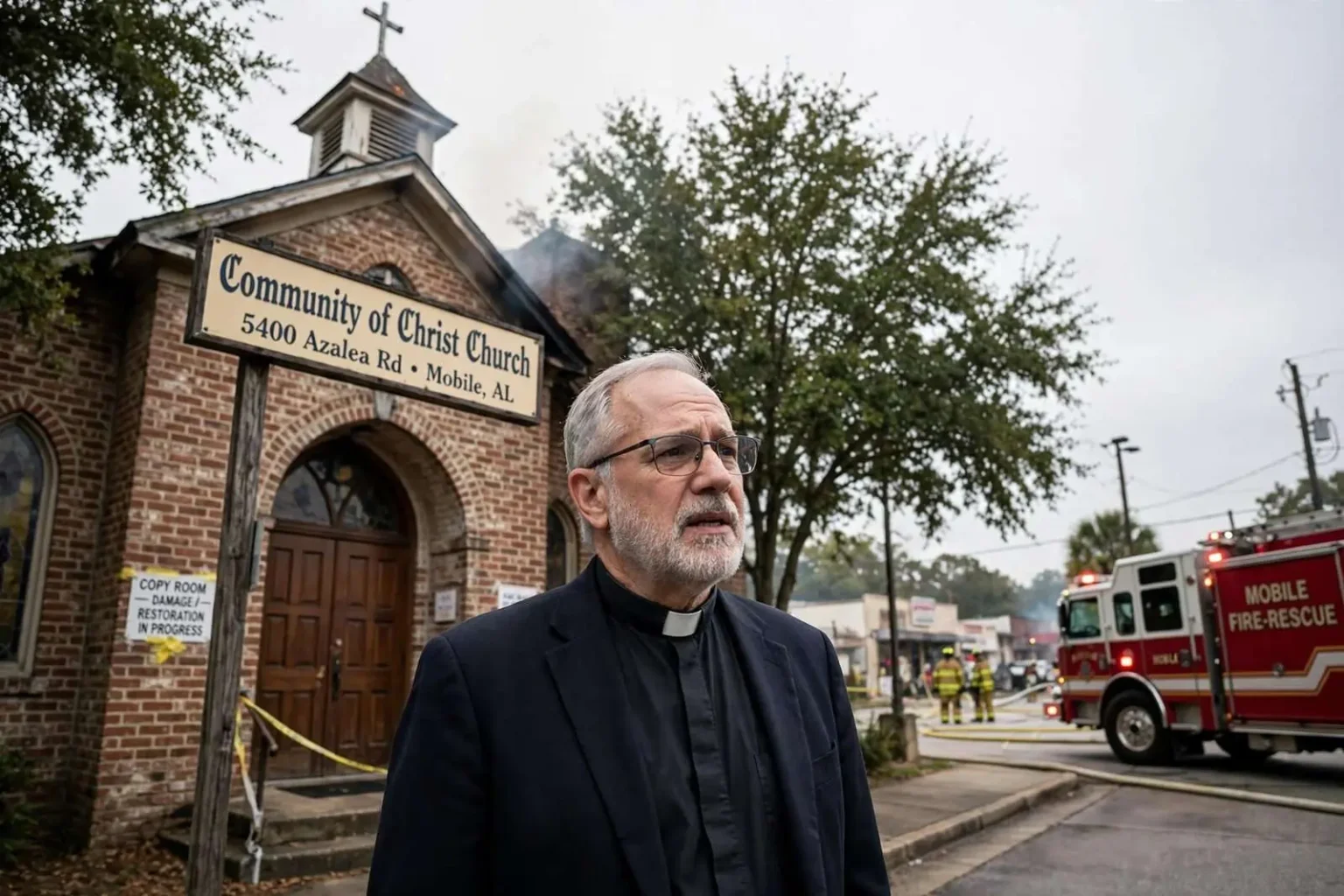
A fire that broke out inside the Community of Christ Church on Azalea Road in Mobile was contained before it could destroy the building, and the congregation’s pastor said he was thankful he happened to be on the property when the flames appeared. The Rev. Wayne Gibson told reporters that his presence at the church that Wednesday morning likely made the difference between a manageable repair and a total loss.
“One good thing is that I was here,” Gibson said. “The next thing is, no one else was here so nobody got hurt.”
The fire, which Gibson said he believes began with an electrical problem, broke out in a copy room inside the church and was caught in its earliest stages. By the time firefighters arrived, the damage was confined to the room where it started, though smoke and heat touched other parts of the building. For a congregation that worships in an older structure along one of west Mobile’s busier commercial corridors, the outcome could hardly have been better.
For Gibson, the sequence of small details mattered as much as the big ones. The air conditioning he had turned down an hour earlier meant the building was quieter than usual, which may be why the popping noise stood out at all. The breaker panel he was walking toward put him in the right part of the building. The copy room door he opened gave him a look at the fire while it was still small enough to contain with a closed door and a quick phone call.
How the fire was discovered
By Gibson’s account, he had arrived at the church around 8 a.m. About an hour and a half later, near 9:30, he turned the air conditioning down. Roughly an hour after that, he heard a loud popping noise somewhere inside the building and went to investigate.
When the power stopped working, he moved toward a breaker to check it. Along the way he opened the door to a copy room and was met with a wall of fire.
“Flames going all the way up the wall to the ceiling,” he recalled.
Gibson said he immediately shut the door to slow the spread and dialed 911 from his cellphone. He believes the fire began with an electrical problem. Closing the door was a decision fire safety experts would endorse: an unventilated room is starved of the fresh oxygen a fire needs to grow, and a closed door can hold back flames and smoke long enough for responders to arrive.
Firefighters responded to what was described as a three-alarm call, and crews worked to keep the blaze from moving beyond the room where it started.
A three-alarm response brings additional engines and ladder companies to a scene, a escalation reserved for fires that threaten to grow beyond what the first-arriving crews can handle. In this case the extra manpower served as insurance, allowing incident commanders to rotate crews and ensure the fire was fully knocked down before it could extend into the attic or roof structure, where church fires so often turn deadly for the building itself.
The response left the church standing and, more importantly, left every person who might have been inside the building unharmed. Gibson was the only one on the property when the fire began, and his early arrival meant the fire was reported within minutes of ignition rather than after it had burned unchecked for hours.
A congregation counting its blessings
The timing of the fire was especially difficult. The church had planned a family get-together and cookout for that evening, a gathering Gibson said would most likely have to be canceled.
He expected the sanctuary would still be usable for worship, though without air conditioning until repairs could be made. In south Alabama’s climate, worshiping without air conditioning is no small sacrifice, but congregations in the region have endured far worse, and Gibson said the church intended to keep its schedule intact as much as conditions allowed.
Even so, the pastor struck an unmistakably grateful tone. He noted that had no one been present, the fire could have burned unchecked for far longer. Instead, quick action kept the damage confined and, most importantly, kept anyone from being injured.
“The good Lord will take care of us,” Gibson said. “Always has and probably always will.”
For a congregation of modest size, the difference between a damaged copy room and a destroyed sanctuary is measured in more than money. A total loss would have meant finding a temporary home for worship, replacing hymnals, furniture and records, and rebuilding at a pace set by insurance adjusters and contractors. Instead, members faced repairs and cleanup, with the church’s identity and gathering place intact.
Electrical fires and older buildings
The incident was a reminder of a hazard familiar to congregations and small organizations across Mobile that occupy older structures. Electrical faults can smolder or ignite with little warning, and a popping sound followed by a loss of power, as Gibson experienced, can be an early signal that something has gone wrong behind a wall or ceiling.
Fire officials have long encouraged building custodians to treat unexplained electrical failures seriously and to have wiring inspected when problems recur. Aging wiring, overloaded circuits and aging appliances are among the leading contributors to electrical fires in houses of worship, schools and small offices, buildings that often sit unoccupied for long stretches of the week when no one is present to notice the early signs.
Fire safety officials recommend that organizations occupying older buildings have their electrical systems inspected periodically, keep breaker panels accessible and clearly labeled, and treat any burning smell, flickering power or unexplained trip of a breaker as a warning rather than an inconvenience. Smoke detectors and, where possible, monitored fire alarms add a layer of protection for the hours when a building sits empty.
In this case, the pastor’s decision to look into the noise rather than wait proved to be the crucial step. Had he assumed the popping sound was a minor mechanical issue and left it until the next day, the fire would have had a full night to spread through an empty building, and the three-alarm response would likely have been fighting a structure fire rather than confining a room fire.
Members of the congregation arrived throughout the morning as word spread, many of them expecting to see a ruined building and instead finding a church with one damaged room. Gibson greeted them outside, recounting the morning’s events and repeating the two things he wanted everyone to know: the damage was contained, and no one had been hurt.
What comes next for the congregation
For the members of the Community of Christ Church, the days ahead would involve cleanup and repairs, particularly to the copy room and the areas touched by smoke and heat. Smoke damage travels farther than fire, settling into carpets, upholstery and air ducts, and the restoration work typically involves cleaning surfaces, replacing filters and treating the building to remove lingering odor.
The church sits on Azalea Road, a thoroughfare that cuts through a stretch of west Mobile lined with churches, offices and small businesses. Congregations along the corridor range in size and resources, and many occupy buildings that have served their members for decades. The Community of Christ, a denomination with congregations across the Gulf South, counts among its members many who have attended the Azalea Road church for much of their lives.
But as the congregation gathered its bearings, the prevailing sentiment was relief. The building still stood, the sanctuary remained, and the people who called the church home were safe.
Gibson said he intended to keep the doors open for worship as soon as conditions allowed, trusting that the congregation would weather the setback much as it had weathered others. The fire, he suggested, was a hardship but not a defeat, and one made far smaller by the simple fact that he had been there to catch it.
The canceled cookout, the air conditioning awaiting repair, the copy room needing rebuilding — all of it, members said, was bearable in light of what did not happen. No one was hurt. The flames never left the room where they began. And a pastor who happened to arrive at work early heard a noise he could have ignored, and did not.
Insurance adjusters and contractors would set the pace of the repair work, and Gibson acknowledged the process would take time. In the meantime, church offices and classrooms outside the damaged area remained usable, and the congregation planned to carry on with Bible study and midweek activities alongside Sunday worship, adjusting its routine where the restoration work required it.
Fire investigators with the Mobile Fire-Rescue Department were expected to review the scene to confirm the origin of the blaze, though Gibson’s account of the popping noise and the loss of power pointed squarely at an electrical cause. Their findings would go into the incident report that accompanies any working fire, and would help the church’s insurer document what happened in the copy room that Wednesday morning.
For congregations across Mobile and the Gulf Coast, the story offers an understated lesson in preparedness: the difference between a scare and a catastrophe is often measured in minutes, and it belongs to whoever happens to be there when something first goes wrong.