Mobile GOP Leader Jerry Lathan Calls on RNC Chairman Michael Steele to Resign
In a letter to the Alabama Republican Executive Committee, Lathan cited private jets, limousines and luxury hotels, warning that donors are balking months before the November elections.
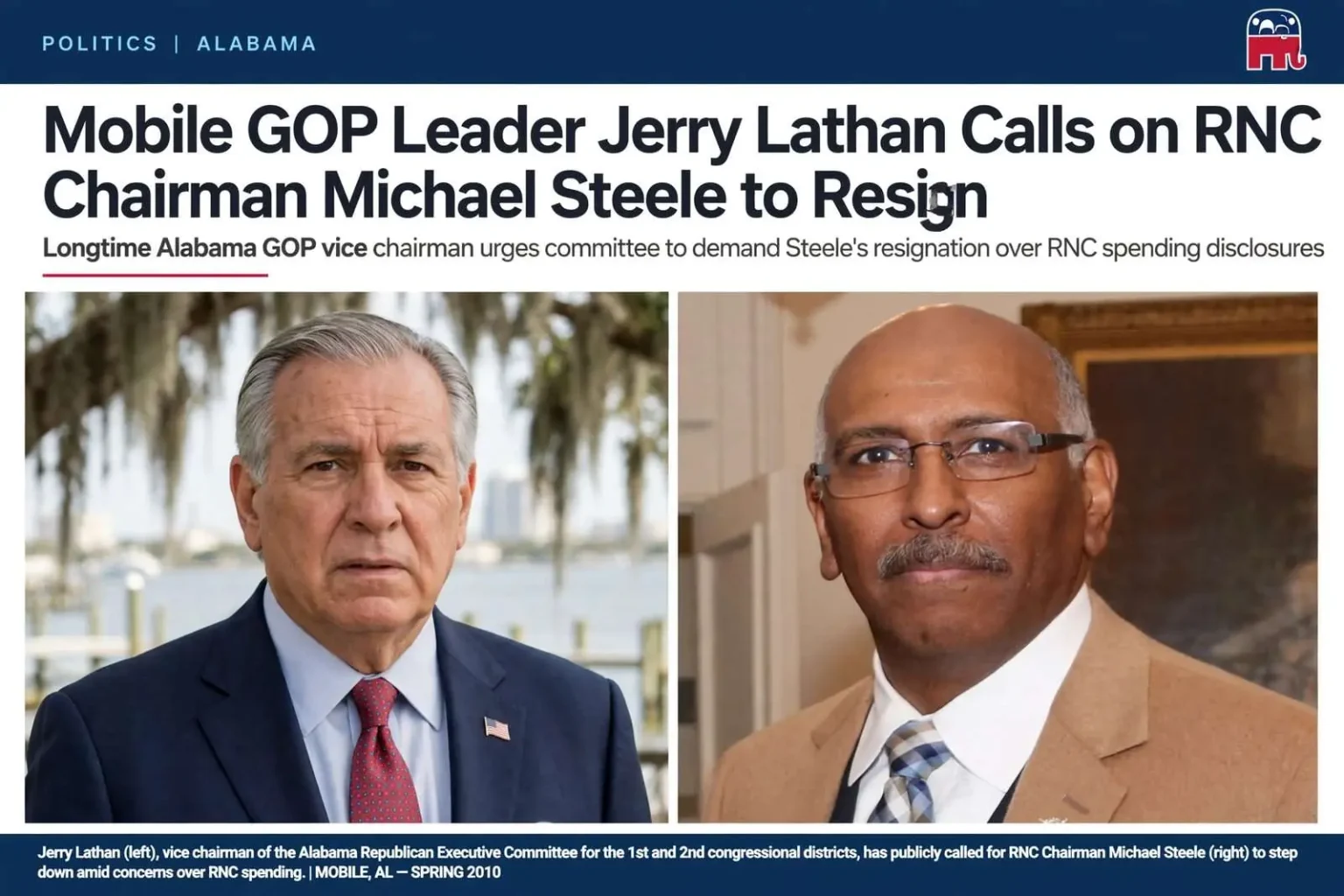
Jerry Lathan of Mobile, a longtime Republican leader and vice chairman of the Alabama Republican Executive Committee for the 1st and 2nd congressional districts, has written to his fellow committee members urging them to call for the resignation of Republican National Committee Chairman Michael Steele. The letter is a notable public break by a senior figure in south Alabama Republican circles with the national leadership of his own party, seven months before an election Republicans expect to win.
Lathan’s district vice chairmanship puts him inside the machinery of the state party, where committee members from the congressional districts serve as the connective tissue between the Republican National Committee and Alabama’s grass roots. A public letter from someone in that position is not a blogger’s complaint — it is a signal from inside the tent, from a leader whose days are spent organizing the precinct-level volunteers the party will depend on in November.
“I very rarely make a public statement of this type,” Lathan wrote, “but I believe circumstances require me to share a concern I have with our Republican National Committee.” The circumstances, as the letter laid out, were financial — and the timing, in the months before a midterm election that could hand Republicans control of Congress, is what made the public airing remarkable.
‘This Is Unconscionable’
The concern is money — specifically, how the RNC has been spending it. Lathan cited federal disclosure records showing the committee spent $17,514 on private aircraft in the month of February alone, along with $12,691 on limousines in the same period. News reports of a February RNC trip to California, he noted, included a $9,099 stop at the Beverly Hills Hotel and $6,596 at the Four Seasons.
The numbers, drawn from the committee’s own filings with the Federal Election Commission, landed in a political climate that made them explosive. Alabama’s unemployment sat near the double-digit mark the letter invoked, small businesses along the Gulf Coast were still cutting hours, and the party’s national message that spring centered on Washington’s spending habits. Every private jet receipt and hotel bill was, in effect, a ready-made advertisement for the other side.
Lathan also pointed out that several months into Steele’s tenure, the committee’s spending had already prompted a resolution requiring checks to be signed by at least two RNC officers and contracts over $100,000 to go out for competitive bidding — an extraordinary internal check on a sitting chairman. Such controls are the sort imposed on organizations in crisis, not on committees at the height of their fortunes, and their existence a year into a chairmanship told its own story about the confidence of the committee’s own members.
“This exhibits poor leadership in the most prosperous of times,” Lathan wrote. “In this tough economy with news of 10% unemployment, and ever increasing taxes from the Democrats, this is unconscionable.”
The Alabama Angle
Lathan said he had spoken with Alabama’s three representatives on the RNC — state party chairman Mike Hubbard, Paul Reynolds and Bettye Fine Collins — and that each shares his concerns. He asked committee members to contact them and press them to ask Steele to step aside. “I hope you will join me in asking them to ask Chairman Steele to resign for the good of our party.”
Alabama’s trio on the national committee carried weight beyond the state’s size. Hubbard, the state chairman, was in the middle of building Alabama’s Republican supermajority ambitions from Auburn; Reynolds, the national committeeman, and Collins, the national committeewoman and a veteran Jefferson County commissioner, sat in the small circle whose voices the national committee actually hears. A unified Alabama delegation raising the question of resignation would not unseat a chairman by itself, but it would add a Deep South voice to a growing chorus.
Steele’s chairmanship had been turbulent from the start. Elected in early 2009 after six rounds of balloting, the former Maryland lieutenant governor became the party’s first African American national chairman and its most visible spokesman during the opening battles of the Obama presidency. He was also, by the account of many committee members, a costly one: a high-profile book tour, chartered flights, a heavier communications staff and a stream of comments that forced party officials into cleanup duty.
The spending disclosures Lathan cited were only the latest round. Committee members had already moved the internal controls he referenced, and state parties — the organizations that actually depend on RNC transfers to run their fall campaigns — had begun to complain that the money they counted on was being consumed by overhead at the national level. In an election year, those transfers matter: they fund the voter-contact programs, the absentee operations and the staff that decide close races.
Why a Midterm Chairmanship Matters So Much
The timing explains the frustration. Midterm elections are the Republican Party’s opportunity to convert economic anxiety and Democratic overreach into congressional and gubernatorial seats, and the national committee is supposed to be the engine of that effort. A chairman distracted by spending controversies is a chairman whose message operation stutters at the exact moment it matters most — and every story about hotel bills is a story not about the opposition’s record.
The stakes were particularly clear in Alabama, where the party had spent a decade consolidating control and saw 2010 as the year to complete it. The state GOP had ambitious targets: legislative chambers that had not been in Republican hands since Reconstruction, a governor’s race with an open seat, and a handful of congressional districts where redistricting-era Democrats looked vulnerable. None of that depended on the RNC chairman personally, but all of it depended on money, coordination and credibility — the three currencies Steele’s controversies were burning through.
Lathan’s letter also reflected a broader impatience among the party’s operational layer. County and district chairmen, vice chairmen and state committee members are the people who must actually execute a fall campaign, and their complaints about the national committee tend to be practical rather than ideological: less money transferred to the states, more spent on travel and consultants, and a chairman whose remarks require explaining. When that layer starts speaking publicly, the leadership’s position is weaker than any internal vote count suggests.
Whether Steele would survive the season remained an open question in the spring of 2010. Chairmen serve at the pleasure of the 168-member national committee, and while mid-cycle removals are rare, the combination of disclosure records, internal controls and public letters from state leaders had put several chairmen’s predecessors out of business. Lathan’s letter did not claim to speak for the state party — but it made certain that Alabama’s grass roots would not be counted among the chairman’s quiet supporters.
The View From South Alabama
For the Mobile area’s Republicans, the letter carried the weight of local standing. Lathan has been a fixture of the party’s organization across the Gulf Coast, part of the generation of activists who built the GOP’s dominance in a region that once sent conservative Democrats to every office in sight. When a leader of that generation breaks with the national committee, it is read locally as worry — worry that a winnable election year will be compromised by a self-inflicted distraction.
The complaint, notably, was not about policy. Lathan’s letter did not quarrel with Steele’s ideology or with the party’s direction on issues; it quarreled with stewardship. That distinction matters in a midterm year built around fiscal discipline. A party running on the argument that Washington cannot manage money cannot afford a national committee that spends $17,514 on private aircraft in a single month, and Lathan’s letter pressed the point in exactly the language — unemployment, taxes, the economy — that the fall campaign was expected to use.
The episode was also a preview of the accountability that national chairmen face from their own 168 members. State party leaders, district vice chairmen and national committeemen are not national figures; they answer to local activists who notice when the committee’s overhead grows while the transfers shrink. Letters like Lathan’s circulate among exactly that audience, and their accumulation has historically mattered more than any single state’s official position.
By urging his fellow committee members to lobby Alabama’s three RNC representatives, Lathan sketched the practical path a resignation push would take — a groundswell of state-level pressure aimed at the small circle of representatives who actually vote on the chairmanship. Whether that pressure would force Steele from the race before November, or simply harden the committee’s internal controls, would depend on weeks Lathan could not control. What he controlled was the message from Mobile: that south Alabama’s Republicans wanted the spending stopped, the leadership changed, and the election year back where it belonged — on the opposition.