McCain Adviser: Senator Has Made No Endorsement in Mobile Mayor’s Race
A Sam Jones mailer highlighting his Navy service under John McCain drew a pointed clarification from the senator's political adviser: McCain had endorsed no one in Mobile's mayoral election.
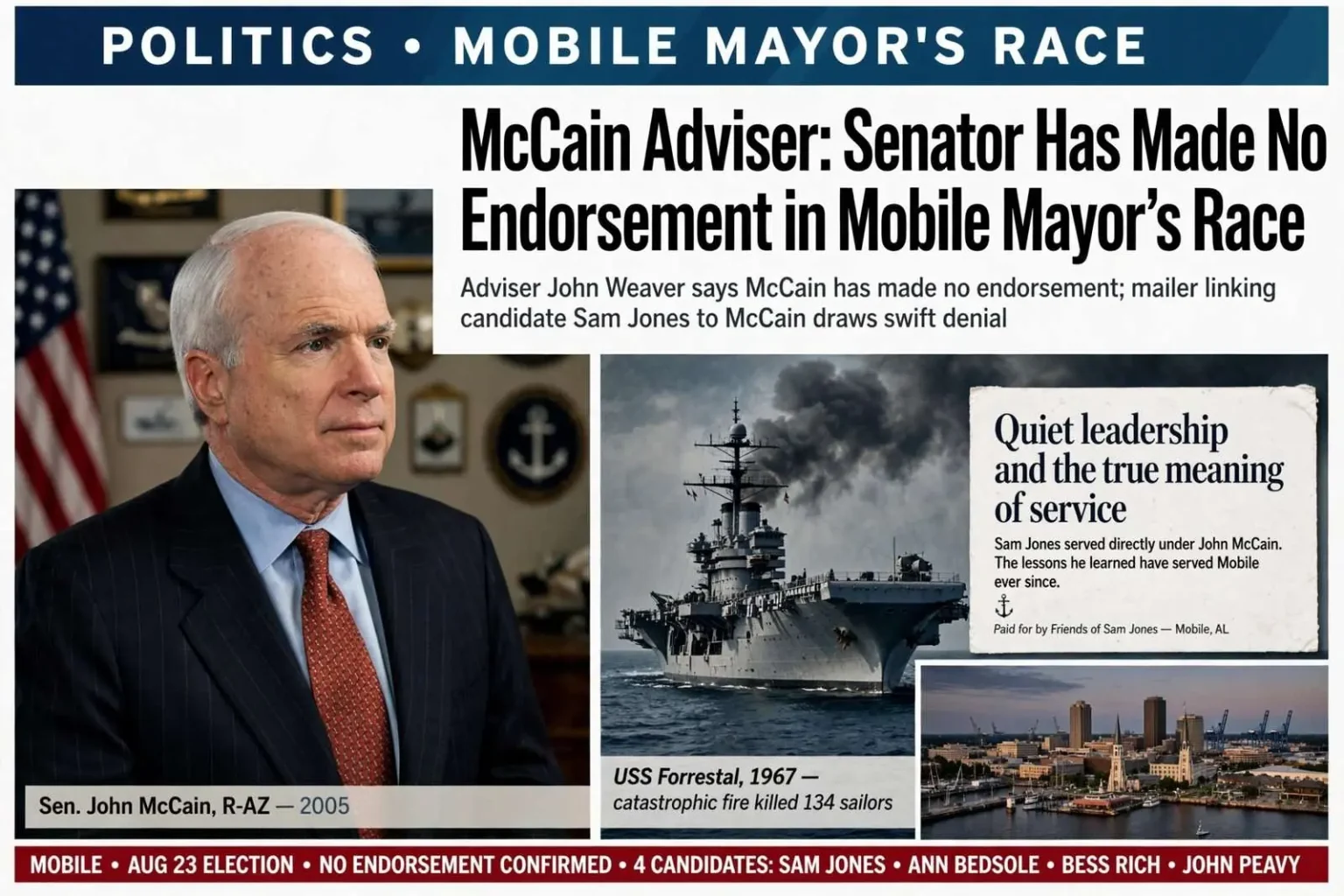
A direct mail piece linking Mobile mayoral candidate Sam Jones to U.S. Sen. John McCain drew a sharp clarification from the Arizona Republican’s camp, with McCain’s political adviser saying flatly that the senator had made no endorsement in Mobile’s Aug. 23 election — and that if he did back anyone, it would likely be one of Jones’ three opponents.
The mailer
The piece, headlined “Quiet leadership and the true meaning of service,” drew repeatedly on Jones’ military record and his connection to McCain during the Vietnam era. Above a photograph of a warship, the copy read: “At an early age, in a difficult time, Sam Jones served directly under John McCain. The lessons he learned have served Mobile ever since.”
Jones served aboard the USS Forrestal during the Vietnam era as a flight deck troubleshooter. The mailer continued: “After Vietnam, Sam re-enlisted and reported directly to Executive Officer John McCain at Cecil Field Naval Air Station as Equal Opportunity Officer and Race Relations Education Specialist.”
“McCain and Sam shared an understanding — it doesn’t matter what your background or where you come from, in war you have to be able to trust your life to the brave soul fighting beside you,” the piece said.
The Forrestal connection was real and heavy history in the Navy. The carrier suffered a catastrophic fire off Vietnam in 1967 that killed 134 sailors, and McCain — then a young aviator — survived it before his later shootdown and years as a prisoner of war in Hanoi. Cecil Field, near Jacksonville, Florida, was a busy East Coast naval air station where McCain served in the years after his release. A candidate invoking those postings was invoking chapters of McCain’s biography that most Americans knew well by 2005, the year the senator would come within a few states of the Republican presidential nomination.
The response from Arizona
John Weaver, McCain’s political adviser, said the senator appreciated Jones’ service but had taken no side in the Mobile race.
“While he appreciates Mr. Jones’ service to the country, Sen. McCain has made no endorsement in the mayor’s race in Mobile,” Weaver said. “There should be no inference by Mr. Jones or anyone else that he has.”
Weaver went further, noting that if McCain were to lend his name to a candidate at any level, he would do so as a Republican supporting candidates who espouse Republican principles. Jones had held office on the Mobile County Commission as a Democrat for more than eighteen years, while his three opponents — Ann Bedsole, Bess Rich and John Peavy — had all either held or sought office as Republicans. Mobile’s city election is nonpartisan and carries no party labels on the ballot.
“Obviously, the senator is not involved in any way in the mayor’s race in Mobile and clearly the senator doesn’t even know the other candidates,” Weaver said.
The statement’s force was notable. Advisers to national figures usually ignore a mayoral race in a Gulf Coast city of fewer than 200,000 people; Weaver not only denied the endorsement but volunteered the partisan direction McCain would have taken — a reminder that behind a nominally nonpartisan ballot, national Republican politics was watching, and choosing sides mattered.
The Jones campaign’s position
The Jones campaign issued a statement that did not retreat from the substance of the mailer but denied claiming any endorsement.
“The most defining period in my life were the years I spent serving our country in the U.S. Navy,” the statement read. “The lessons I learned in the Navy, and specifically, while serving with Executive Officer John McCain, have helped define who I am today, and the way I go about serving our community. At no time have I asked or expected Senator McCain to get involved in the mayor’s race, nor have I suggested that he has endorsed my campaign.”
The distinction the campaign was drawing — between invoking a shared history and claiming a blessing — is one that campaign mail has long tested. A photograph of a ship, a famous name and a sentence about lessons learned can carry an implication that no lawyer would call an endorsement, and that no adviser in Arizona was willing to let stand unchallenged.
In a military city, the distinction mattered more than usual. Mobile’s economy and identity are tied to its naval history — from the decommissioned warships at the Alabama State Docks to the thousands of veterans who settled in the region after their service — and a candidate’s record in uniform has always carried particular weight here. The mailer’s authors understood that, and so did Weaver, which is why the exchange unfolded so quickly in the final week of the race.
Jones’ record
Jones enlisted in the Navy and served nine years, including duty as a community services coordinator. After his military service he returned to Mobile and became executive director of Mobile Community Action, a public service agency, where from 1980 to 1987 he supervised more than 240 employees and administered a $5 million annual budget, according to his campaign. He was elected to the Mobile County Commission in 1987.
The biography assembled a classic Mobile political résumé: enlisted service, a decade running an anti-poverty agency that touched thousands of households, and then eighteen years on the county commission, the body that controls roads, drainage and rural services across most of Mobile County. It was a career built on constituency service rather than headline legislation — which was precisely the theme his mailer pressed: quiet leadership.
The stakes
The exchange came less than a week before Mobile voters went to the polls. A runoff was scheduled for Sept. 13 if no candidate took more than fifty percent of the vote on Aug. 23. Incumbent Mayor Mike Dow, after four terms, had decided not to seek reelection, leaving the office open for the first time in sixteen years.
McCain, then a senator with a national profile built substantially on his own Navy service and captivity in Vietnam, was a name with genuine currency across party lines in a military-heavy Gulf Coast city — which was precisely why the mailer had been sent, and precisely why his advisers moved quickly to draw a line around it.
With four credible candidates splitting an open field, the campaign’s final days were a contest for recognition and contrast as much as policy. Each of the rivals — Bedsole, Rich and Peavy — carried long records in Republican politics that a nonpartisan ballot would blur; Jones, the lone Democrat in the race, leaned on the biography that the mailer distilled. The question the McCain episode crystallized was whether borrowed stature helps a candidate who must still win over a city that has never elected a Black mayor — and whether a denial from Arizona would be the last word voters read before they voted.
How the race got here
The mailer fight capped months of positioning for an office with no incumbent for the first time since 1989. Dow had announced his retirement after four terms spent steering the city through the loss of Brookley Air Force Base, the expansion of the state docks and the rebirth of downtown, and his departure set off the widest-open mayoral field Mobile had seen in a generation.
Bedsole brought the longest résumé of the three challengers: a former state senator, a former Mobile City Council member and a onetime candidate for the Republican gubernatorial nomination, with decades of relationships in Montgomery and in Washington. Rich had served on the City Council and built a reputation as the council’s most persistent questioner of budgets and contracts — a record she positioned as accountability for a city government that had grown large and expensive. Peavy, the District 7 councilman, had returned to office through a special election and had collected early financial backing from a state-level political action committee, giving him a war chest unusual for a municipal race.
Jones, the only Democrat among the four, had spent eighteen years on the Mobile County Commission representing a district that reached across the county’s western communities. His campaign leaned on that record of constituent work and on the argument that the city’s next mayor needed to unite a city whose population was split almost evenly between Black and white residents — a task, his literature argued, that his own history across both worlds equipped him for uniquely.
Mail in a nonpartisan city race
Direct mail has long been the workhorse of Mobile city elections. With no party label to do the sorting, candidates use mail pieces to introduce themselves, define their opponents and — when a race is crowded and turnout is low — borrow credibility from wherever it can be found. Military service is the most reliable currency of all in a city shaped by the Navy, the shipyards and the veterans who stayed after their tours.
That is what made the McCain piece a calculated risk rather than a gaffe. Its claims were factual: Jones had served under McCain, first aboard the Forrestal and later at Cecil Field. What it implied — that the ties remained warm, that the senator’s esteem followed — was what Weaver’s statement dismantled within days. In the arithmetic of a low-turnout election, a single mail piece can be the difference between a runoff spot and an exit, and a denial from a famous endorser can erase the margin it was meant to create.
The episode also previewed a structural fact of Mobile politics that the campaigns themselves seldom said aloud. The city’s elections are officially nonpartisan, but its voting patterns, its donor networks and its political personnel are thoroughly partisan, and every race for citywide office involves a Republican-leaning electorate, or a split one, evaluating candidates who carry invisible party histories. Jones’ eighteen years as a Democratic county commissioner were an asset in some precincts and a liability in others; the mailer attempted to wrap that résumé in a name that transcended party. Weaver’s reply made clear that the name itself had a party — and that it belonged, at least in that year’s politics, to the other side.