Jamie Ison Opens Re-Election Bid With a 132-Member Host Committee in Spring Hill
State Rep. Jamie Ison, R-Mobile, prepared to launch her campaign for a third term in House District 101 with a July 14 reception in Spring Hill backed by a host committee 132 couples strong.
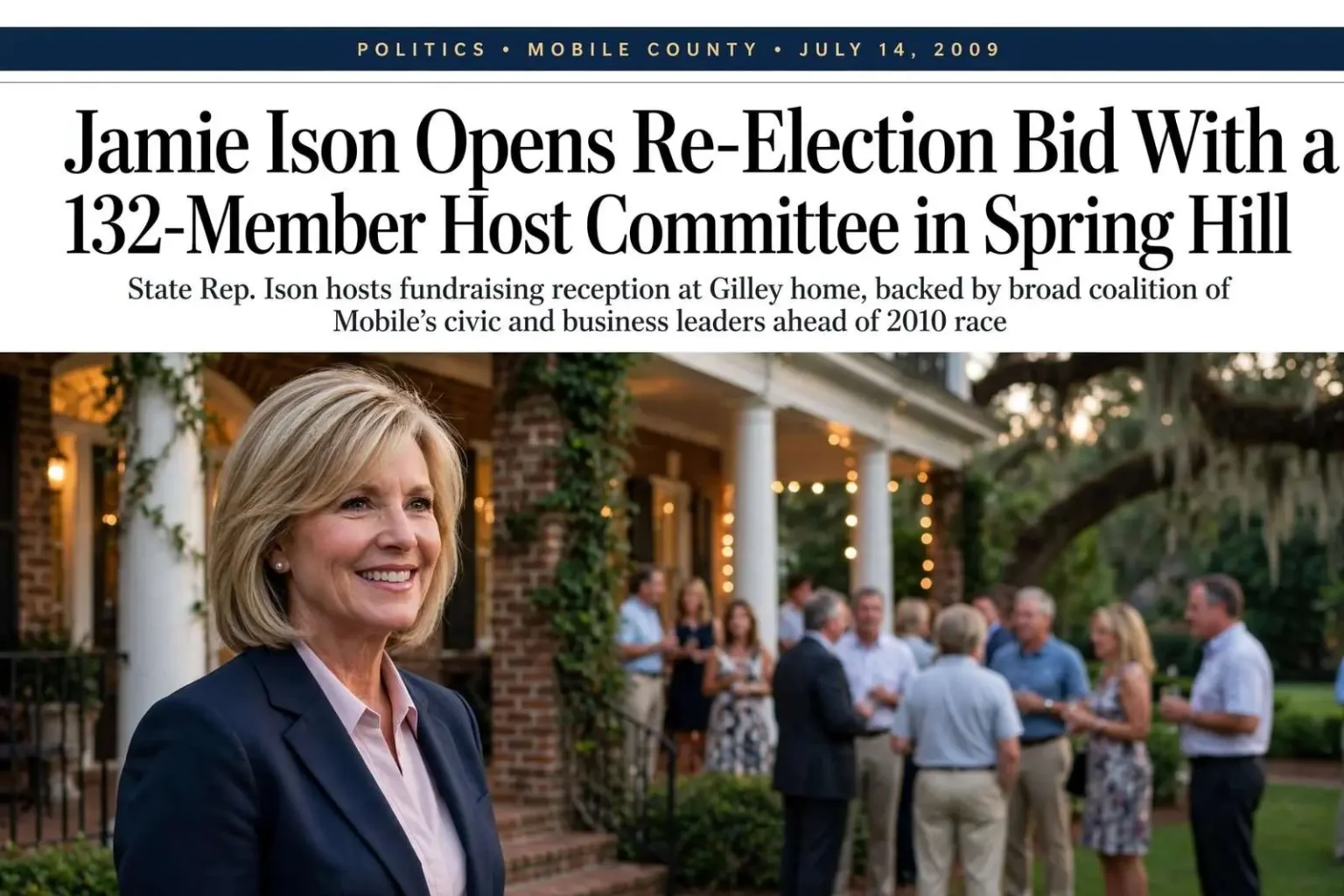
State Rep. Jamie Ison, R-Mobile, moved in July 2009 to put an early stamp on her re-election campaign, lining up one of the largest host committees the Mobile political scene had seen for a legislative race and scheduling a fundraising reception at a Spring Hill home. The kickoff reception for Ison’s bid to keep the House District 101 seat was set for 5 to 7 p.m. Tuesday, July 14, at the home of Lillian and Ed Gilley. The invitation noted that donations were appreciated but did not suggest an amount — an unusually low-key ask for an event of its size.
A Show of Strength
The host committee ran to 132 names, a roster that read like a directory of Mobile’s civic, legal and business leadership and that crossed the usual partisan lines. Among those listed were Sen. Ben Brooks and his wife, Kathy; Rebecca and Bradley Byrne, then preparing his own campaign for governor; former City Council President Reggie Copeland; state Rep. Victor Gaston and his wife, Jean; state Sen. Rusty Glover and his wife, Connie; state Rep. Chad Fincher and his wife, Caresse; Beth and Jimmy Lyons; Nell and Elliot Maisel; Fran and Harris Morrissette; Rep. Chris Pringle; and Alicia and Fred Stimpson.
A list like that carried information beyond the names themselves. Ben Brooks held the Senate seat overlapping much of Ison’s district, and Gaston, Fincher and Pringle sat near her in the county’s House delegation, so the roster amounted to the sitting legislative delegation vouching for one of its own. Copeland, the longtime council president, and Stimpson, a former mayoral candidate with deep business ties, pulled in the city government and downtown business worlds, while Byrne’s presence tied the reception to the statewide campaign already taking shape.
In legislative politics, a host committee of that size functions as a message as much as a fundraising vehicle. Announced a full year before the 2010 primaries, it signaled to any would-be challenger that the district’s established networks were already spoken for. At the time the invitation went out, Ison had no announced opposition, and every additional name on the committee raised the practical cost of becoming the first.
House districts in Alabama are small — roughly 45,000 residents each — so legislative races are won through personal networks, church pews, civic clubs and the small-dollar generosity of neighbors rather than through television. A host committee numbering in the dozens of couples represented precisely those networks, assembled and displayed in a single invitation. In a district where the primary had historically been the only real contest, the July reception was less a fundraiser than a public registration of ownership.
The choice of venue reinforced the point. The Gilley home in Spring Hill sat in one of the old-pattern neighborhoods of midtown and west Mobile where District 101’s reliable voters lived, and a Tuesday-evening reception there put the candidate in front of the district’s most dependable primary electorate without the expense of a rented hall or a catered rally. The unsuggested donation amount fit the same logic: the event was about demonstrating breadth of support, not extracting maximum money from a small circle.
Who Ison Was
Ison was seeking her third term in the Alabama House. Her committee assignments included Agriculture and Forestry as well as Judiciary, a pairing that gave her a hand in both the rural-policy questions that came before the agriculture panel and the legal issues — from tort debates to criminal law revisions — that moved through the Judiciary Committee each session.
District 101 covered a swath of midtown and west Mobile that has long been among the most reliably Republican legislative seats in the county, and it has sent to Montgomery a series of members drawn from the city’s civic establishment. The district’s voters tilted toward established names, long records of community involvement and moderate, business-oriented politics, which shaped the kind of candidate who could hold the seat and the kind of challenge that could plausibly dislodge one.
Before her election, Ison built a career in the field of communicative disorders. She received her bachelor’s degree in speech pathology and a master’s degree in communicative disorders from the University of Mississippi, and she served as regional director for the Alabama Institute for Deaf and Blind until 2003. The institute, headquartered in Talladega, operates schools and service programs for sensory-impaired Alabamians across the state, and its regional directors were the point of contact for families navigating screening, education and support services in their home territories.
Her civic record ran long even by the standards of Mobile’s volunteer-minded civic establishment. At the time of the reception she sat on the board of the Alabama Department of Senior Services, and she had previously served on the boards of Leadership Mobile, Habitat for Humanity and the Mobile Advisory Commission for the Disabled. She remained active as an alumna of Leadership Alabama and was a past president and current member of the Mobile Sunrise Rotary Club.
Those affiliations mapped almost exactly onto the host committee’s roster. Rotary boards, leadership programs and nonprofit boards were where Mobile’s business and professional class met, worked together and formed the mutual obligations that a host committee converted into political backing. Ison’s decade-plus of board service meant that many of the 132 names on the invitation were not donors being courted but colleagues returning a favor.
She and her husband, M. Harland “Jay” Ison Jr., are the parents of two sons, Philip and Wyatt, and attend All Saints Episcopal Church. The family’s roots in the district’s institutional life — church, Rotary, school networks — gave her candidacy the local-grounded profile that District 101 voters had historically rewarded, and that any challenger would have had to match before the race even reached questions of policy or party.
The 2010 Landscape
The reception came at a moment when Alabama’s political calendar was beginning to fill. The 2010 cycle would put the governor’s office, every statewide constitutional post and all 140 legislative seats on the ballot, and Republicans across the state were mounting an organized push to take control of a Legislature that Democrats had held for more than a century. Mobile County, where the GOP had already consolidated much of its suburban base, was central to that effort.
The county’s legislative delegation illustrated the trend. Seats in west Mobile, the suburbs along Airport Boulevard and the growing communities down toward Tillman’s Corner had flipped to the GOP over the previous two decades, and delegation Republicans such as Brooks, Gaston, Fincher and Pringle formed a bench that party strategists pointed to as evidence the region could be carried wholesale. An incumbent who could gather that bench in one living room was, in the party’s practical terms, an asset to be protected rather than a race to be watched.
For incumbents such as Ison, the strategy in the summer of 2009 was straightforward: raise money early, lock down supporters, and make the seat look expensive to contest. A reception hosted by more than 100 couples in Spring Hill, one of the wealthiest and most politically engaged neighborhoods in the city, did all three at once. Any prospective challenger reading the guest list had to reckon not only with the incumbent’s own account but with the fundraising capacity of everyone standing behind her.
Legislative fundraising in Alabama at the time operated under rules that permitted political action committees to transfer money among themselves, a practice that made it difficult for voters to trace the original source of a contribution. Critics had argued for years that the practice laundered special-interest money through chains of committees before it reached candidates, and every legislative session of the era produced another attempt to ban the transfers, only to see the measure stall.
Ethics and campaign-finance reform were already shaping up as themes of the coming election year, and candidates in both parties were being asked where they stood. For a Republican incumbent in a safe district, the question was mostly academic in the summer of 2009 — but the 2010 wave that followed would make the issue central in Montgomery, driving the ethics and disclosure overhauls that the next Legislature took up once Republicans took control of both chambers for the first time since Reconstruction.
Seen from July 2009, though, none of that was settled. What was settled, the invitation argued by its very existence, was the shape of House District 101’s race: an incumbent with a career in public service, a delegation’s worth of colleagues on her host committee, and a head start of a full year. The remaining business of the 2010 campaign in the district was reduced to whether anyone would decide the price of challenging that arrangement was worth paying.