Mobile’s Highest-Paid City Employees Named as Deficit Looms
Documents tied to Mobile's effort to close a projected $18.5 million budget gap listed the city's 100 highest-paid employees, topped by the public works director.
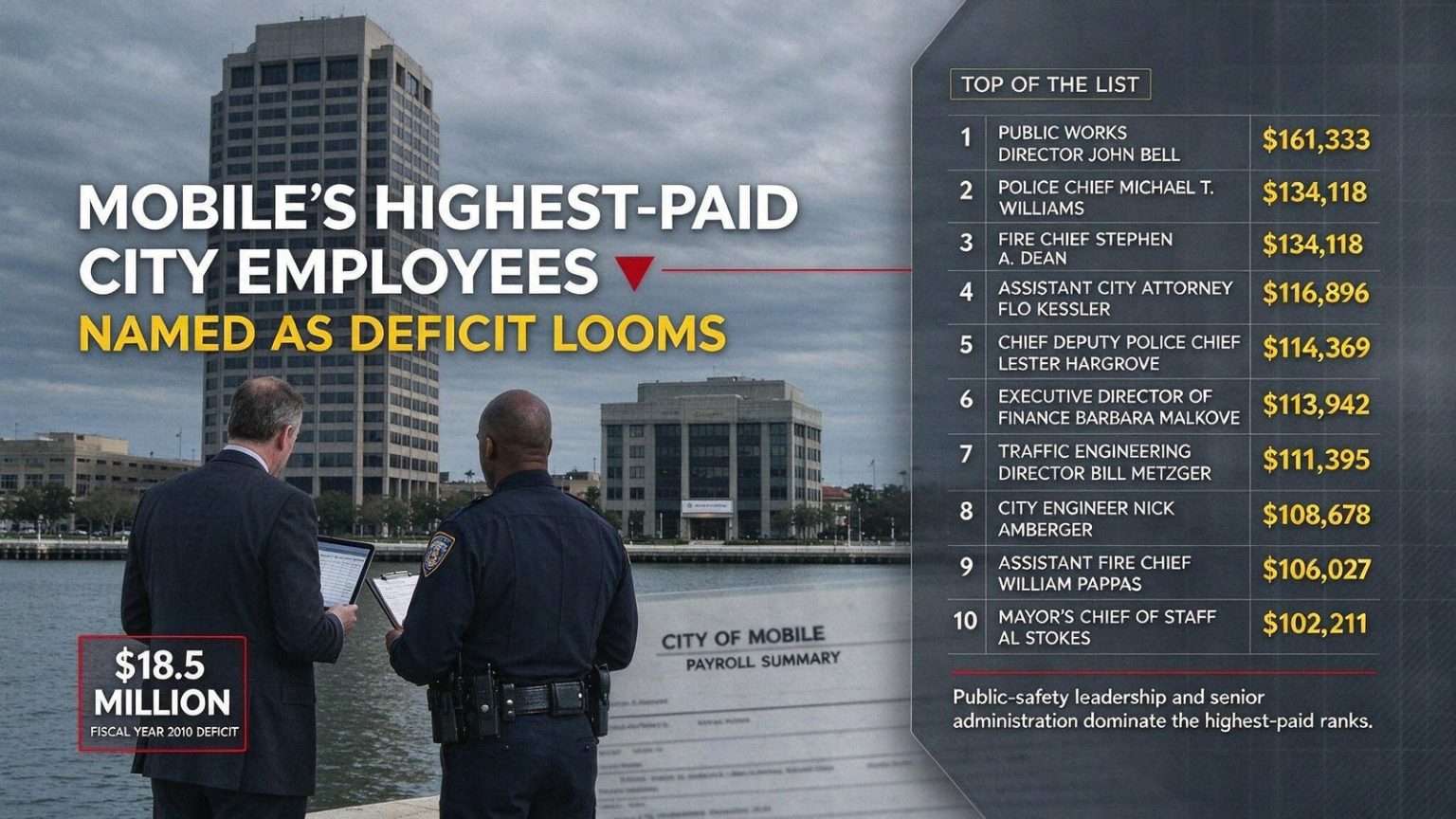
As the city of Mobile worked to close a projected $18.5 million deficit in its 2010 fiscal year, documents developed in connection with that effort laid out the salaries of the city’s highest-paid employees, a roster of 100 workers whose annual pay ranged from about $161,000 at the top to roughly $63,000 at the bottom of the list.
The timing made the figures impossible to separate from the budget crisis that produced them. Mobile, like municipalities across the country, was wrestling with the aftermath of the recession — sales tax receipts that had fallen with consumer spending, property values that had softened, and state revenues that had declined in step. Every department had been asked what it could give up, and the disclosure of exactly what the city’s most senior workforce earned landed in the middle of that conversation.
The documents offered a rare, granular answer to a question residents rarely get to ask: who runs the city, and what does the city pay them? The answers ranged across public safety, engineering, law, finance, and the mayor’s office, and the top of the list told its own story about where the city concentrates its compensation.
At the Top of the Payroll
The single highest-paid employee was Public Works Director John Bell, at $161,333. He was followed by Police Chief Michael T. Williams and Fire Chief Stephen A. Dean, each at $134,118.
The rest of the top of the list was dominated by public-safety commanders and senior administrators: Flo Kessler, assistant city attorney, $116,896; Lester Hargrove, chief deputy police chief, $114,369; Barbara Malkove, executive director of finance, $113,942; Bill Metzger, traffic engineering director, $111,395; Nick Amberger, city engineer, $108,678; William Pappas, assistant fire chief, $106,027; Al Stokes, the mayor’s chief of staff, $102,211.
Several employees were clustered near identical figures further down the list, including information technology director Sue Farni and real estate and asset management director Bill Demouy, each at $100,918, along with a group of deputy police and fire chiefs and the director of urban development at $96,056. Chief Municipal Judge Holmes Whiddon was listed at $94,494, and City Attorney Larry Wettermark at $92,601, a figure the documents suggested reflected a retainer with additional legal work billed hourly by him and his firm.
The pattern in those numbers is instructive. Public-safety leadership — police and fire chiefs, their deputies, and assistants — claims a large share of the top tier, reflecting both the size of those departments and the specialized command structures the city maintains around the clock. Public Works and engineering follow, a measure of the sprawling physical operation a port city must run: streets, drainage, traffic signals, and the infrastructure that keeps a coastal municipality functioning through hurricane season.
The Wettermark arrangement also caught attention in the documents. A retainer-plus-hourly structure for the city attorney’s office differs from the salaried arrangements of every other department head listed, and the documents’ notation that additional legal work was billed by him and his firm acknowledged the difference. Contracted legal services occupy a familiar gray zone in municipal budgeting — part payroll, part procurement — and their appearance on a compensation roster invited the scrutiny that followed.
Beyond Base Pay
The salary figures did not tell the whole story. The documents noted that some city workers also received benefits such as favorable health-insurance terms, take-home vehicles and food allowances, as well as participation in the state’s Deferred Retirement Option Program, known as DROP, among other perquisites.
Each of those benefits carries a budget consequence that base salary comparisons miss. Take-home vehicles, standard for command staff and department heads who must respond at any hour, cost the city the purchase price, fuel, insurance, and maintenance of a fleet that never appears on a payroll sheet. Food allowances accumulate quietly. Favorable health-insurance terms, negotiated across the workforce, weigh heaviest at the top, where family coverage is most expensive.
DROP deserves particular explanation, because it is the least understood and most consequential item on the list. The program, administered through the state retirement system, allows eligible employees to declare retirement and begin drawing their pension into an account while continuing to work for their regular salary. For the employee, it can mean collecting retirement savings and a paycheck simultaneously for up to several years before actually leaving. For the city, it means a senior employee’s departure date — and the savings that come with replacing a top salary with a junior one — recedes year after year.
Defenders of DROP note that it keeps experienced leaders in place and encourages retirement planning, while critics have long argued the program pays employees twice for the same years and distorts succession planning in city government. In a budget year defined by an $18.5 million hole, those arguments acquired new urgency, and the documents’ mention of DROP participation alongside the salary figures was no accident.
The Budget Crisis Behind the Disclosure
The disclosure arrived at a pointed moment. With the city facing a multimillion-dollar shortfall, the pay of its senior workforce, particularly when paired with its benefits, became part of the debate over where cuts should fall. Municipal budget crises of that era tended to follow a predictable script — hiring freezes, delayed capital projects, service reductions, and difficult conversations about personnel costs — and Mobile’s version was no exception in structure, if notable in the transparency of its numbers.
Personnel dominates any city budget, and senior personnel dominate the compensation side disproportionately. The 100 names on the list represent only a fraction of the city’s workforce, but their combined salaries run to millions — a figure that guarantees any serious cost-cutting exercise will, at some point, reach the offices at the top of the list.
The recession context also framed the public’s reaction. Private-sector workers across the Gulf Coast had absorbed pay cuts, layoffs, and frozen retirement accounts by 2010, and the revelation that the city’s top administrators earned six figures, several of them well above, sharpened the question of shared sacrifice. At the same time, defenders of the pay structure pointed out that the positions listed — running a police department, a fire department, and a public works operation for a city of Mobile’s size — command comparable or higher compensation in peer cities across the Southeast, and that losing experienced leadership mid-crisis carries its own costs.
What the List Revealed About City Government
Read as a snapshot, the roster mapped the machinery of Mobile’s government at a moment of stress. The presence of a chief municipal judge among the highest-paid employees reflects the city’s own court system, an operation with its own staffing, revenue, and caseload. The urban development directorate’s placement speaks to the city’s ambitions during that era — downtown revitalization, waterfront investment, and the redevelopment fights that would define the decade that followed. The finance and information-technology posts mark the administrative backbone that keeps a large municipal organization auditable and functioning.
The list also documented how thin the line is between elected priorities and appointed execution. The mayor sets policy, but the people actually running public works or negotiating the city’s legal exposure are the salaried professionals on this list, and their compensation is the price of a government that functions without the top leadership having to learn each job on the fly. When budgets tighten, that is precisely the layer whose value gets debated — because it is the layer whose work is least visible to the public and most expensive to replace.
For the city’s rank-and-file employees, the disclosure carried its own message. A workforce absorbing furloughs and frozen raises could now see exactly how far its pay sat from the top of the structure, and the compression between the bottom of the list — roughly $63,000 — and the six-figure tier above it illustrated the steepness of the municipal pay curve.
The Larger Lesson of the Documents
Municipal compensation disclosure has become more common in the years since, driven by public-records requests, transparency ordinances, and websites that compile government payrolls. In 2010, a document like this was considerably rarer, and its existence in Mobile was itself a byproduct of the budget crisis: the same exercise that mapped every department’s costs to find $18.5 million also, incidentally, produced one of the clearest pictures of the city’s senior pay structure the public had seen.
The episodes that followed — the cuts, the debates, the eventual rebalancing of the city’s books — belong to the longer history of Mobile’s recovery from the recession. What endures from the disclosure is the precedent: that in a city of Mobile’s size, the public can see who earns what, why the public-safety commands sit at the top, and how benefits like take-home vehicles and DROP participation shape the true cost of leadership. Compensation debates in city government are perennial, and every one of them since has run through the same questions the 2010 documents forced into the open.
For residents who lived through that budget season, the figures confirmed what the deficit had already suggested: the city’s personnel costs were both its greatest expense and its greatest obligation, and closing the gap would test every assumption — including the ones written into the paychecks at the top of the list.