Mobile’s Sales Tax Receipts Jumped More Than 20 Percent in the Month of the Tax Holiday
City figures showed Mobile collected $9.7 million in August 2006 sales taxes, up more than 20 percent from the prior year, in the month of Alabama's back-to-school sales tax holiday.
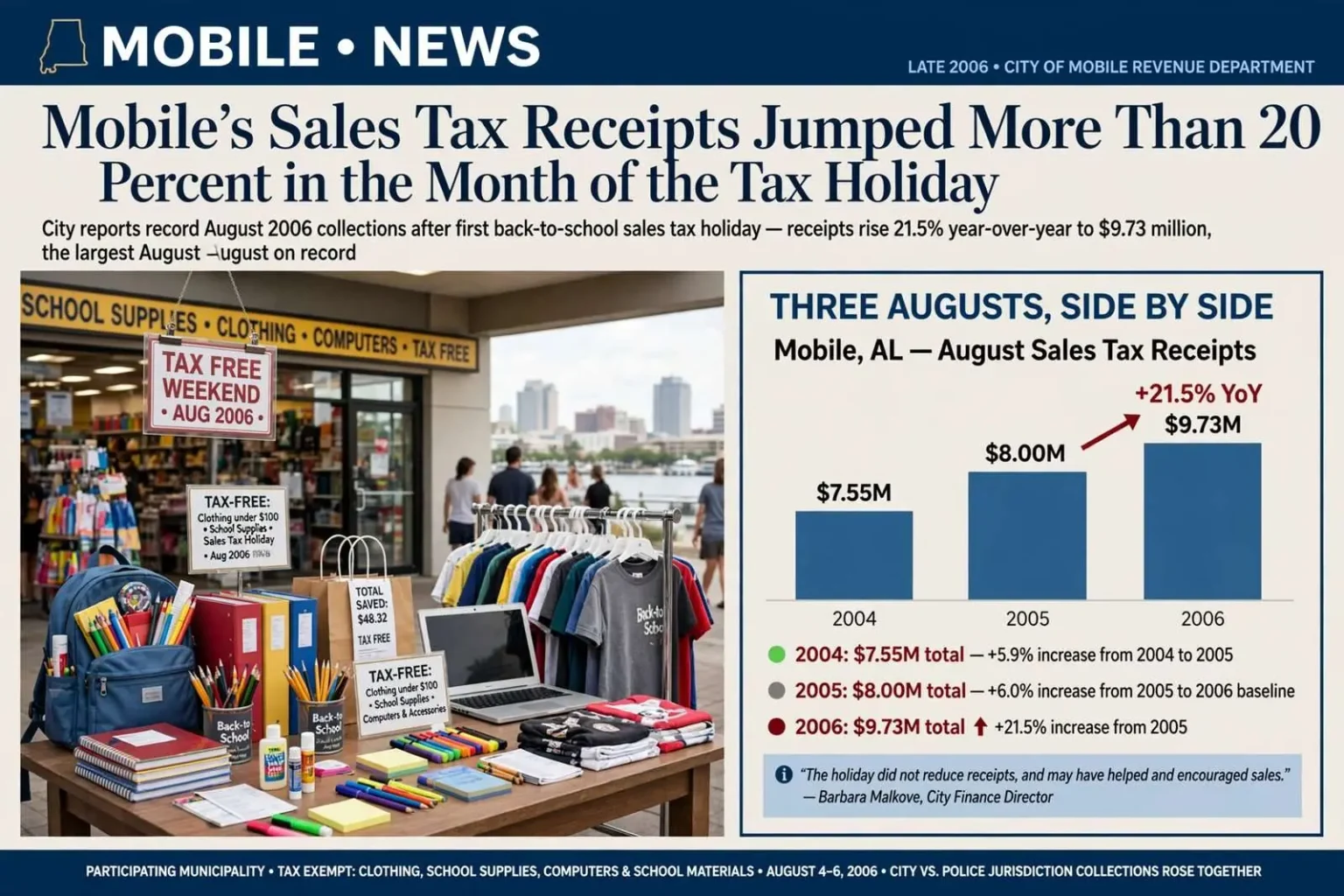
Figures released by the City of Mobile’s Revenue Department in late 2006 gave supporters of Alabama’s new back-to-school sales tax holiday a statistic they were happy to repeat: collections in the month of the holiday rose more than 20 percent over the previous year. The holiday, held in August 2006, temporarily exempted clothing, school supplies, computers and related items from state and participating local sales taxes. Critics had warned that municipalities would simply forgo revenue. The city’s own numbers told a different story.
Three Augusts, side by side
The Revenue Department’s sales tax statistics for the month of August, over three consecutive years, ran as follows:
2004: city, $6,116,279; police jurisdiction, $1,434,462; total, $7,550,741
2005: city, $6,502,690; police jurisdiction, $1,498,918; total, $8,001,608
2006: city, $7,887,658; police jurisdiction, $1,838,848; total, $9,726,506
The year-over-year increase from 2005 to 2006 came to more than 21 percent, an extraordinary jump for a single month in a mature municipal revenue stream. Growth from 2004 to 2005, by contrast, had been under 6 percent — the kind of steady, unremarkable climb a built-out retail market typically produces. Something had changed in August 2006, and the holiday was the most obvious candidate.
The city’s assessment
“We had more than 20 percent growth in monthly receipts from 2005 to 2006,” said city Finance Director Barbara Malkove. “I think we can safely say that the holiday did not reduce receipts, but may have helped and encouraged sales in the area.”
Malkove’s phrasing was carefully measured, and deserves to be read as such. She did not claim the holiday caused the increase. She said the receipts did not fall and that the holiday may have encouraged sales. The distinction mattered because the debate over the holiday had been framed in causal terms: critics predicted revenue loss, supporters predicted stimulus, and a single month’s receipts could not settle a question that economists had argued about for decades.
What the numbers did establish was the bottom line that mattered most to city government. Mobile had entered its first sales tax holiday braced for a hole in one of its steadiest revenue months, and instead recorded the largest August in its history. Whatever the mechanism, the feared loss had not materialized.
What the numbers can and cannot prove
Adherents of supply-side economics, the theory that lower tax rates can stimulate enough additional activity to offset the revenue lost, seized on the figures as a vindication. The claim is at least plausible on its face: shoppers who came out for exempt school supplies plainly bought taxable goods while they were in the store, and retailers scheduled promotions around the weekend to capture the traffic. A family buying exempt clothing and notebooks also bought taxable shoes, snacks and household items, and the sales tax on those purchases flowed to the city as usual.
A more cautious reading would note some complicating factors. The Gulf Coast economy in August 2006 was running unusually hot in the aftermath of the 2005 hurricane season, with insurance money, reconstruction spending and displaced households circulating through the regional retail market. Mobile had absorbed an influx of evacuees after Katrina, and the rebuilding economy touched everything from lumber yards to restaurants. Rising prices also inflate a sales tax figure, which is measured in dollars rather than in units sold. Untangling how much of a 21 percent jump belongs to the tax holiday, how much to the post-storm economy and how much to ordinary growth would require analysis beyond a comparison of three Augusts.
The police jurisdiction line
Worth noticing in the city’s table is the police jurisdiction column, which tracks sales taxes collected in the unincorporated areas surrounding Mobile where the city provides certain services and levies a reduced rate. It rose in step with city collections, from roughly $1.5 million to $1.8 million.
That parallel movement suggests the surge was not confined to downtown or to any one retail corridor but was broadly distributed across the metropolitan trading area. Had the holiday’s effect been limited to a single shopping district or a handful of big-box stores, the police jurisdiction figures — drawn from a different and wider geography — would likely have diverged from the city’s own. They did not. Growth in both columns moved together, pointing to an increase in overall retail activity across the trade area rather than a shift of purchases from one jurisdiction to another.
The police jurisdiction itself is a distinctive feature of Alabama municipal finance. Cities may levy taxes and provide police and fire services in unincorporated territory within a defined distance of their limits, and Mobile’s police jurisdiction collections had grown steadily alongside the suburban retail development in those fringe areas. The 2006 figures showed that territory participating fully in the August surge.
The holiday’s design
Alabama’s back-to-school holiday, adopted by the Legislature in 2006 as one of the first of its kind in the Southeast, exempted a defined list of items during a single weekend in August: clothing priced under a set threshold, school supplies, computers and computer accessories, and books. The state gave up its sales tax on those items automatically, but participation by cities and counties was optional — each jurisdiction had to opt in to forgo its local share. Mobile was among the municipalities that participated, which is why the holiday’s cost and benefit both appeared in its own books.
The optional structure created a natural experiment across the state, with some jurisdictions opting in and others standing aside, and with fiscal officers everywhere watching their August receipts for evidence. Opponents had argued that shoppers would simply time purchases they would have made anyway, shifting sales from taxable July and September into the exempt weekend and leaving governments with nothing but lost revenue. Supporters countered that the holiday would draw shoppers from across state lines — Mississippi and Florida both lacked comparable holidays at the time — and stimulate enough incidental taxable buying to wash out the loss.
Mobile’s three-August comparison could not resolve that dispute, but it did undercut the strongest version of the opposition case: that the holiday would gut municipal receipts. The city’s August total did not merely hold steady; it jumped by more than $1.7 million over the prior year, far outside the range of the previous year’s growth.
Katrina’s long shadow on the retail economy
Any interpretation of Mobile’s 2006 receipts has to run through Hurricane Katrina, which struck the central Gulf Coast a year earlier. The storm displaced thousands of households into the Mobile area, many of whom remained through the school year and beyond, each requiring clothing, furniture and household goods. Insurance settlements and federal assistance put spending money into circulation. Reconstruction of the storm-damaged coast to the south kept contractors and suppliers busy and drew workers whose wages were spent in Mobile’s stores. The retail economy that August was not operating at its baseline, and a 21 percent increase could plausibly reflect some of that elevated activity rather than any tax policy.
At the same time, the holiday fell precisely in the month when displaced families and recovering households were most likely to be buying the exempt goods: clothing for a new school year, school supplies, and in many cases replacement computers. The convergence of the post-storm economy and the tax-free weekend makes it genuinely difficult to apportion the increase, which is why Malkove’s cautious phrasing — the holiday did not reduce receipts, and may have helped — was as far as the city’s finance office could responsibly go.
Price trends complicate the picture further. Sales taxes are levied on dollars spent, not items sold, so any inflation in the goods Mobile shoppers bought shows up as revenue growth even if unit volumes were flat. Back-to-school categories — clothing, electronics, school supplies — had seen steady price movement, and a 5 or 6 percent underlying growth rate, added to post-storm activity, could account for a meaningful share of the jump before any holiday effect was counted.
What shoppers did with the savings
The holiday’s appeal to families was straightforward: a weekend in late August when school shopping cost several percent less, at exactly the season when those purchases were unavoidable. For a family outfitting several children, the exempt items could represent hundreds of dollars of purchases, and the savings were real even if modest in absolute terms. Retailers amplified the effect with their own promotions, stacking store discounts on top of the tax exemption and advertising the weekend heavily.
The cross-border argument carried particular weight along the Gulf Coast. Shoppers near the state lines, including those in Mobile’s trade area who might otherwise split their spending with Florida panhandle retailers, had an added reason to buy in Alabama during the holiday weekend. Whether the weekend actually shifted measurable spending across state lines was the kind of question that would require neighboring jurisdictions’ receipts to answer, but the promotional energy around the event was undeniable.
For city government, the practical takeaway from August 2006 was not an economic proof but a fiscal reassurance. Mobile had opted into the holiday, surrendered its tax on a defined list of goods for a weekend, and watched its August receipts set a record anyway. Whatever mixture of holiday traffic, post-storm spending and ordinary growth produced the number, the worst-case scenario the critics had warned about — a city writing off revenue for nothing — had not come to pass.
A durable Alabama institution
Whatever the economics, the politics were settled quickly. The back-to-school sales tax holiday became a fixture of the Alabama calendar, with cities and counties across the state opting in year after year, and it remains one of the few tax measures in Alabama that no one of either party campaigns against. The event’s popularity with families and its visibility on retailers’ calendars gave it a constituency that outlasted the scholarly debate over its effects, and subsequent states across the Southeast adopted their own versions, turning the exemption weekend into a regional competition for school shoppers.
For Mobile’s finance office in 2006, the practical conclusion was simply this: the city had feared a hole in its August receipts, and instead found the largest August it had ever recorded.