Ten Million Federal Dollars Headed to Choctaw Point and the State Docks Rail Terminal
The U.S. Department of Transportation agreed in February 2007 to release more than $10 million to the Alabama State Port Authority for the Choctaw Point Terminal and an intermodal rail facility.
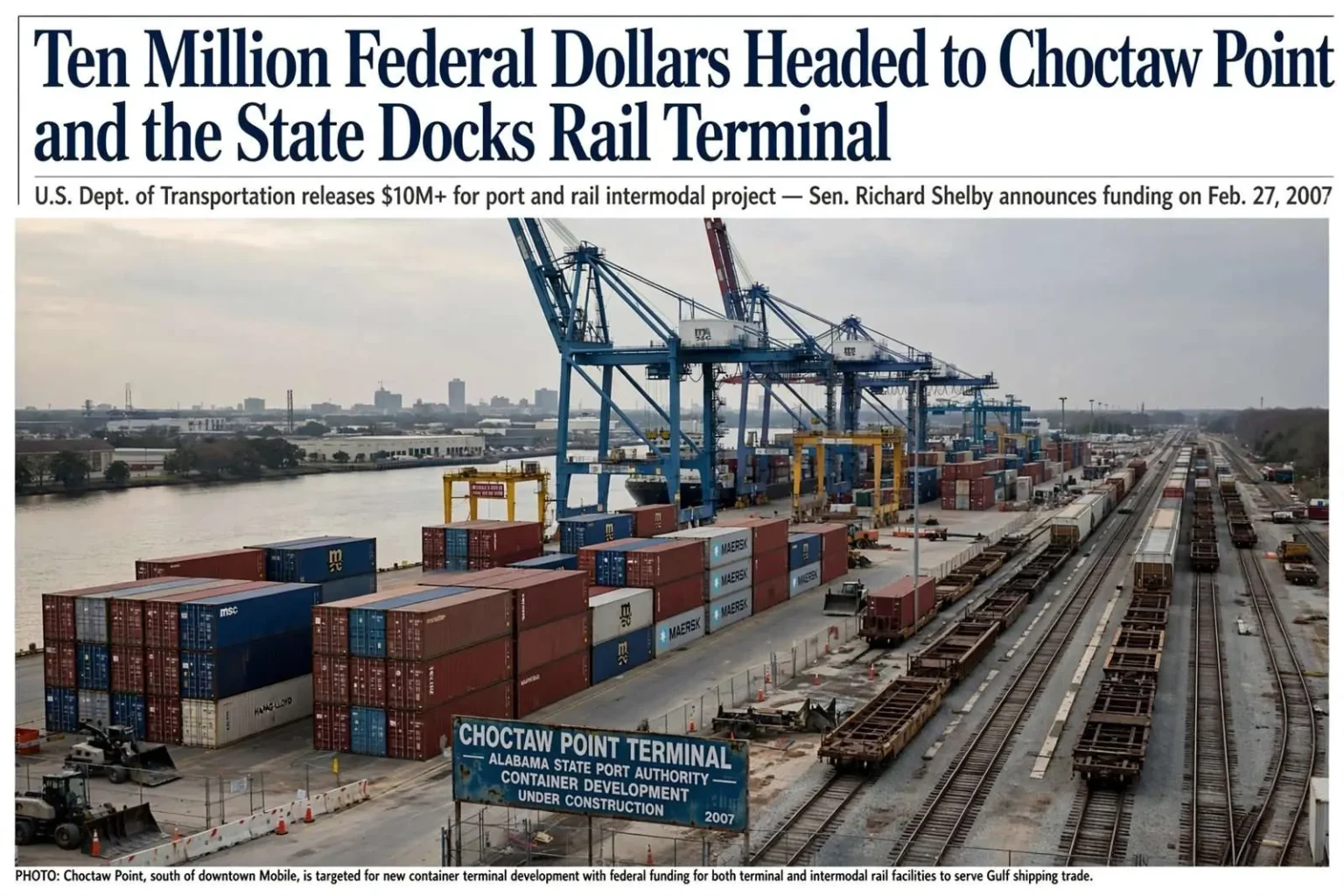
The U.S. Department of Transportation agreed to release more than $10 million to the Alabama State Port Authority in late February 2007, money directed at two projects intended to remake the Port of Mobile into a modern container and rail gateway.
U.S. Sen. Richard Shelby, a member of the Senate Appropriations Committee, announced the funding on Tuesday, Feb. 27, 2007. It was split between two line items: $6,674,580 for the Choctaw Point Terminal, and $3,378,430 for the Alabama State Docks Intermodal Facility.
The two figures were not merely adjacent appropriations; they were two halves of a single strategic argument. A container terminal without an intermodal rail connection is a warehouse at the water’s edge, and a rail facility without a terminal to feed it is a solution to a problem that does not exist. The federal money arrived for both at once because the port’s leadership and its advocates in Washington had made the case that neither piece was useful without the other.
For the Port Authority, the announcement was also a signal to the shipping industry. Federal infrastructure dollars follow plans that officials believe will be executed, and the release of more than $10 million told carriers and terminal operators that Mobile’s container ambitions were backed by more than renderings. In port development, credibility is built in exactly this way: one announcement at a time, each one demonstrating that the last promise was kept.
What Choctaw Point was meant to be
Choctaw Point sits south of downtown Mobile on the west bank of the Mobile River, a stretch of waterfront that the state had targeted for a new container terminal. The project represented a deliberate strategic turn for a port whose business had historically been built on bulk cargo, coal, forest products, chemicals and steel, rather than on the standardized shipping containers that had come to dominate global trade.
“The Port of Mobile has a substantial impact on Alabama’s economy and investing in it will pay dividends for years to come,” Shelby said. He described the container and rail intermodal terminal at Choctaw Point as an effort that would increase shipping and receiving capabilities at the port and called it “an integral part of the State Docks’ development.”
The bulk trades that had built the port were not declining — coal, timber products, chemicals and steel continued to move through Mobile in large volumes — but they were not where the growth was. The container revolution had consolidated global cargo into standardized steel boxes that could move from a ship in Asia to a truck in Ohio without ever being unpacked, and the ports that handled those boxes captured the fastest-growing share of world trade. A port without container capability was, increasingly, a port without a future in the fastest lane.
Choctaw Point offered the physical ingredients the trade required: deep water close to the river channel, rail access on the waterfront, and land sufficient for the cranes, container yards and gate complexes that modern terminals demand. The site’s position just south of downtown also placed new development near the city’s existing industrial and transportation fabric rather than requiring an entirely new corridor.
Building a container terminal is a years-long undertaking — channel work, wharf construction, crane procurement, yard paving — and the federal contribution announced in February 2007 was one stream of funding among several that the project would eventually require. But for a project of that scale, early federal participation is often what unlocks the rest, because it gives state and port authorities the confidence to commit their own capital.
Why the rail piece mattered
The intermodal facility funded alongside the terminal was, in its way, the more important half of the equation. A container terminal without efficient rail connections is a bottleneck. Containers arriving by ship must move inland quickly and cheaply, and in the American freight system that means rail.
Mobile’s geographic argument rested precisely on this point. The port sat at the southern end of a rail and waterway network reaching deep into the interior of the country, with the Black Warrior-Tombigbee system running north toward Birmingham and rail lines connecting to the national network. What it lacked was the modern terminal infrastructure to exploit that position.
An intermodal facility is the machinery of that connection: miles of track, transfer stations where containers move between railcars and trucks, and the storage and handling capacity that keeps cargo flowing without piling up. When it works, a container landed at a Gulf port can be rolling north within hours; when it does not, containers stack up on the dock and the additional cost erases the geographic advantage that attracted the cargo in the first place.
The competitive stakes were regional. Gulf ports in Louisiana, Texas and Mississippi were all chasing the same container growth, and the difference between winning and losing cargo was often measured in the quality of inland connections. Mobile’s case — a river, rail lines and inland waterways converging on one deepwater harbor — was strong, provided the infrastructure existed to act on it.
The Gulf of Mexico argument
Shelby’s second statement went further, laying out the ambition behind the investment in unusually expansive terms. “The Alabama State Docks have the potential to become one of America’s most economically viable ports in this century because of their proximity to emerging trade routes on the Gulf of Mexico,” he said. “Continued growth at the Port of Mobile is essential to further economic development opportunities in Mobile and throughout the state.”
The reference to emerging trade routes was not idle. Planners in 2007 were watching the anticipated expansion of the Panama Canal, which promised to bring larger vessels from Asia directly to Gulf and East Coast ports rather than forcing them to unload on the Pacific coast. Gulf ports that could handle the traffic stood to gain enormously. Ports that could not would be bypassed.
The canal expansion, ultimately completed years later, has since reshaped global shipping exactly along the lines port planners described in 2007: bigger neo-Panamax vessels calling directly at Gulf ports, carrying Asian cargo that once transshipped through West Coast harbors and inland rail networks. In 2007, the question was which Gulf ports would be ready when the larger ships began arriving — and readiness meant channels deep enough for the drafts, terminals with the crane reach and yard capacity, and inland connections that could evacuate cargo as fast as the ships could discharge it. Mobile’s Choctaw Point plan was its answer to that question, announced years before the answer was due.
Shelby’s role in the appropriations process gave Alabama an advocate few states of its size could match. As a senior member and later chairman of the Senate Appropriations Committee, he steered federal investment toward the state’s transportation infrastructure with a consistency that made port officials’ planning horizons realistic. The February 2007 release was one entry in a long ledger of such decisions.
A pattern of investment
The February 2007 announcement fit a broader pattern of federal money flowing toward Mobile’s maritime infrastructure in the mid-2000s. In the same period, appropriations bills carried funds to replace the 14 Mile CSX railroad bridge that obstructed barge traffic on the Mobile River, and port security grants were expanding sharply under the homeland security budget.
Each of these pieces addressed a different constraint on the same system: the bridge that slowed barges, the terminal that could not handle containers, the rail connection that could not move them inland, the security regime that had to cover it all.
That systems-level view is what distinguished the mid-2000s investment push from ordinary year-by-year appropriations. A port is a chain of dependent capacities, and money spent on one link achieves little if the next link is the constraint. A modern terminal fed by a low railroad bridge achieves nothing; a fast intermodal connection serving an undersized terminal achieves nothing either. The simultaneous funding of terminal, intermodal facility, bridge replacement and security upgrades suggested that Mobile’s advocates in Washington had grasped the whole chain and were funding it in coordinated pieces.
The security dimension deserves its own note. After 2001, federal port security grants became a permanent feature of maritime funding, paying for fencing, surveillance, access control and patrol capability at ports across the country. For a working harbor like Mobile’s — with petroleum terminals, coal docks and chemical storage crowded along the river — those grants were not ornamental. They were the price of admission to the modern shipping world, where carriers and insurers expect a documented security regime.
The stakes for the region
Shelby said he had been instrumental in securing the funding during the appropriations process, and that Alabama’s economy was “flourishing and open for business.”
Behind the campaign-season phrasing lay a real calculation. The Port of Mobile supported thousands of jobs directly and many more indirectly, in trucking, warehousing, rail, ship repair and the professional services that cluster around a working waterfront.
Ports are economic multipliers of an unusual kind. Every vessel call sets off a chain of local hiring — longshore labor, tug services, agents, customs brokers, drayage truckers — and every industrial facility sited near a port does the same again. The ThyssenKrupp steel project then rising in north Mobile County was itself a port story: a mill of that scale imports raw materials and exports finished product by water, and it chose its site because deep water was close at hand. Port capacity and industrial recruitment are, in practice, the same investment viewed from two directions.
A port that lost the container trade would remain a port, but it would be a smaller one, and the industrial recruiting pitch that Alabama took to manufacturers around the world would be measurably weaker without it.
That is the quiet logic underneath the February 2007 announcement. The $10 million released that week was a modest fraction of what a full container terminal would ultimately cost, but it was the piece that signaled seriousness — to carriers deciding where to route cargo, to industries deciding where to build, and to the state officials who would be asked to commit their own money to the same vision. The Choctaw Point project that grew from that vision would, in time, change the skyline of Mobile’s riverfront and the arithmetic of Alabama’s economy.