Spanish Fort Advances $90,000 in Road and Drainage Repairs After Historic April Flood
Spanish Fort council approves nine emergency road and drainage repair projects totaling $90,615 after historic April 2014 flooding.
SPANISH FORT, Ala. — Months after a historic late-April deluge tore up roads and drainage systems across the city, Spanish Fort leaders are moving forward with a slate of repairs aimed at shoring up the damage before the next big storm arrives. The Spanish Fort City Council voted unanimously during a special-called meeting to declare a state of emergency and award a $90,615 contract to Sunset Contracting Inc., a Mobile-based firm that submitted the lowest bid for the work.
The emergency declaration was the procedural key that unlocked faster contracting, letting the city move repair crews onto storm-damaged streets without the full waiting period a routine award would require. Spanish Fort, a fast-growing city of roughly 7,000 perched on the ridge above Mobile Bay between Daphne and Malbis, had spent the weeks since the flood documenting damage street by street — the record-keeping that federal disaster reimbursement demands and that the repairs themselves now depend on.
The contract covers nine separate road and drainage projects scattered throughout the city, each tied to erosion, sinkholes or structural damage caused by the storm. The flooding, driven by as much as 13 inches of rain in a single 24-hour stretch, overwhelmed culverts, ditches and stormwater systems across Baldwin County. Rainfall of that magnitude in one day approaches what the region expects in a tropical system, and it arrived on saturated ground with no hurricane attached — a reminder that Gulf Coast storm risk does not require a named storm to do serious damage.
Spanish Fort had already spent roughly $27,000 in emergency repairs the previous month to fix a blown-out culvert near Caisson Trace along Spanish Main. City officials say the newly approved projects target locations where the ongoing threat to public safety and private property is greatest. The two expenditures together represent only the opening act of the recovery; engineering assessments were still assigning long-term price tags to some of the damaged drainage infrastructure when the council met.
The late-April storm caught Baldwin County with little ceremony. Forecasters had tracked a slow-moving line of thunderstorms, but the training cells that set up over the eastern shore of Mobile Bay dumped rain on the same neighborhoods hour after hour, turning creeks into torrents and ditches into canyons. By the time the rain ended, roads were cracked, flumes were undermined and residents were photographing sinkholes that had opened overnight in their own subdivisions. County and municipal crews fanned out to barricade the worst spots even as the water was still receding.
Spanish Fort’s terrain explains much of the damage. The city sits on the high ground of the Bronze Age-era ridgeline that parallels the bay, laced with steep ravines carrying runoff toward Blakeley River, Bay Minette Creek and the bay itself. Streets thread across those drainages on culverts and flumes, and when a storm exceeds what the structures were built to handle, the failures appear exactly where the water concentrates — beneath road crossings, at channel joints and on the slopes below.
Nine trouble spots across the city
Blakeley River Road saw a drainage flume undermined and four sinkholes form after Spanish Branch overtopped its banks. A sinkhole opened along Caisson Trace, while high-velocity stormwater on Spanish Main caused a joint failure that is threatening both that street and nearby Bull Run. Each of those failures traced to the same mechanics — water channeled downhill with enough force to carve out the soil beneath pavement — and each left a street that looked intact but was losing its footing from underneath.
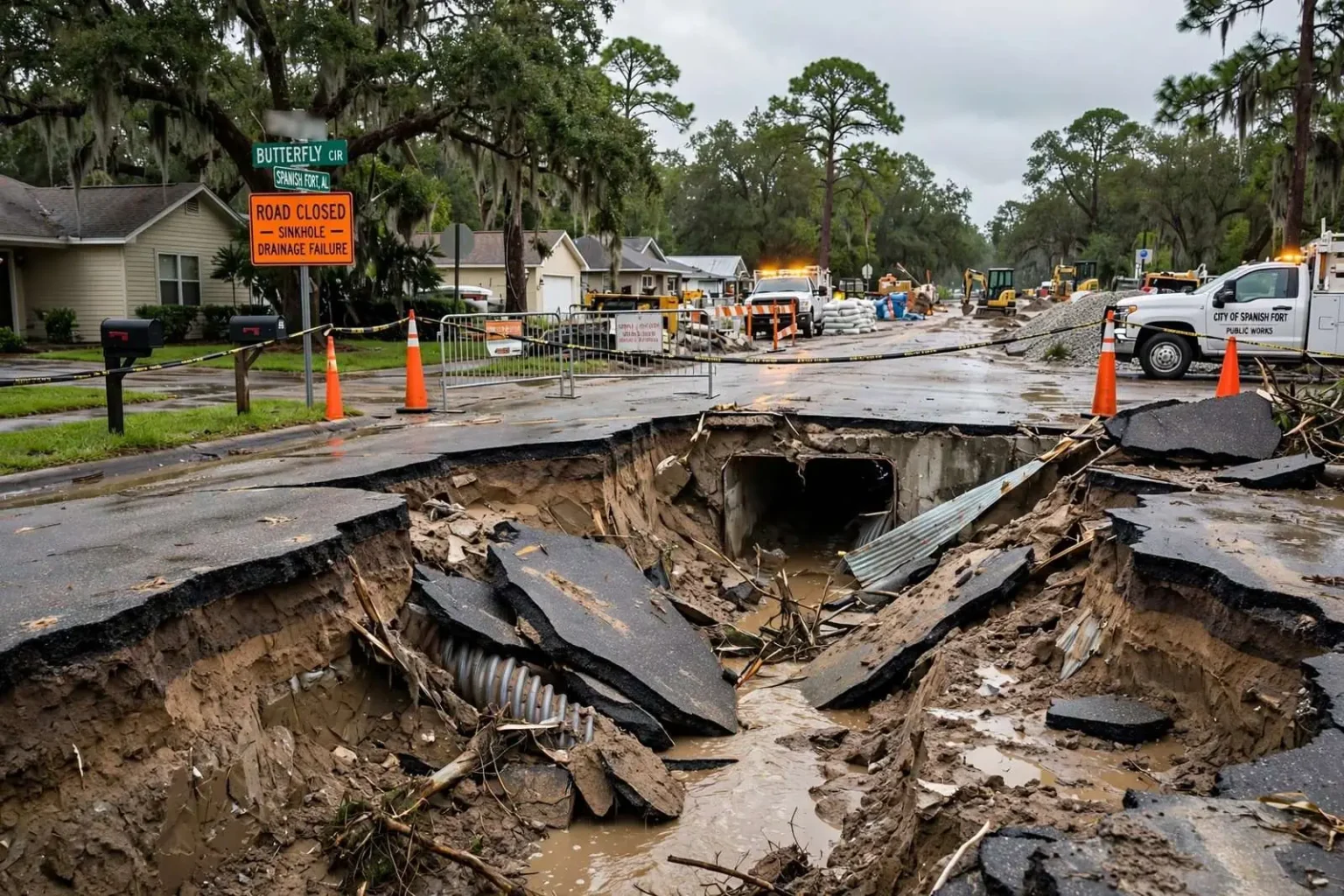
Other trouble spots include Confederate Drive and Rebel Road, where a bulging, failed section of asphalt could worsen with more rain, and Waites Lane, where floodwater carved deep trenches into an unpaved stretch of roadway. On Butterfly Circle, nearly 150 feet of pavement has partially collapsed into erosion ruts, creating what officials describe as a real hazard for drivers, cyclists and pedestrians in the subdivision.
A damaged concrete flume on Stanton Road threatens to take out a driveway and possibly a home if another major storm hits, while a large concrete flume on Artillery Range Road was undermined in three sections, raising the risk of further erosion, property damage and sediment runoff into Bay Minette Creek. The creek connection matters beyond one neighborhood: sediment washed into waterways during storms degrades habitat downstream and adds to the sediment load that eventually reaches the bay, a concern environmental regulators track across Baldwin County’s fast-developing watersheds.
At Spirit Park, a washed-out drainage box beneath the parking lot could collapse during a future heavy rain. Public parks occupy a particular place in this kind of damage inventory — the failure is out of sight until it isn’t, and a parking lot that gives way beneath a family vehicle during a Saturday game is precisely the scenario city engineers flagged in prioritizing the site. The list as a whole mapped the city’s vulnerability with unusual precision: nearly every failure sat where stormwater concentrates, on streets built across the ravines and drainages that define the ridge-top geography.
The Butterfly Circle failure became the neighborhood’s most visible symbol of the storm. Pavement that partially folded into erosion ruts does more than slow traffic — it changes how families use their own street, keeping cyclists and walkers off asphalt that can no longer be trusted. Residents in the subdivision pressed the council at public meetings for a timeline, and the contract award gave the city its answer: repair crews would reach the subdivision as part of the nine-site package rather than through a slower standalone project.
Sunset Contracting, the low bidder, took on a project list that reads like a tour of the city’s drainage weak points. Municipal contracts of this kind are awarded on unit pricing per site, and the Mobile firm’s bid came in below the field, allowing the council to lock in the work while FEMA documentation was still being assembled. The firm’s schedule will move site by site as weather permits, with the city inspecting each repair before reimbursement claims are finalized.
Who pays for the recovery
Because the damage stemmed from a federally declared disaster, Spanish Fort expects the Federal Emergency Management Agency to reimburse roughly 75 percent of the repair costs, with the state and city splitting the remainder. That formula — three-quarters federal, the balance shared between Montgomery and the local budget — is the standard arrangement in a federally declared disaster, and it transforms a nine-project repair slate from a budget crisis into a manageable but still significant local expense.
The paperwork behind that reimbursement is considerable. Every project must be documented to FEMA’s standards — damage assessments, photographs, bid records, invoices and inspections — and the emergency declaration the council approved was the first step in a paper trail that runs for months after the asphalt is patched. City staff across Baldwin County spent much of the summer navigating that process while also keeping their normal duties moving.
Separately, the city continues to grapple with long-running erosion along a bluff on Patrician Drive, a project that has been tied up in litigation since 2009. The April flooding added more than $1 million to that project’s price tag, pushing its total cost to an estimated $2.5 million. The Patrician Drive bluff has become Spanish Fort’s most persistent infrastructure headache — a slope failure that has outlived multiple councils, cost estimates and legal skirmishes, and which the storm made measurably worse.
The contrast between the two situations illustrates how differently storm damage can unfold. The nine projects in the contract were sudden, storm-driven failures with a clear cause, a disaster declaration and a federal funding path. The Patrician Drive erosion is a slow-motion failure years in the making, with liability disputed in court and a price tag that has climbed with every season of rain. City officials have treated them as separate tracks — one repaired with urgency, the other litigated with patience — but both drain the same reserve of public attention and money.
The late-April storm entered Baldwin County’s record books alongside other benchmark rain events, and it exposed a generational infrastructure question for the county’s boomtowns. Spanish Fort, Daphne and Fairhope have grown rapidly across terrain of steep ravines and clay soils that move when saturated, and drainage systems sized for a smaller city now absorb runoff from decades of new rooftops and pavement. Engineers across the county have urged municipalities to treat events like the April deluge not as anomalies but as design benchmarks for what the next storm may bring.
City officials say the newly funded repairs are intended to head off more serious and costly damage before the region’s next heavy rain event. In that sense, the $90,615 contract is less a recovery than an investment in the next storm — a bet, backed by a unanimous council vote, that fixing nine failing streets now costs less than replacing them later, and that the memory of 13 inches in a day is still fresh enough to act on.