Baldwin County’s Stormwater Amendment Faces an Uphill Vote Amid ‘Rain Tax’ Backlash
Baldwin County leaders asked voters to approve a stormwater management measure on the November ballot, but a wave of anti-government sentiment and a 'rain tax' label left the proposal facing a difficult path.
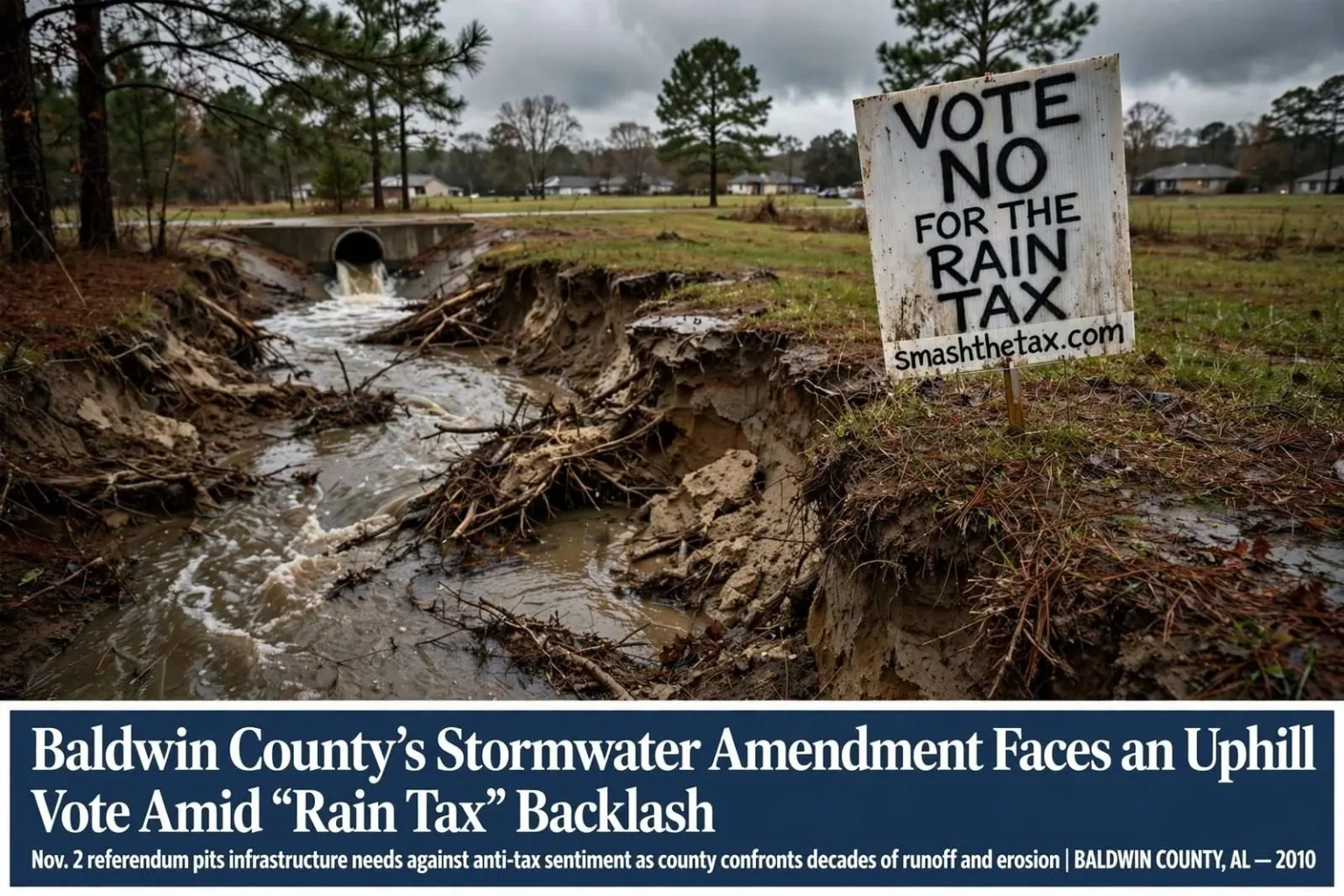
Stormwater management rarely ranks as a marquee political issue, but Baldwin County’s leaders warned that neglecting it was like ignoring high blood pressure, a quiet condition that could erode a community’s quality of life. In the fall of 2010, they placed that argument before voters in the form of a Nov. 2 referendum. The comparison captured the county’s predicament: nothing about drainage ditches, eroding creek banks or silted-in streams makes headlines, but the cumulative damage — to property, to waterways and to the quality of life that draws newcomers to the Eastern Shore — accumulates every year that the problem goes untreated.
The referendum came at an awkward moment for any measure that could be painted as a new cost. The Deepwater Horizon oil spill had battered the coast’s economy and its faith in large institutions, the recession had emptied county and municipal budgets, and anti-tax sentiment was running high in one of Alabama’s most reliably Republican counties. County leaders put the amendment on the ballot anyway, betting that voters would weigh a long-term infrastructure problem against the politics of the moment.
What Amendment One would do
Local Amendment One would create a countywide public corporation to finance comprehensive stormwater management. Supporters stressed that the measure carried no immediate additional financial burden for taxpayers; a yes vote would only give the county’s legislative delegation permission to create the local law, not automatically levy any fee. The corporation structure would allow the county to issue revenue bonds, accept grants and manage projects on a watershed basis rather than parcel by parcel, insulated from the annual budget cycle that makes multi-year infrastructure work so difficult.
With many municipalities and one of the largest land areas of any county east of the Mississippi River, Baldwin County had long operated “catch as catch can” on issues of erosion, flooding and water quality, even as three decades of development strained its waterways. The county’s geography makes the problem hard to overstate: rivers and creeks that rise in one city’s limits flow through three more before reaching Mobile Bay, and a subdivision’s parking lot in one municipality sends its runoff into a drainage system another town’s residents depend on.
Under the existing arrangement, each city handled stormwater inside its own boundaries, the county handled what it could in unincorporated areas, and no single body owned the problem at the scale of the watershed. The amendment’s drafters argued that the corporation was the only structure that matched the problem’s actual shape — water does not observe municipal limits — and that decades of piecemeal responses had proven the point.
Three decades of growth gave the urgency its force. Baldwin County’s population growth, among the fastest in Alabama, converted pine forest and pasture into rooftops, roads and driveways at a pace that changed how the land sheds water. Every impervious acre sends rain downhill faster and dirtier than the forest it replaced, and the county’s streams had been accumulating the evidence in their banks for a generation.
The opposition forms
Opposition formed around the prospect of a service charge on property owners, which would be calculated based on the amount of impervious surface, such as roofs, sidewalks, roads and parking lots, that generates runoff. The impervious-surface formula is standard practice in stormwater utilities across the country — the property that sheds the most water pays the most — but in Baldwin County’s charged political climate it was heard as something simpler: a tax on rain.
Critics branded the measure a “rain tax” and rallied under a “Vote No for the Rain Tax” banner, directing property owners to a website called smashthetax.com. One opponent scoffed that “environmental radicals” wanted “a slush fund,” while another declared that “resistance is not futile.” The slogans did what slogans do: they compressed a complicated governance question into a single phrase that could fit on a yard sign, and they gave voters who distrusted any new government entity an easy shorthand for a no vote.
The opposition’s structure was largely grassroots, organized online and through property-rights networks rather than through any single campaign organization. Its core argument held that the amendment was a tax in embryo — a corporation created now, a fee added later, with voters absent from the decision when it came. The fact that the amendment itself levied nothing was, in the opposition’s telling, precisely the problem: it was the enabling act for a cost that would arrive after the election was forgotten.
Supporters never quite escaped that framing. Every explanation of the corporation’s financing structure seemed to confirm that a fee was possible, if not certain, while every denial of an immediate tax seemed to concede that one was coming eventually. In a county where the property-rights wing of the Republican Party was ascendant, that ambiguity proved difficult to overcome.
Proponents make their case
Roberta Swann, director of the Mobile Bay National Estuary Program, acknowledged the steep climb. “As you can imagine, given the oil spill, the economic recession, and general mistrust of government, passage of this amendment is going to be tough,” she wrote. The Mobile Bay National Estuary Program, one of the nation’s estuary programs under the Clean Water Act framework, exists to coordinate protection of the bay’s watersheds, and Swann’s office had spent years documenting the decline of the very streams the amendment was written to address.
She pushed back on the “rain tax” framing, explaining that as hard surfaces multiplied, rain could no longer soak into the ground and instead rushed across pavement at greater speed and volume, degrading streams, creeks and rivers on their way to polluting Mobile Bay and the Gulf. The degradation is physical and measurable: flashier flows scour stream banks, carry sediment into channels, and deliver the nutrients and pollutants of urban runoff to the estuary that anchors the region’s economy, from its seafood industry to its beaches.
Swann warned that if the amendment failed, the county would be set back for years, and that rejection of a local solution would likely invite greater federal involvement through the Environmental Protection Agency. “If the County votes to keep the status quo, we can look forward to having EPA tell us what to do, instead of the community taking charge of itself,” she said. The argument inverted the anti-government pitch of the opposition: the choice, in her telling, was not between local control and no government at all, but between local control and federal control.
She noted an irony: opponents cited the failure of government even though the proposal aimed to minimize government’s role and involve the public more directly. The corporation model, in the proponents’ design, was meant to be leaner than a new county department, governed by a board with public participation, and funded by users of the system rather than by general taxation. To Swann, the amendment was a smaller-government answer to a problem the county had been ignoring — and its critics were attacking it as the opposite.
A developer weighs in
Baldwin County real estate developer Larry Chason, a member of the county’s stormwater management committee, conceded that proponents were swimming against a strong current of anti-government feeling but argued the problem was too big for any single one of the county’s governmental bodies to solve. When a developer who builds the subdivisions that generate runoff speaks for a stormwater measure, his argument carries a particular weight with the audience most skeptical of it.
He chided the naysayers point by point, insisting that coordination among the cities was lacking, that the EPA was poised to act, and that the amendment would neither set a fee nor create new bureaucracy. The coordination point went to the heart of the county’s experience: watershed-scale problems had defeated every ad hoc effort yet tried, because each city optimized for its own limits and the water paid no attention.
“Voting ‘yes’ on Amendment 1 is the first step towards protecting the most important thing that makes Baldwin County a special place to live,” he said. For Chason, the county’s waterways were not an environmental abstraction but the asset beneath the real estate market itself — the creeks, rivers and bayfront that sell the Eastern Shore lifestyle to the newcomers driving the county’s growth. Degrading them, in his view, was a threat to the same property values the opponents said they were protecting.
The developer’s involvement also pointed to a quieter split within the growth industry. Homebuilders and developers whose projects would bear the brunt of any impervious-surface fee might have been expected to oppose the measure uniformly, but the committee’s own membership included builders who had concluded that a predictable, countywide stormwater program was preferable to the alternative — piecemeal requirements, failing drainage infrastructure and, eventually, federal mandates imposed from outside.
A history of retreat
The City of Mobile had pushed a similar financing plan in the late 1980s, only to retreat under fierce blowback from developers. That episode cast a long shadow over the Baldwin County campaign, because it demonstrated that a stormwater fee could survive the policy process and still die politically. The experience taught the region’s officials a lesson that shaped the 2010 campaign: the technical merits of watershed management are no match for a well-organized tax revolt, unless the case is made early and made by messengers the opposition cannot dismiss.
Baldwin County’s amendment tried to absorb that lesson. By routing the financing through a public corporation and leaving any fee to later local legislation, its drafters hoped to put before voters only the question of whether the county should organize to solve the problem at all. But the “rain tax” framing collapsed the two-step design into a single question — do you want to pay for rain? — and in the political environment of 2010, that was the question voters heard.
The campaign’s outcome would rest with voters at the polls on Nov. 2, and both sides claimed to read the county’s mood accurately. The opponents saw a county that had just watched Washington mishandle an oil spill in its own waters, a recession squeezing household budgets, and a property-tax-sensitive electorate in no mood for new government entities. The proponents saw the same voters as the county’s longtime residents, who had watched their creeks fill with silt for thirty years and understood that nobody else was going to fix them.
What made the contest unusual was the substance underneath the slogans. Stormwater management is among the least glamorous and most consequential functions of local government: it determines whether roads flood, whether yards erode, whether shellfish waters close, and whether the streams that feed Mobile Bay run clear or brown. Few voters study it; every property owner pays for its failure, one way or another, in drainage problems, flooded roads and declining water quality.
The same tension, between the cost of action and the cost of inaction, defined a debate whose outcome would rest with the voters. Whatever Baldwin County decided at the polls, the rain would keep falling on three decades of pavement, and the county would keep paying the bill — either through the corporation its leaders had proposed, or through the slow, unreimbursed damage the county’s waterways had been absorbing for a generation.