A Falling Stock Price, a Phone Call to a Senator, and Champagne at Brookley
Mobile learned it had won the Air Force tanker contract in a scramble of stock tickers, cell phone calls and hastily bought sandwiches, and the political consequences began almost immediately.
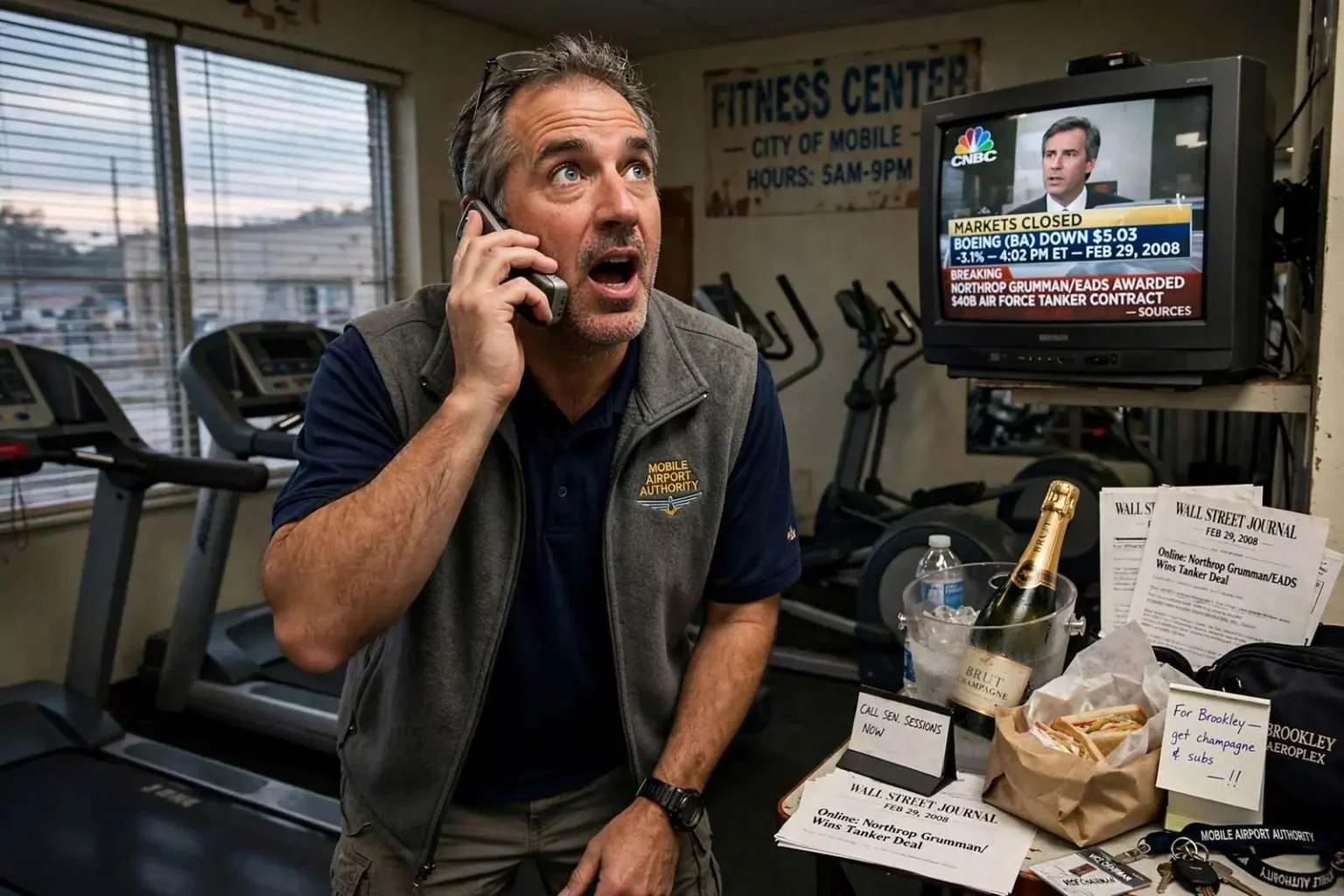
The news that Mobile had won the $40 billion Air Force refueling tanker contract reached the city sideways — through a stock ticker on a gym television, a cell phone call to a U.S. senator who had not yet been told, and a last-minute run for sandwiches and champagne.
How the Word Spread
Shortly before 3 p.m. on Friday, Feb. 29, 2008, a semi-retired Mobile executive on an exercise machine glanced up at a television and saw on the scrolling ticker that Boeing’s stock had fallen $5 at the market’s close. He drew the obvious conclusion, shouted it across the fitness center, and called an investment adviser to confirm. The adviser checked, saw the same dip, and within minutes The Wall Street Journal was reporting that the Northrop Grumman and EADS team had beaten Boeing.
He immediately called U.S. Sen. Jeff Sessions on his cell phone. “He’s in his Senate office waiting on the call from the Air Force,” the adviser recounted. “He answers immediately. I yell out ‘We got it — the whole thing’ so loud he doesn’t recognize my voice. I identify myself, tell him again, and he asks with genuine wonder in his voice, ‘How do you know? They have not called us yet.'”
The man who spotted the ticker was vice chairman of the Mobile Airport Authority — which meant that the first person in Mobile to know that an aircraft assembly line was coming to Brookley Field had, in a sense, exactly the right job. The Airport Authority operates the Brookley Aeroplex on the old air base site, and no one in the city had a greater personal stake in what the Air Force decision meant for the property. Markets had effectively announced the result before the Pentagon could: Defense Department contract awards of this size move hundreds of millions of dollars in supplier stocks, and Boeing’s decline told the story before any official statement crossed a wire.
A Scramble at Brookley
City Hall’s celebration at Brookley was improvised. The Brookley complex director was scrambling at the last minute for sandwiches and champagne. An administrative executive in the mayor’s office said the gathering had not been scheduled — it was an impromptu get-together to watch news reports from the Pentagon.
“Bloomberg’s was the first to call with the news, but we were still not sure and we decided to wait on Sen. Sessions,” she said. “Nothing would have us feel better than to have the entire council there had we known it was going to be a win for Mobile. We didn’t know.” City officials had been bracing for the announcement for months without knowing the date, and the Pentagon’s own timing — a Friday afternoon, with no advance notice to the city — left no time to organize anything resembling a formal ceremony.
At least two City Council members were annoyed at not receiving a heads-up. The mayor’s office said staff had begun calling council members as soon as the news broke. The friction was a small footnote, but a telling one: after a competition the city had pursued for years, its own elected officials learned the result through news reports rather than from the city’s leadership, and the missed call became the subject of the same day’s celebration.
The Political Arithmetic
The photographs from Brookley — Mobile Mayor Sam Jones and County Commissioner Stephen Nodine celebrating together on the front page — were the kind of image that money cannot buy in an election year. Nodine was up for re-election and had no known opponent in either party. County Commissioner Mike Dean, who did face a Republican challenger and possibly a Democrat in November, was at a county commission association meeting in Washington and missed the festivities entirely.
Nodine’s timing continued the following week. He and the county attorney traveled to Washington on county business and happened to be present for the first House subcommittee hearing on the tanker contract. For a county commissioner whose district included the Brookley site, being in the room as Congress opened its review of the largest aerospace award in the region’s history was the kind of fortuity no campaign could arrange and no opponent could match.
What Mobile Thought It Had Won
Brookley Field had been an open wound in Mobile since 1969, when the closure of Brookley Air Force Base wiped out thousands of jobs and shrank the city. The base had been one of the Gulf Coast’s largest military installations, and its closing — ordered as part of the post-Vietnam drawdown — removed an economic anchor that the city spent the next four decades trying to replace. Generations of Mobilians remembered the base’s payroll, its housing and the neighborhoods that emptied after the gates closed. The prospect of building military tankers on the same runways carried a symbolic weight that the raw job numbers never fully captured.
The celebration proved premature. Boeing protested the award, and in June the Government Accountability Office sustained the protest, finding significant flaws in the Air Force’s evaluation. The competition was reopened, and Boeing won the recompeted contract in 2011. The reversal stunned Mobile’s political leadership, which had already begun planning around an assembly line that would never arrive on military terms.
Mobile got its aircraft plant anyway. Airbus opened a commercial A320 final assembly line at Brookley in 2015, and has since expanded it — an outcome that traces directly back to the relationships and site work that began in the frantic hours of that Friday afternoon. The tanker campaign, whatever its outcome in the courtroom of the Government Accountability Office, had taught the city’s leadership how to compete for aerospace work: assembling a site, a workforce plan, an incentive package and a bipartisan political coalition that stretched from the mayor’s office to Alabama’s congressional delegation. EADS, the European parent of the losing tanker team, had seen in Mobile exactly what a commercial manufacturer would later see — deepwater port access on the Mobile River, an airfield with long runways, a shippable site for large aircraft sections and a workforce pipeline being built around it.
The Feb. 29 celebration itself faded quickly as the GAO’s June ruling rewrote the story. But the day left its mark on the city’s self-image: proof that Mobile could be in the running for work at that scale, and that a $40 billion decision could turn on evaluations conducted in Washington about a runway complex on the Mobile Bay causeway. The executives, politicians and civic leaders who crowded into the improvised celebration at Brookley would, within a few years, watch a different aircraft plant rise on the same ground — built by a different company for a commercial market rather than an Air Force contract, but standing on the foundation the tanker fight had poured.
For the officials whose photographs ran on the front page that weekend, the tanker victory and its later reversal bracketed the whole arc of Mobile’s modern economic development story — the improvised champagne at Brookley, the GAO ruling, the recompetition, and finally the A320 line that made Brookley an aerospace manufacturing site after all. The lesson city leaders drew from the episode was repeated for years afterward in economic development circles: Mobile had learned to play for the biggest stakes in the industry, and even losing a recompetition could not undo what the pursuit had built. The aircraft that eventually rolled out of Brookley bore the name of a company that had watched the 2008 contest from the losing side — and concluded that the city, at least, was worth the investment.
The scenes of that Friday afternoon — the gym ticker, the shouted phone call, the champagne run — have since taken their place in the local lore of a city that learned its biggest news of the century, for one afternoon, before Washington did. They also illustrate how contract competitions of that magnitude ripple through a community in real time: investment advisers watching supplier stocks, senators’ offices camped by their phones, city staff monitoring wire services for the official word. In Mobile, where the stakes ran to tens of thousands of eventual jobs on a site the city had spent decades trying to redevelop, the moment when the answer arrived mattered to nearly everyone.
The rival teams themselves carried the story across the region. The Northrop Grumman and EADS team had proposed assembling the KC-45 tankers at Brookley, with work shared with facilities in Europe, while Boeing had defended its incumbent position built around its Kansas and Washington state plants. Alabama’s entire congressional delegation had lobbied for the Mobile bid, and Gov. Bob Riley’s administration had invested heavily in the state’s recruitment effort. The Air Force’s decision, when markets divined it late that February afternoon, validated a bid that had been mocked early on as a long shot by a European newcomer with no American assembly line. For one weekend, at least, the long shot had won.
What followed the GAO’s reversal became its own chapter in the city’s history. The rebid process stretched on for years, with requirements rewritten to favor renewed competition, before the Pentagon ultimately awarded the tanker contract back to Boeing in 2011 through the recompeted contest. Mobile’s disappointment was softened only much later, and by a different industry: the commercial aviation boom that made Airbus look for its first U.S. assembly site found Mobile already prepared — with the site, the port, the runway, the workforce plan and the political relationships all tested and ready. The champagne at Brookley was premature in February 2008. The celebration the city eventually held, when the first Alabama-built A320 took shape on the same ground seven years later, was not.