Party Panel Knocks RaShawn Figures Off Ballot in Challenge to Rep. James Buskey
A Democratic Party subcommittee disqualified 28-year-old RaShawn Figures from the House District 99 primary on residency grounds, a ruling his campaign said it would appeal.
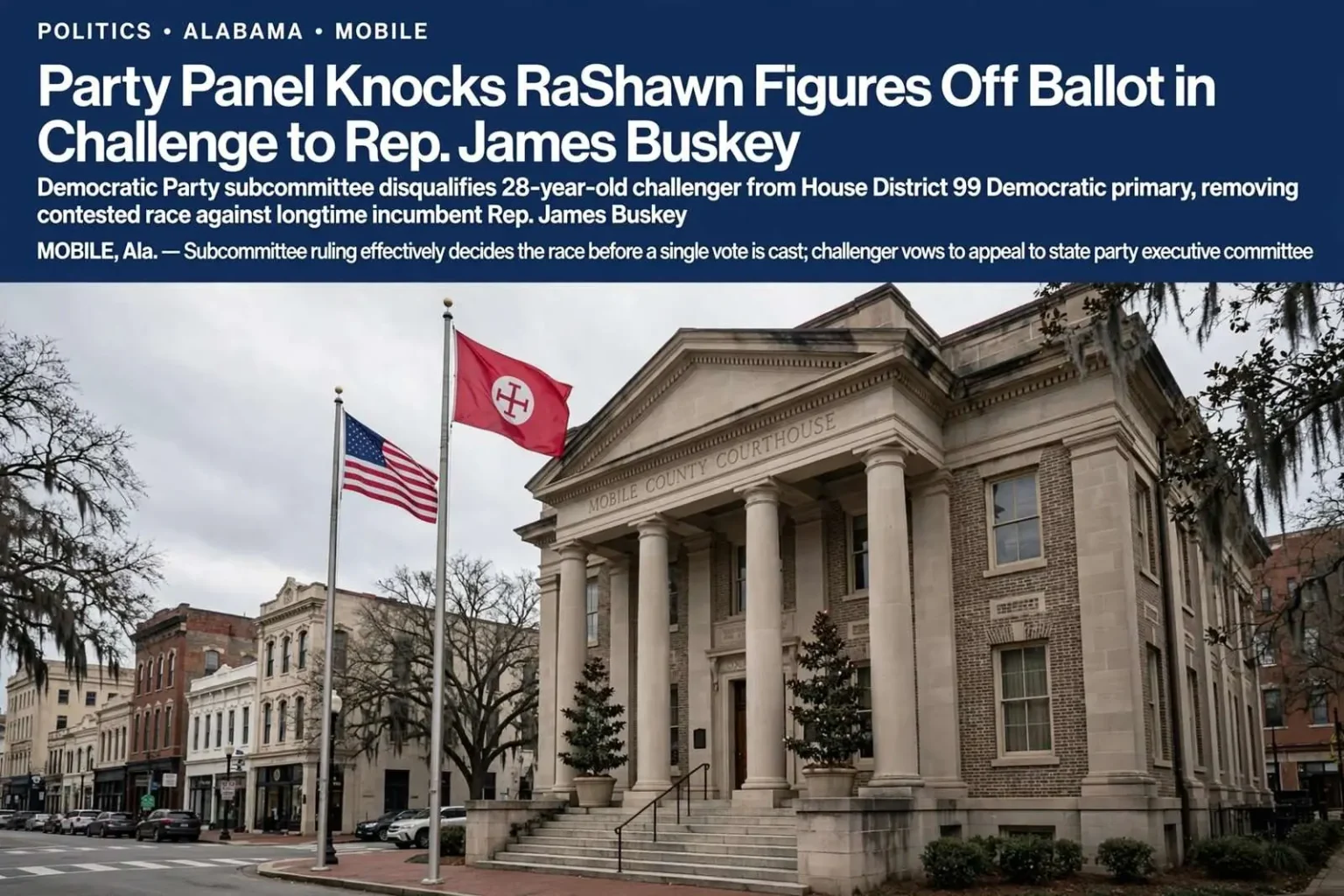
MOBILE, Ala. — A Democratic Party subcommittee has disqualified RaShawn Figures, the 28-year-old challenger to longtime incumbent state Rep. James Buskey, from the House District 99 Democratic primary, removing a rare contested race in one of Mobile’s oldest legislative seats.
The decision came through the party’s internal qualification process, the mechanism Alabama law gives political parties for judging whether their own candidates meet the legal requirements for the offices they seek. Because House District 99 is overwhelmingly Democratic, the party primary has for decades functioned as the real election, which meant the subcommittee’s ruling effectively decided the race before a single vote was cast.
The Residency Question
The challenge to Figures’ candidacy came from Buskey himself, who alleged that the young real estate investor did not meet the residency requirements for the office. The Alabama Constitution requires that a candidate reside within a district for one year prior to running to represent it — a provision that has ended more than one legislative bid in the state.
Residency challenges have become a recurring feature of Alabama election seasons, particularly in districts where the primary is decisive. The constitutional language sounds simple, but applying it rarely is: candidates move, own property in multiple places, and maintain family ties across district lines, and hearings turn on voter registration records, property records, utility bills and testimony about where a candidate actually lives and intends to remain. The one-year requirement is judged as of the date the candidate qualified, and challengers comb through the timeline looking for gaps.
The subcommittee agreed with Buskey and struck Figures from the ballot. For the challenger, the ruling meant the end of a campaign that had drawn attention precisely because serious opposition to the district’s incumbent is so unusual.
Figures Vows an Appeal
Figures said he expects to overturn the ruling on appeal. In his telling, the facts weighed heavily in his favor, but at the subcommittee level they were outweighed by something else: the presence of longtime Alabama Democratic Party official Joe Reed, who chaired the panel and who, Figures said, was firmly in Buskey’s corner.
Figures’ attorney, John Lawler, said several party officials appeared genuinely surprised by the decision that went against his client. The comment reflected what observers at the hearing described as a gap between the evidence presented and the outcome — a gap the appeal process will now be asked to close.
The appeal path runs through the state Democratic Party itself before any courtroom becomes an option. Alabama’s appeal structure for candidate disputes gives the state party executive committee the first look at subcommittee rulings, and only after the party machinery is exhausted can a rejected candidate ask the courts to intervene. The timeline is unforgiving, because ballots must be printed and absentee voting must begin on a fixed schedule set by state law, and a candidate who is not certified by those deadlines cannot appear on the ballot no matter how the dispute ultimately resolves.
A Long-Held Seat
Buskey, who turned 73 earlier this month, is a retired educator who was first elected to the Alabama House in 1976. He has held House District 99 ever since, making him one of the most senior members of the Mobile County legislative delegation and one of the longest-serving legislators in the state. Seats of that vintage rarely draw serious primary opposition, which is part of what made the Figures candidacy notable.
District 99 threads through some of Mobile’s most historic neighborhoods, and its voters have sent Buskey back to Montgomery through nearly five decades of change in the city — desegregation of its schools, the growth of its port and aerospace industry, and waves of redevelopment downtown and along the waterfront. Seniority in the State House translates into committee chairmanships and influence over the budgets that fund Mobile’s schools, roads and institutions, and longtime incumbents argue that is exactly what constituents give up when they turn a seat over.
The Figures name is among the best known in Mobile politics, associated with the late state Sen. Michael Figures and his widow, state Sen. Vivian Figures. RaShawn Figures’ father, Norman, and Michael Figures were first cousins, tying the young challenger to a political family that has represented Mobile in the Legislature for a generation and a half. Michael Figures built his career in the Senate at a time when Black legislators in Alabama were still fighting for basic procedural influence, and Vivian Figures has carried the family’s seat and its legacy since his death. That lineage gave the 28-year-old challenger name recognition most first-time candidates would envy, and it made the district’s first serious contested primary in years a test of whether the family’s political capital could transfer to a new generation.
RaShawn Figures’ day job in real estate investment placed him squarely in the neighborhood-redevelopment conversations that dominate Mobile politics, and his campaign framed the district as needing a generational handoff after decades under one officeholder. Buskey’s camp answered that the incumbent’s seniority and record were assets no newcomer could match. The ballot challenge, rather than the campaign, became the instrument that settled the question — at least for now.
What the Ruling Means
Party qualification disputes of this kind are decided internally, not in a courtroom, and the courts generally defer to party judgments made in good faith under the party’s own rules. That deference is why the composition of the hearing panel matters so much to candidates, and why Figures pointed to Reed’s role. Reed has been a dominant figure in Alabama Democratic politics for decades, leading the party’s minority caucus operations and controlling significant organizational muscle within the state party, and candidates challenging establishment figures have long viewed his panels with suspicion.
If the appeal fails, Buskey will run in the general election effectively unopposed by any candidate with a realistic path to victory, extending a tenure that began when Jimmy Carter was president. If Figures prevails, the primary would be restored, though the compressed calendar could force ballot reprinting and a scramble through absentee voting deadlines.
Beyond this race, the dispute is a reminder of how much power Alabama’s party qualification process holds over who actually reaches the ballot. In districts where one party dominates, a subcommittee of party officials — meeting with limited public attention — can function as the final election. Candidates, campaigns and voters in Mobile have now watched that power operate in real time, in one of the oldest legislative seats in the state.
The Mechanics of an Internal Election Ruling
The subcommittee’s hearing itself was a compressed affair by the standards of a courtroom. Panels of this kind convene on short notice, take testimony from the candidate and the challenger, accept documents into the record, and rule from the dais. There is no cross-examination in the legal sense, no formal rules of evidence, and no requirement for a written opinion explaining the decision. Candidates who come prepared with bank records, lease agreements and witness testimony can find that the deciding factors were organizational rather than evidentiary.
That structure is why attorney John Lawler’s observation about surprised party officials carried weight in the aftermath. If members of the party’s own apparatus expected a different result based on the record, the appeal to the state executive committee becomes not just a procedural formality but a genuine second chance for the evidence to control the outcome. The state party will review what the subcommittee heard, consider any new material the challenger offers, and decide whether the disqualification stands.
Timing will shape everything. Alabama’s election calendar leaves little slack between qualification disputes and the start of voting, and every week the appeal sits unresolved narrows the challenger’s practical options even if he wins. An overturned ruling that comes too late can leave a candidate qualified on paper but with no time to raise money, staff a headquarters or reach the voters he would need to unseat an incumbent with five decades of accumulated goodwill.
Residency and the Modern Campaign
The case also fits into a broader pattern of residency scrutiny in Alabama races. As more candidates maintain flexible living arrangements — a family home in one district, a rented apartment in another, a busy professional life that straddles the line — the constitutional one-year requirement has become the first weapon of choice against upstart challengers. Incumbents and party insiders know that a paperwork fight is cheaper and more certain than a campaign, and challengers increasingly discover that proving where they live is as important as convincing voters why they should win.
For District 99’s voters, the immediate consequence is a quieter election season than the candidate filing period promised. The seat will still appear on the ballot, and its eventual occupant will still cast votes in Montgomery on the education budgets, infrastructure funding and local legislation that shape Mobile’s future. What the district will not have, unless the appeal succeeds, is the open argument between generations that a contested primary represents.
Whether RaShawn Figures’ candidacy is revived or ends here, the episode has already clarified the terrain for future challengers in Mobile: in a safe district, the qualification hearing is the general election, and preparing for it deserves the same seriousness as any campaign stop. The state party’s appellate decision will determine whether this one ends with a knock-out punch or a rematch before the voters.