One City Along I-65? North Mobile County Weighed a Merger It Knew Would Never Happen
With a steel plant rising at Calvert and a new school system drawing families to Saraland, developers and officials debated dissolving Chickasaw, Satsuma and Creola into a single north Mobile County city.
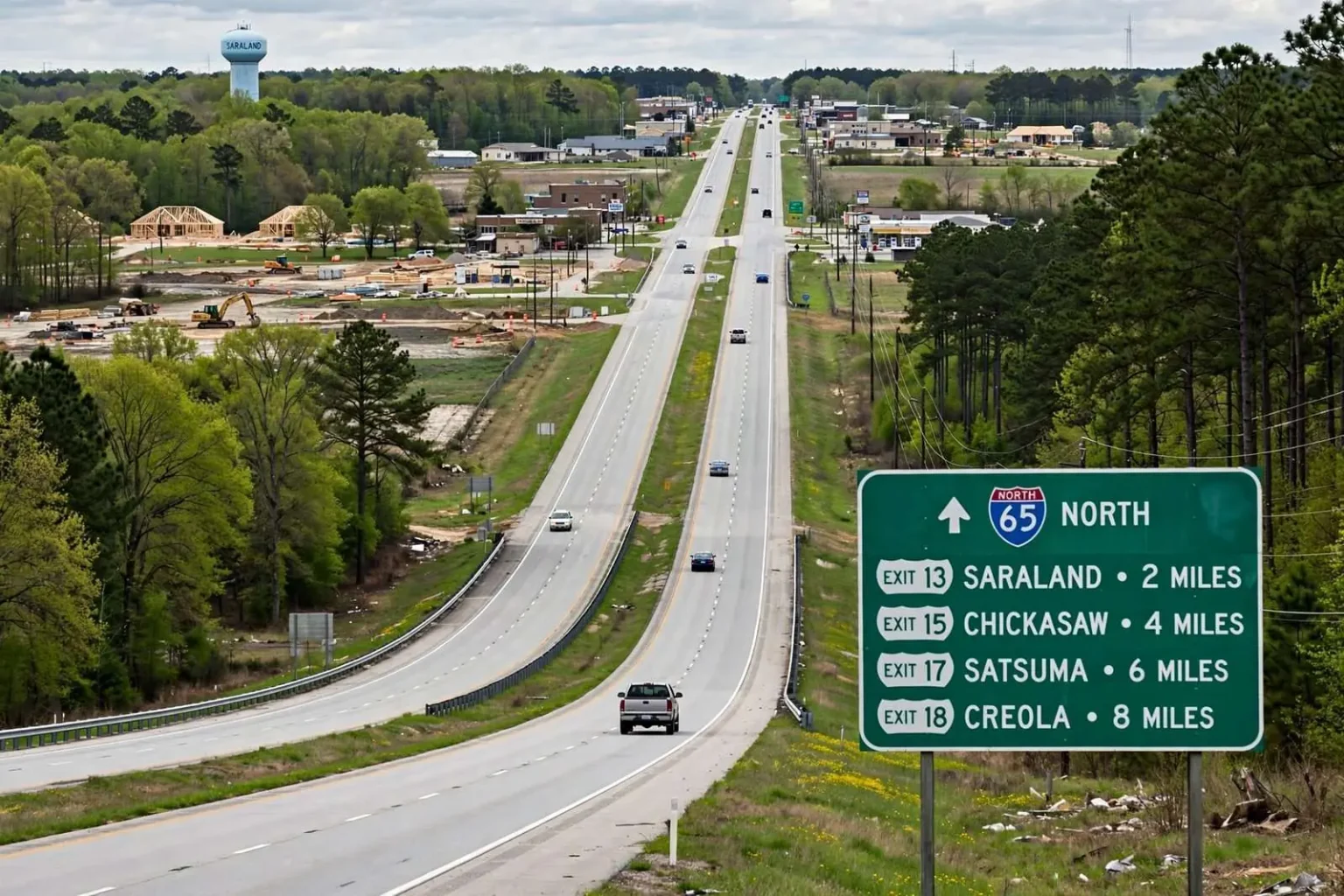
In the spring of 2008, north Mobile County was growing faster than at any time in memory — and a question that had been asked quietly for years surfaced again: what if Saraland, Chickasaw, Satsuma and Creola were one city instead of four?
Nobody thought it would happen. Almost everybody thought it was worth discussing.
The four towns sit in a chain along the northern edge of Mobile County, strung between U.S. 43 and Interstate 65 as the suburbs run north out of Mobile. Together they held roughly 20,000 residents, but their boundaries interlock awkwardly — unincorporated pockets between them, school zones crossing city lines, and development pressure arriving faster than any single town’s zoning could absorb. The idea of consolidation had surfaced before in civic conversation and died each time, for reasons that had not changed: each town prized its own identity, and Alabama law offers no easy mechanism for merging municipalities.
Saraland’s boom
Saraland Mayor Ken Williams put his city’s population at roughly 14,000 and predicted it would more than double, to 30,000, by 2012 — with or without any merger.
He said Saraland had been approached by owners of 2,700 contiguous acres about annexing into the city, and he rattled off a list of developers and investors who had contacted him from Fort Worth, Dallas, Tucson, Jackson, Memphis, Miami, Indianapolis, Lansing, Dayton, Birmingham and, memorably, an African country whose representative’s name he could not pronounce.
The list told its own story. Site consultants working national retail and residential deals had flagged north Mobile County on their maps, and a mayor fielding calls from eight states and another continent was describing, in his own way, a region that had appeared on the national growth radar almost overnight. The 2,700-acre annexation approach alone, if consummated, would have enlarged Saraland by an area larger than most of its existing footprint.
The engine, he insisted, was not the ThyssenKrupp steel complex rising at Calvert to the north, nor the proposed motorsports park, though both mattered. It was the school system.
Saraland had voted to break away from the Mobile County system and form its own city school district, and families were moving north to get into it. “The number one card is the school system,” Williams said, estimating that 60 to 70 percent of new residents tied to the steel plant would choose to live in Saraland because of it — and adding that he might be conservative in that estimate.
As for the neighboring towns: “We would welcome them in if they wanted to come. I don’t see it happening, but we would welcome them.”
The case for consolidation
The strongest argument came from a Mobile attorney who had grown up in the area and said he had rarely distinguished one town from another as a boy — church in Saraland, elementary school in Satsuma, the barber shop and city pool in Chickasaw, youth baseball across all of them. A merged city, he argued, would have a school system with enough existing facilities and tax base to operate at a scale none of the towns could reach alone, and a single government speaking with one voice instead of four.
Developers and site consultants agreed almost unanimously on the economics. One counted roughly 15 miles of interstate frontage across the four communities — comparable to Mobile’s own — and noted that the frontage sat in four separate jurisdictions with four separate zoning codes, four permitting offices and four sets of ambitions. A consolidated city controlling that frontage end to end could plan it the way a single developer plans a master-planned community: commercial nodes here, residential districts there, industrial sites where the rail and port access favored them.
The duplication argument ran alongside the growth argument. Four police departments, four fire services, four municipal clerks and four city halls served a combined population smaller than several single suburbs elsewhere in the state. Consolidation advocates argued that a merged government could afford professional-grade services — planning staff, engineers, economic development professionals — that no town of three or four thousand could support alone, and that the smallest towns, Chickasaw and Creola chief among them, were already straining to deliver basic services on shrinking tax bases.
There was a state-level precedent for the argument. Alabama’s city-county consolidations elsewhere had failed repeatedly, but municipal mergers in other states — Jacksonville’s consolidation with Duval County being the famous one — showed that unified governments could market themselves to national employers with a single address, a single school system and a single permit. North Mobile County’s problem, the attorney argued, was not potential but fragmentation: the growth was arriving, and four small governments were competing to catch fragments of it rather than planning for it together.
Why it was never going to happen
The case against consolidation was, in the end, simpler and more decisive than the case for it. Alabama law does not provide a practical mechanism for merging incorporated municipalities: cities grow by annexation, and annexation requires the consent of the territory and its residents — a bar that no set of town hall meetings in north Mobile County was going to clear. A merger would have required a local act of the Legislature tailored to the four towns, and legislators whose districts included some of the towns but not others had no unified incentive to carry it.
The identity argument did the rest. Chickasaw, a former company town with a century of its own civic history; Satsuma, whose citrus-era roots ran deep; Creola, proud of its small-town scale; and Saraland, suddenly the region’s growth engine, each had reason to fear being the junior partner in someone else’s city. Consolidation debates across Alabama had foundered on the same rock for decades: the argument that a bigger government would be more efficient rarely beat the argument that it would be somebody else’s government.
Williams himself had described the arithmetic without pretending it was realistic. Saraland’s annexation pipeline — the 2,700 acres and the calls from eight states — gave his city the option of simply growing outward instead of merging, and every acre Saraland absorbed was an acre the merged-city map lost. Consolidation required neighbors to join a winner that no longer needed them, which is the single hardest sell in municipal politics.
The schools complicated it further. Saraland’s breakaway from the Mobile County system had been the community’s signature achievement, carried through a local legislative act and years of planning, and its city schools were the magnet driving the real-estate boom. Chickasaw and Satsuma would eventually pursue school breakaways of their own — a development that, had it been foreseen in 2008, would have given each town exactly the asset consolidation would have dissolved. The school card that made Saraland grow was also the card that made merging unthinkable for its neighbors.
ThyssenKrupp changed the region anyway, without any merger. The steel complex at Calvert, one of the largest private industrial investments in state history, brought thousands of construction workers and hundreds of permanent jobs to the northern county, and the growth Williams predicted arrived — in Saraland, but also in Satsuma, Creola and the unincorporated land between them. The interstate frontage was developed piecemeal, jurisdiction by jurisdiction, exactly as the fragmentation critics had predicted: no unified plan, four sets of decisions, and growth that favored whichever town got to a site first.
What the discussion left behind
The 2008 conversation mattered mostly as an early map of what was coming. Williams’s forecast — a Saraland approaching 30,000 — proved roughly accurate in direction if not in timetable, and the acreage annexations he described moved the city’s boundaries steadily northward through the following decade. Satsuma and Chickasaw both formed their own school systems in the early 2010s, completing the pattern the merger debate had foreshadowed: not consolidation, but parallel institution-building, town by town.
The debate also fixed the region’s long-term question in place. North Mobile County remains, in effect, one continuous community served by four governments — one police jurisdiction blending into the next, one school zone crossing a city line, one interstate corridor split among four planning authorities. Every comprehensive plan drafted since has had to negotiate the same fragmentation the 2008 consolidationists named, and every annexation fight since has replayed the same identities they could never overcome.
The lesson the episode left for civic leaders was double-edged. Fragmentation costs real money and real planning capacity — the developers’ 15 miles of frontage argument has aged well — but Alabama’s structure makes merger a legislative long shot, and the communities involved would each rather grow alone than merge. In the years since, growth has answered the question the region asked in 2008: north Mobile County became one economy without ever becoming one city.