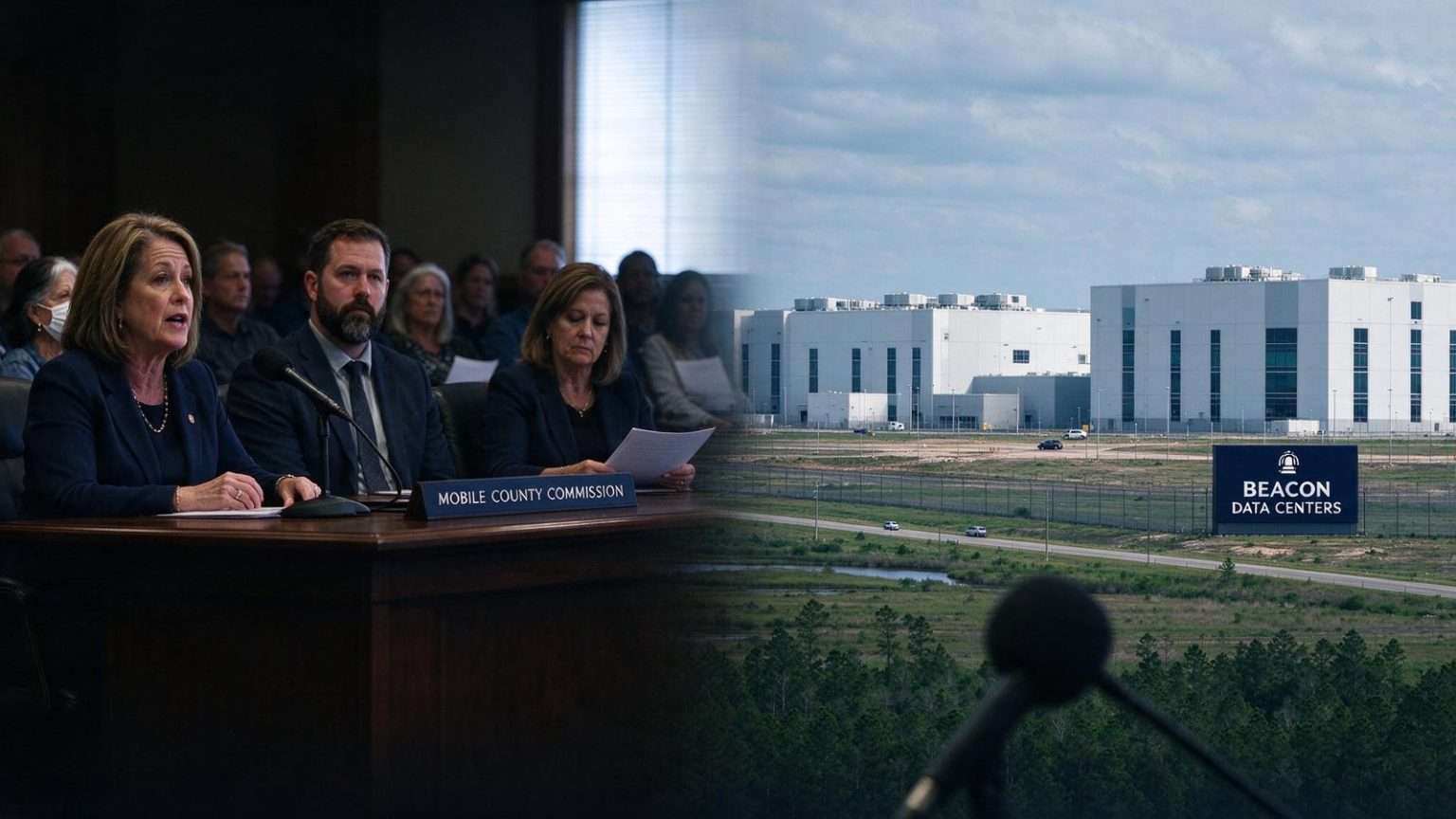
The sprawling data center campus planned between Calvert and Mount Vernon will not raise local utility bills and will pour tens of millions of dollars in taxes into Mobile County’s coffers every year — that was the message county commissioners and utility officials delivered to a skeptical audience this week.
Mobile County Commission President Connie Hudson, a District 2 commissioner whose district includes the project site, invited representatives from area utility providers and the Mobile Chamber to the commission’s Tuesday, July 28, meeting to answer residents’ concerns about Beacon Data Centers’ proposal for a 95-acre information processing complex known as the Calvert Infrastructure Hub. Company materials describe roughly $6 billion in initial construction, about 1,000 construction jobs and around 250 permanent operational jobs, with the first building slated for completion in 2027.
Why the County Says Its Hands Are Tied
Hudson and the county’s other two commissioners have stressed repeatedly that the county has no legal authority to stop or even shape the project. Alabama counties lack home rule powers over land use in unincorporated industrial zones, the county does not issue the construction permits, and Beacon has not requested tax abatements or other incentives that would require a vote of the commission.
Hudson said they listened to concerns and tried to explain the county does not have the legal authority to prevent such a development from coming to Mobile, because they don’t have home rule; they don’t issue construction permits because it’s in an industrial zone; and the developers have not requested tax abatements or anything of that nature requiring approval. Hudson said this is just factual information for their benefit.
The distinction matters to residents who have asked commissioners to intervene. At the commission’s July 13 meeting, three women urged the board to stop the project, citing fears about power and water consumption, bears being pushed into neighborhoods, and even claims that the facility would raise temperatures nearby or affect livestock. Commissioners have said many of those claims are not supported by evidence, but they have also acknowledged the anxiety behind them is real — and they brought in the utilities to address the parts of it that can be quantified.
The Water Question
Donnie Cunningham, executive director of South Alabama Utilities, which would supply water to the project, said the campus would consume roughly 7,500 gallons per day once operational — about what a 50-lot subdivision uses. That water would serve the data centers’ employee facilities. The servers themselves are planned to be cooled by a closed-loop system, similar in principle to a car radiator, which recirculates coolant rather than evaporating water at the site.
Beacon would bear the cost of any upgrades needed to the local water and sewer system, Cunningham said, and the utility’s existing supply gives it plenty of headroom. A natural well producing around 1.7 million gallons per day has the company “in great shape,” he said.
Cunningham said anything like this will not affect a rate increase; they are not going up on any rates.
The Power Question
Electricity is the bigger resource question for any data center campus, and Alabama Power’s Mobile division manager Erin Delaport addressed it directly. She said data centers do not make other customers’ power bills rise because the utility’s contracts require the facilities to pay the full cost of serving their operations.
Delaport said data centers do not make power bills go up. At Alabama Power, they have a disciplined approach requiring data centers to pay their full cost to serve their operations. Alabama Power will not enter into any contract with the data center until an engineering study is completed.
She added that Beacon would pay to improve the local electrical grid, though the utility did not detail how much power the campus would ultimately draw or whether specific upgrades are already needed regardless of the project.
The Tax Base Argument
David Rogers, the Mobile Chamber’s vice president of economic development, told commissioners that Beacon’s investment would translate into significant tax revenue for the county and its schools — tens of millions of dollars annually, by the county’s estimate. Because Beacon has not sought abatements, the property taxes and sales taxes generated by construction and operation would flow to local governments at or near their full rates, an unusual posture for a project of this size.
For a rural corner of north Mobile County that has watched industries pass it by, the promise of a permanent tax base and hundreds of jobs carries real weight. For the residents who live closest to the site, the concerns are less about money than about water pressure, traffic on rural roads, noise from cooling equipment and what a 95-acre industrial campus does to a landscape defined by timberland and river frontage.
What Happens Next
Construction is slated to begin by the end of the year, with the first building expected in 2027. Because the site sits in an unincorporated industrial zone, permitting runs through state and federal agencies rather than through the county commission, leaving residents’ recourse largely limited to the regulatory review those permits require and to whatever conditions the utilities’ contracts impose.
Commissioners have promised continued briefings as the project develops. What Tuesday’s session made clear is that the county’s role in the largest private investment ever proposed for north Mobile County will be limited to asking questions — and passing along the answers.
Related coverage from South AL News
- $6 Billion AI Data Center Planned for Calvert — and Residents Want It in Writing
- Mobile County Commissioners Tell Residents They Have No Legal Power to Halt the Calvert AI Data Center
- Prichard Council Weighs 480-Day Pause on New Data Center Permits
- Alabama Regulators Open Data Center Power Contract Review as Calvert, Prichard and Stockton Projects Loom