Cranbury Township Fraud Tops Mobile’s $14.7 Million Arena Loss, but N.J. Town Recovered Most of Its $26 Million
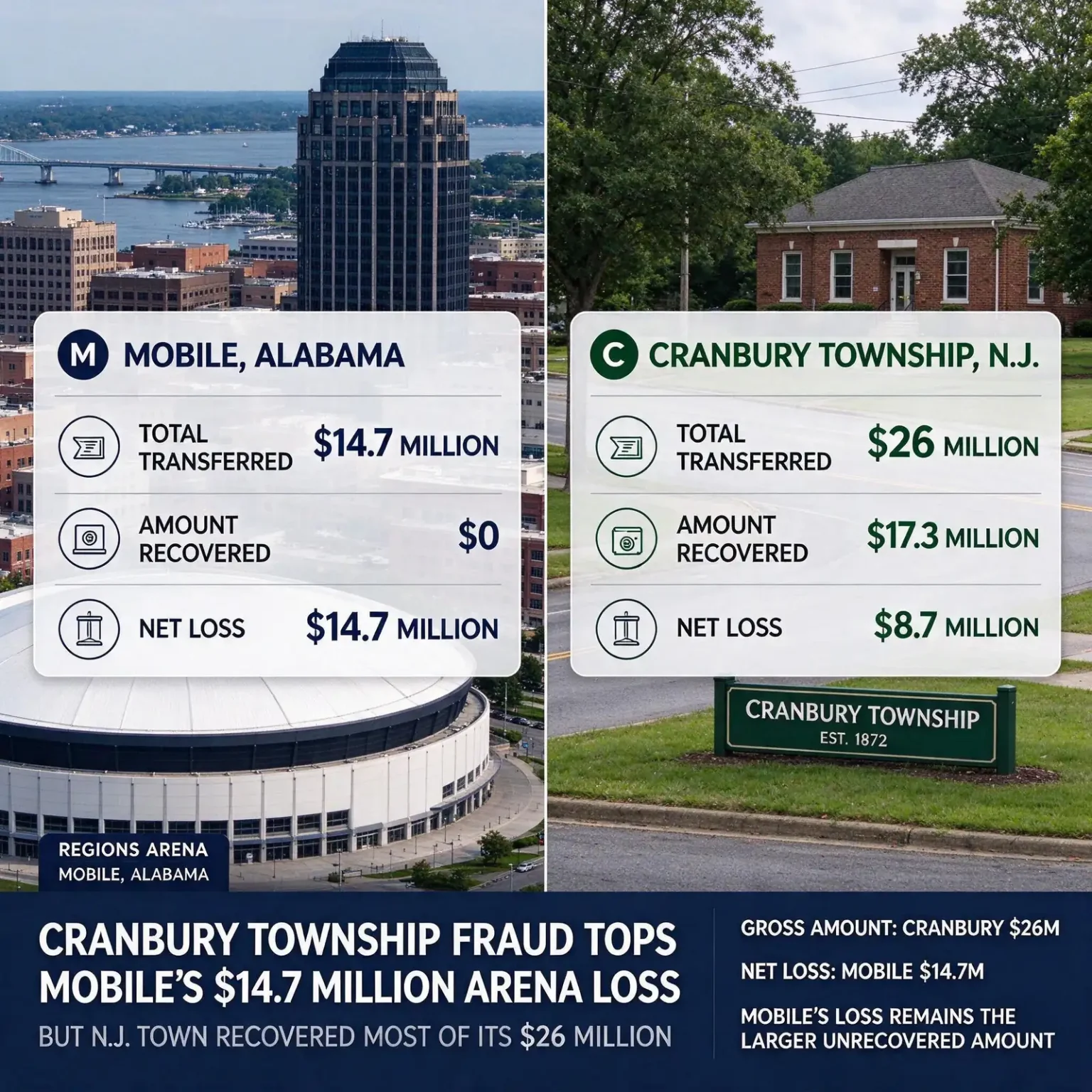
A New Jersey township was tricked into wiring $26 million in September, topping Mobile's $14.7 million arena fraud. But Cranbury recovered $17.3 million, so Mobile still holds the record for money lost and not recovered.
MOBILE, Ala. — The city of Mobile no longer holds the dubious distinction of losing the most money in a single fraudulent wire transfer by an American municipality, at least not on paper. Cranbury Township fraud disclosures made last week show the New Jersey community lost about $26 million to a scammer in September, though investigators have since recovered most of it.
Cranbury Township Mayor Lisa Knierim announced that the township was tricked into wiring roughly $26 million on Sept. 28, 2026. About $17.3 million has been recovered, leaving the township’s net loss at around $8.7 million. That means Mobile, which lost $14.7 million to a fraudster posing as the Regions Arena construction contractor in early October and has not recovered any of it, still appears to hold the record for the most municipal money lost and not recovered in a scam.
What happened in Cranbury
Cranbury is a small township in Middlesex County, N.J., about an hour south of New York City. Knierim disclosed the theft in a Facebook post.
Knierim wrote that on September 28, 2026, Cranbury Township was the victim of a sophisticated financial theft involving approximately a $26 million wire transfer. He wrote that the funds were designated for the purchase of property intended to support the Township’s affordable housing obligations.
New Jersey municipalities have a legal duty, rooted in the state Supreme Court’s Mount Laurel decisions, to provide a realistic opportunity for their fair share of housing that low- and moderate-income families can afford. Buying land for that purpose is one way towns try to meet those obligations, which helps explain why a small township would have been moving such a large sum at once.
Knierim credited local, county, state and federal law enforcement investigators with recovering $17.3 million of the stolen money.
The announcement came several weeks after the fraudulent transfer and only days after Cranbury voters went to the polls on Tuesday, Nov. 3, in the election for the Township Committee, the township’s governing body.
Cranbury’s response
Knierim said the Township Committee plans to strengthen its finance department by hiring an assistant administrator and an assistant chief financial officer, and to bring in a municipal accounting firm for consultation.
She acknowledged that the news would alarm residents.
Knierim wrote that they recognize the news will understandably raise questions and concerns among residents, that those concerns are legitimate and taken seriously. He wrote that their commitment is to protect the financial interests of Cranbury Township, support the ongoing investigation, maintain essential municipal services, and keep the community informed as verified information becomes available.
Township officials did not publicly describe how the scheme worked, who received the money or whether anyone has been identified as a suspect.
How the numbers compare
The Cranbury case reshuffles a short and unwelcome list. Before Mobile announced its loss on Tuesday, Oct. 20, the largest known municipal fraud loss belonged to Portland, Ore., which wired about $6.7 million to a fraudster in an email scam in 2025. Portland ultimately got its money back after its bank flagged a mismatch on the receiving account and the FBI seized the funds.
- Cranbury Township, N.J.: About $26 million transferred on Sept. 28, 2026; about $17.3 million recovered; net loss of roughly $8.7 million.
- Mobile: $14.7 million sent on Oct. 2, 2026; no recovery announced.
- Portland, Ore.: About $6.7 million wired in 2025; recovered.
By gross amount, Cranbury’s transfer is now the largest of the three. By money actually lost, Mobile’s $14.7 million remains the largest, well ahead of Cranbury’s roughly $8.7 million.
The timing also stands out. Cranbury’s transfer went out on Sept. 28, just four days before Mobile’s payment left the city’s accounts on Oct. 2, meaning the two schemes played out almost side by side, hundreds of miles apart.
Mobile’s loss, by the numbers
In Mobile, the money was a legitimate monthly payment owed to B.L. Harbert International, the Birmingham-based general contractor building the roughly $300 million Regions Arena on the site of the former Mobile Civic Center. Mayor Spiro Cheriogotis has said an impostor first contacted the city’s Finance Department in late May, posing as a Harbert employee, and that the first change to the contractor’s banking information was entered into the city’s system on May 27.
Over the following months, a city employee and the fraudster exchanged what the mayor described as hundreds of communications. The $14.7 million payment went out on Oct. 2. Harbert told the city on Oct. 7 that it had not been paid, but the problem was not brought to Cheriogotis and Executive Director of Finance Logan Gewin until Oct. 16.
Fraud experts have said the chances of reversing a fraudulent transfer drop sharply if the theft is not discovered within about 48 to 72 hours, because criminals quickly move the money from account to account. Cranbury has not said how quickly its theft was discovered or how investigators managed to recover the $17.3 million.
In Mobile, the FBI is leading the effort to trace the money, and five agencies, including the FBI and the U.S. Secret Service, are investigating and will oversee a forensic audit. No arrests or charges have been announced.
Cheriogotis said last week that the scheme succeeded because employees missed a series of warning signs, as South AL News reported. He said frankly that the fraud should have been caught, that the red flags were everywhere and were not chased down. Among them, he said, staff confirmed the banking change by calling a phone number supplied in the impostor’s own email rather than a number the city already had on file for Harbert.
One Finance Department employee has been fired and two others remain on paid administrative leave. The employees have not been named.
Where the money comes from
The lost $14.7 million came out of the arena’s $15 million owner’s contingency, the reserve set aside for cost overruns. The city has also said the loss represents an estimated $22.2 million in bond payments over 20 years. Project manager Sam Matheny told the City Council’s Finance Committee on Nov. 3 that construction is about 75% complete and that the arena is projected to cost about $281.6 million.
Cheriogotis has said he does not expect insurance to cover the loss, though he remains hopeful that federal agents can recover some or all of the money. The 10,000-seat arena is scheduled to open on March 25, 2027, with a concert by the Red Clay Strays.
Since the loss, Mobile has tightened its rules. Payments of $1 million or more must now be made by hand-delivered check rather than by wire or other electronic transfer, and every change to a vendor’s banking information must be verified three times, including by Gewin, who will give final approval before payments are released.
A growing national problem
The Cranbury and Mobile cases fit a pattern that fraud investigators call business email compromise, in which criminals impersonate a trusted vendor or employee and persuade an organization to send money to a new account. Local governments are frequent targets, in part because public bid documents and meeting records reveal which contractors are working on which projects and roughly how much they are owed.
The FBI has reported that losses from business email compromise exceed $3 billion a year. Other public bodies hit in recent years include the north Alabama city of Arab, which lost more than $432,000 earlier this year in a scheme involving an impostor posing as an officer of a construction company; Lexington, Ky., which lost $4 million in fake housing payments; and Peterborough, N.H., which lost $2.3 million it never recovered.
Experts consistently give the same advice to cities, businesses and individuals: verify any request to change payment information by calling the vendor at a phone number already on file, not one provided in the request, and move quickly if something seems wrong.
What comes next in Mobile
The fallout from Mobile’s loss is still working its way through City Hall. Upcoming steps include:
- Tuesday, Nov. 10: The City Council was scheduled to discuss appointing special counsel to assist with its own investigation.
- Tuesday, Nov. 17, 1 p.m.: The council’s Finance Committee is scheduled to take up the fraud again.
- Ongoing: A seven-member citizens’ ad hoc committee on financial transaction security, created by the council on Nov. 3, has six months to review city financial procedures and report its findings. Federal agencies continue to trace the money.
Anyone who believes they have been the victim of a wire or email fraud scheme can file a complaint with the FBI’s Internet Crime Complaint Center at IC3.gov.