Mayor Cheriogotis Says ‘Red Flags Were Everywhere’ Before Mobile Lost $14.7 Million to Arena Impostor
Mayor Spiro Cheriogotis says Finance Department staff missed repeated warning signs, from a look-alike email address to a call placed to the impostor’s own number, before $14.7 million meant for the Regions Arena contractor went to a fraudster.
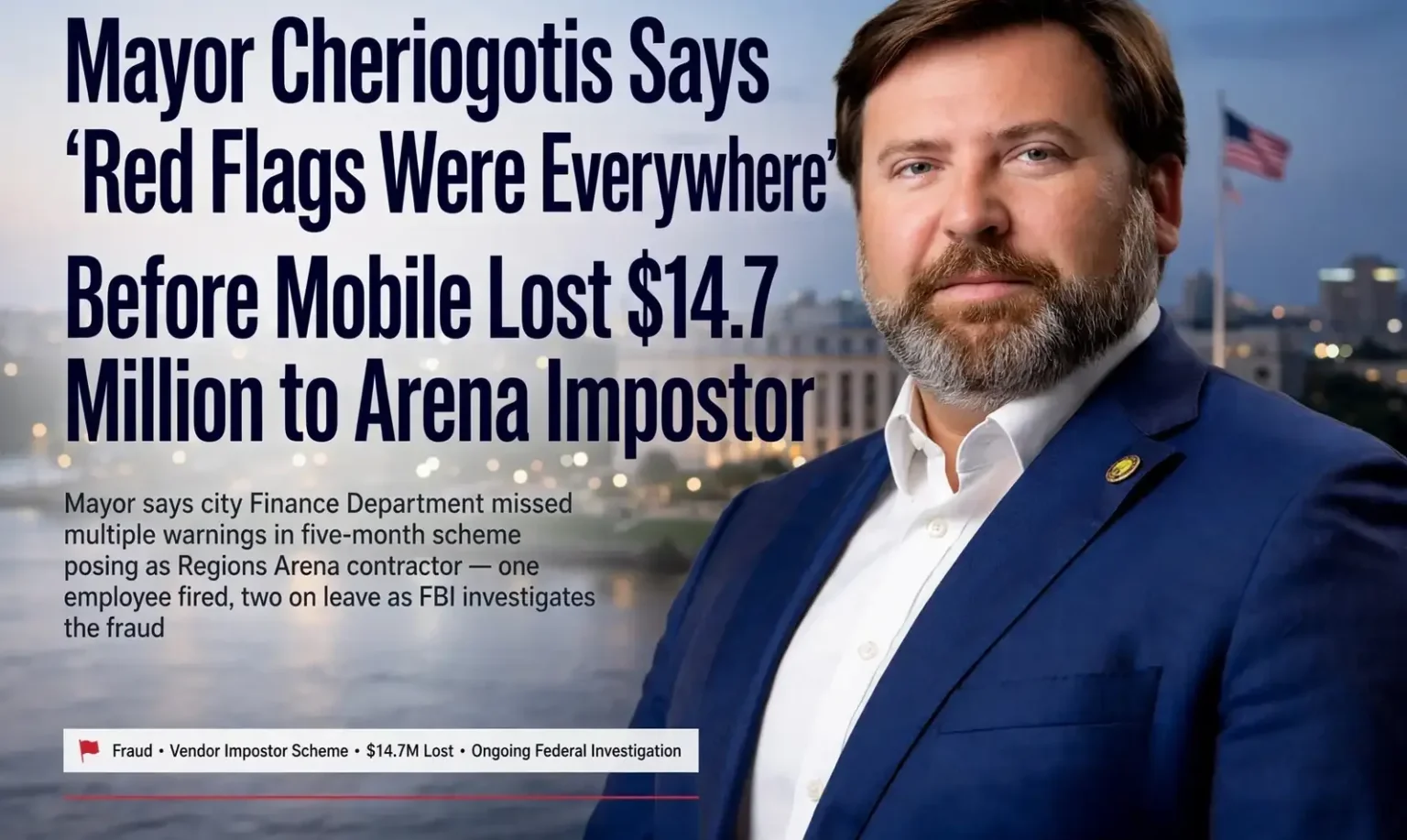
MOBILE, Ala. — Mayor Spiro Cheriogotis says the $14.7 million that Mobile lost to an impostor posing as the Regions Arena contractor should never have left the city’s accounts, and that employees in the Finance Department passed over one warning sign after another during the five months the scheme was unfolding.
“Frankly, this fraud should have been caught. The red flags were everywhere, and they were not chased down,” Cheriogotis said in interviews with reporters on Thursday, Nov. 5.
The mayor’s remarks were his most detailed public account so far of how the scheme worked, why he believes it succeeded and who he holds responsible.
“The more I know about this situation, the more frustrated I become that it happened,” he said.
An email that looked right, almost
The scheme began in late May with an email to the Finance Department from someone claiming to work for B.L. Harbert International, the Birmingham-based general contractor building the $300 million arena on the site of the former Mobile Civic Center.
According to Cheriogotis, the message carried Harbert’s correct logo and referenced the company’s real web address. The sender’s email address, however, contained extra characters added to the company’s standard blharbert.com address, a difference the mayor said should have stood out.
The impostor also presented a convincing persona. Cheriogotis said the person used “a very normal name” and an email signature line listing a plausible job title at Harbert, along with a story explaining why the company needed to change its account information.
“There was some backstory about what the need was to change the account, and I think that telling you exactly what that is probably goes too far,” he said. “But, they had an excuse for needing to change the account information.”
The mayor withheld some details at the request of federal investigators and declined to elaborate on the “charming” accent that Executive Director of Finance Logan Gewin described last week.
The first change to Harbert’s banking information was entered into the city’s internal system on May 27, Cheriogotis said. From then until the payment went out on Oct. 2, a city employee and the fraudster exchanged what the mayor called “hundreds of communications.” He said nothing he has seen suggests the relationship was anything other than professional.
‘A legitimate business doesn’t hide from an audit’
One was the direction in which information flowed. The impostor asked the city for multiple invoices and other records the real contractor would already have had, and city employees supplied them.
“Failure to recognize that is a huge red flag,” Cheriogotis said, noting that such information should come from a contractor, not be requested from the city.
Another was the explanation the impostor kept returning to: that Harbert was undergoing an audit. The mayor said that reasoning should have drawn suspicion rather than cooperation.
“To me, that doesn’t make sense,” he said. “A legitimate business doesn’t hide from an audit. They don’t move money around because of an audit. I think that’s a glaring red flag that, frankly, runs through the communications that should have been seen, and it wasn’t.”
A third was the scope of the changes. The impostor did not simply provide new account and routing numbers, the mayor said, but asked that payments go to an entirely different U.S. bank from the one Harbert had been using. There were several rounds of banking changes over the summer, and the impostor also asked the city to switch the payment method from a wire transfer to an ACH deposit.
The phone call that went to the wrong number
Cheriogotis said the banking change was reviewed in May by two people in accounts payable, and city employees spoke by phone with the impostor at “multiple levels” in an effort to confirm the request. The problem, he said, was which number they dialed.
Staff called a phone number supplied in the impostor’s own email instead of contacting a trusted Harbert representative at a number the city already had on file. The mayor said that kind of independent check should have been routine.
Late in the process, the city also struggled to get its own bank to accept the updated payment instructions, which were sent shortly before the Oct. 2 payment. Cheriogotis said that difficulty alone should have given employees pause.
“I think the fact that they were having difficulty getting the bank to receive our communications to update this information was a massive red flag,” he said.
The impostor never asked for a specific dollar amount, the mayor said. The $14.7 million was a legitimate monthly payment owed to Harbert for work on the arena; the fraudster only had to tell the city where to send it.
‘A confidence scam’
Cheriogotis said the scheme relied on persuasion, not hacking. The city has said its computer systems were not breached and that no employee clicked a malicious link.
To explain it, the mayor reached for a famous example. Frank Abagnale, the con man whose story was told in the 1980 book “Catch Me If You Can” and the 2002 film of the same name starring Leonardo DiCaprio, claimed to have passed bad checks in the 1960s while posing as a Pan Am pilot.
“This scam is Frank Abagnale walking into the bank with a Pan Am uniform and a Pan Am check, convincing the teller that he is a pilot for Pan Am and getting them to cash the check,” Cheriogotis said. “It’s a confidence scam.”
August safeguards were not followed
The arena loss came only weeks after the city stopped a separate, unrelated fraud of nearly $1 million. City Attorney Robert Shreve told council members on Nov. 3 that city funds went to a fraudulent entity on Aug. 13 in that case and were recovered on Aug. 18, and that a new protocol took effect Aug. 28 that took the approval of vendor changes away from accounts payable.
Gewin has said the August rules likely would have stopped the arena scheme had they been in place when it began in May. Cheriogotis went further on Thursday, saying the written protocols were in place before the money went out and still were not followed.
“It’s clear to me from the communications, those were not followed,” he said. “There were opportunities after that August event, after those written protocols were put in place, to stop the transaction from happening, and it wasn’t. $14.7 million was sent to the wrong place, to the wrong people, and that hurts.”
Since the October loss, every change to a vendor’s banking information must be verified three times, including by Gewin, and Gewin will give final approval before payments are released, the mayor said.
Eight days before the mayor knew
Harbert contacted the city on Oct. 7 to say it had not received its payment. The matter was not elevated to Cheriogotis and Gewin until Oct. 16, fourteen days after the money went out and nine days after the first questions arose inside the department.
Asked how concerned he was about that delay, the mayor answered with one word: “Extremely.”
City officials have previously said fraudulent transfers can often be reversed if flagged within about three days. Cheriogotis said employees should have told Gewin about a situation “like this as soon as possible.”
Discipline and the finance director
One Finance Department employee has been fired and two others remain on paid administrative leave. The employees have not been named. Cheriogotis said the different outcomes reflect the three workers’ different employment statuses with the Mobile County Personnel Board, and he said further disciplinary action is still possible.
No one on the mayor’s leadership team has been disciplined, and Cheriogotis spent much of the interview defending Gewin, who started in the job on April 14 after a national search.
“Another thing that is frustrating with me is the amount of backlash the finance director is receiving,” the mayor said. “The bulk of this and the crux of this transaction, which was initial change of vendor banking information, occurred on May 27. It was within a month of Logan’s hiring.”
Gewin arrived to a department under strain, Cheriogotis said. In a division that now has 27 employees, 33 people have quit, left, been fired or otherwise turned over since 2023. Gewin was tasked with quickly filling six positions and writing the fiscal 2027 budget, which the council approved in September.
The department has also cycled through leaders since longtime Finance Director Paul Wesch died in late 2020. Wesch also served as chief of staff to former Mayor Sandy Stimpson. Cheriogotis said the department has had five executive directors since then, but declined to call it “dysfunctional.”
“Paul Wesch left a large hole that no one other person could ever fill,” he said. “We’ve had good directors in that time.” He partly blamed the turnover on public-sector pay that cannot match private industry.
Investigations, insurance and the money
The FBI is leading the effort to trace the money, which has not been recovered. Cheriogotis said five agencies, including the FBI and the U.S. Secret Service, are investigating and will oversee a forensic audit.
The city is working with its insurance providers, but the mayor said he does not expect insurance to cover the $14.7 million loss. He said he remains hopeful federal agents can recover some or all of it.
On the council side, members voted Nov. 3 to create an ad hoc committee on financial transaction security, a panel of seven residents that will review city financial procedures but has no investigative power. Council members are also scheduled to discuss appointing special counsel for their own investigation at their meeting on Tuesday, Nov. 10.
Cheriogotis said he welcomes the citizen committee. “I hope that we’re able to bring in citizens with some expertise, some knowledge, and they’re able to review what we have put in place, what we are doing going forward, that gives [the public] a level of confidence about how these transactions will be handled in the future,” he said. “I think independent eyes are good.”
He was more skeptical of a council-led investigation. He said it was “hard for me to think” one was necessary given the federal work already underway, though he acknowledged that members want “to respond to their constituents.” The cost of the various investigations has not been determined, and any spending on them would add to the city’s losses.
“I’m certainly concerned about spending money unnecessarily,” he said. “For any reason.”
Arena still on schedule
The lost money came out of the arena’s $15 million owner’s contingency, the reserve meant to cover cost overruns. Project manager Sam Matheny told the council’s Finance Committee on Nov. 3 that construction is about 75% complete and that the project is projected to cost about $281.6 million, leaving it slightly under what remains of the budget.
“We are confident we can get this completed in the budget,” Cheriogotis said. “Anything can happen and that is why we have contingencies in place. I’m hopeful … we’ll get it completed within the $300 million budget just in time for the Red Clay Strays.”
The Mobile-formed band is scheduled to open the 10,000-seat arena on March 25, 2027. Councilman Cory Penn has said the lost money would have been a “game changer” for infrastructure in his district, but the mayor said it was always restricted to the arena.
“Everyone can think of what the $14.7 million could be, and people go through the process saying I could do this, that and the other with $14.7 million,” he said. “But it was part of the arena project budget. It was never intended for any other purpose than that. Until that project closes out, there is no other purpose for it.”
What comes next
- Nov. 10: The City Council is expected to discuss appointing special counsel to assist with its own investigation.
- Nov. 17, 1 p.m.: The council’s Finance Committee is scheduled to take up the fraud again.
- Ongoing: Federal agencies continue to trace the money and oversee a forensic audit, and the citizen committee will have six months to report its findings to the council.