New Jersey, Florida Men Get 16 and Nearly 12 Years in Mobile Federal Court for Decade-Long Check Fraud Ring
Vernon A. McCreath of Jersey City and Mikhail C. McCreath of Miami were sentenced in Mobile to 192 and 140 months in federal prison for their roles in a nationwide bank fraud and identity theft ring that ran from 2015 to 2025.
MOBILE, Ala. — Two men from New Jersey and Florida have been sentenced to a combined 332 months in federal prison for their roles in a bank fraud and identity theft ring that prosecutors say stole mail, counterfeited hundreds of checks and money orders and used stolen identities to move money through banks across the country, including in the Mobile area, for nearly a decade.
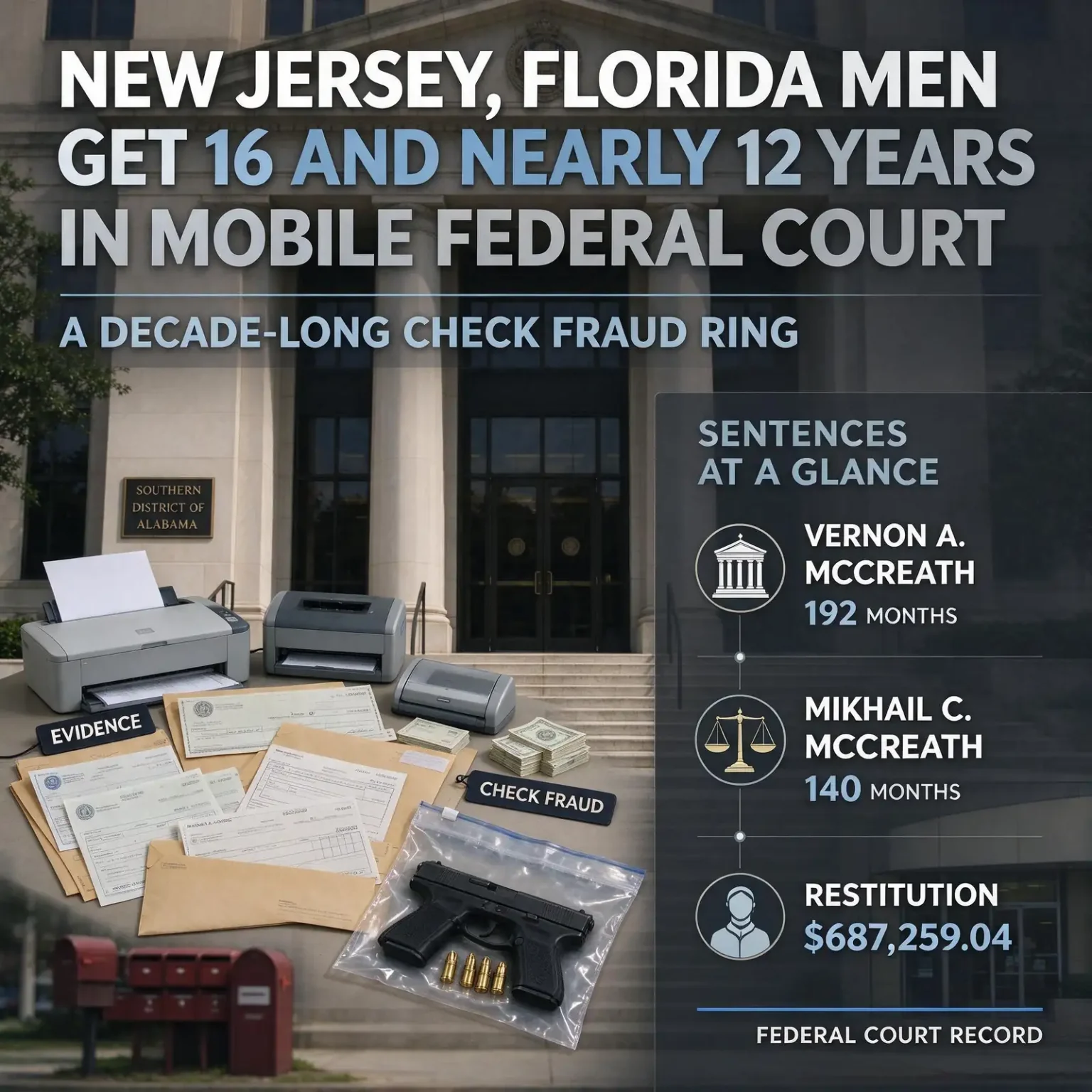
Chief U.S. District Judge Jeffrey U. Beaverstock sentenced Vernon A. McCreath, 39, of Jersey City, New Jersey, to 192 months, or 16 years, in prison. Mikhail C. McCreath, 35, of Miami, Florida, received 140 months, a little less than 12 years. The sentences were announced Nov. 6 by the U.S. Attorney’s Office for the Southern District of Alabama, which prosecuted the case in federal court in Mobile.
The court also ordered the two men to pay $687,259.04 in restitution to victims. After they are released, each will serve five years of supervised release, during which they will be subject to drug testing, financial monitoring and restrictions on opening new lines of credit.
Sentences at a glance
- Vernon A. McCreath, 39, of Jersey City, New Jersey: 192 months in federal prison
- Mikhail C. McCreath, 35, of Miami, Florida: 140 months in federal prison
- Restitution: $687,259.04 to victims
- Supervised release: Five years each, with drug testing, financial monitoring and credit restrictions
What the defendants admitted
According to court documents, both men pleaded guilty to taking part in a scheme that combined bank fraud, identity theft, mail theft and check counterfeiting. Prosecutors said the conduct ran from September 2015 through September 2025.
During that period, the McCreaths and their coconspirators obtained stolen checks and money orders, used victims’ personally identifiable information to open bank accounts in other people’s names, made forged identification documents and counterfeited hundreds of financial instruments. The group then cashed or deposited those instruments at banks around the country, including banks within the Southern District of Alabama, which covers Mobile, Baldwin and several other southwest Alabama counties.
Prosecutors said the victims included religious organizations, small businesses, charities and public school systems, among others.
Search of an Atlanta-area home
A turning point in the investigation came in April 2025, when agents executed a search warrant at the Atlanta-area home of Demetrius J. Manassa, whom prosecutors describe as one of the McCreaths’ primary coconspirators.
Inside, agents recovered dozens of stolen and counterfeit checks and money orders, fake identification documents, stolen mail, check-counterfeiting equipment, printers, blank check stock, a loaded Glock pistol and ammunition, according to the U.S. Attorney’s Office.
Fingerprint analysis tied Vernon McCreath to stolen postal money orders recovered in that search, prosecutors said.
Telegram messages and a $1.3 million deposit image
Investigators also examined cellphones belonging to Manassa and found hundreds of messages on the encrypted messaging app Telegram that he had exchanged with the McCreaths and others involved in the scheme.
According to prosecutors, those messages contained stolen personal information, details used to make fake identification documents, pictures of stolen checks and mail, and videos showing members of the group with large amounts of cash believed to be fraud proceeds.
One image sent through Telegram showed a fraudulent deposit of about $1.3 million. Investigators identified Mikhail McCreath’s fingerprint in that image, the U.S. Attorney’s Office said. Prosecutors also noted that one of Vernon McCreath’s Telegram usernames was “IDoBankFraudd.”
A wider case with roots in Mobile
The McCreaths are the latest defendants sentenced in a case that has been working its way through Mobile’s federal courthouse for more than a year.
In May 2026, U.S. District Judge Kristi K. DuBose sentenced Demetrius J. Manassa, then 38 and listed as a New York resident, to 180 months in prison, and Jarrod A. Ross, 30, of Mobile, to 84 months. Both had pleaded guilty. The court ordered the same restitution figure, $687,259.04, in their cases, and noted Manassa’s prior record, which included a federal crack cocaine conspiracy conviction in Vermont and several state theft, fraud and drug convictions.
The government’s account of the case at that time offered a closer look at how the scheme worked locally. Prosecutors said that in 2022, thousands of blank postal money orders were stolen from three postal facilities in New York and North Carolina. Members of the group counterfeited dozens of those money orders and deposited them into accounts at banks across the Southeast. Postal inspectors said they identified coconspirator Patrick E. Williams on surveillance video depositing many of the fraudulent money orders at banks in the Mobile area.
In one example cited by prosecutors, Ross walked into a Mobile bank on Aug. 5, 2022, and opened a checking account using a fake Mississippi driver’s license that carried his own photo but the stolen personal information of a New York man. The victim told investigators he had never been to Alabama. Prosecutors said the group repeated that approach with dozens of other accounts, and also set up fake businesses so it could try to deposit larger checks, some worth more than $1 million each.
Prosecutors said Ross and coconspirator Khashawn D. Sidberry also submitted more than $400,000 in fraudulent unemployment insurance claims seeking pandemic-era federal benefits, which brought the U.S. Department of Labor’s Office of Inspector General into the investigation.
Where the other defendants stand
According to the U.S. Attorney’s Office, the court has now sentenced these coconspirators:
- Demetrius J. Manassa: 180 months
- Shaquan L. Manassa: 60 months
- Jarrod A. Ross: 84 months
- Khashawn D. Sidberry: 90 months
- Terran E. Walker: 60 months
Two other coconspirators, Patrick E. Williams and Jahvon H. Mosquito, are scheduled to be sentenced at a later date, prosecutors said.
A related trial was held in Mobile in July. A federal jury convicted Jacody Deauntae Roberts Williams, 22, of Mobile, of taking part in the conspiracy after a four-day trial, according to a July 13 announcement from federal authorities. Evidence in that trial included a $34,000 counterfeit check, stolen from the mail and altered to be payable to Williams, that a coconspirator tried to deposit in March 2025; the bank refused it. Prosecutors also said the search of Manassa’s home turned up counterfeit checks and money orders bearing Williams’ name. At the time, his sentencing was set for October 2026 before Judge Beaverstock. The latest announcement did not address his case.
Who investigated
The U.S. Postal Inspection Service and the U.S. Department of Labor’s Office of Inspector General investigated the case. The U.S. Secret Service, the Baldwin County Sheriff’s Office, the Florida Highway Patrol, the Glen Rock Police Department in New Jersey and the South Fulton Police Department in Georgia provided substantial assistance, according to the U.S. Attorney’s Office.
Assistant U.S. Attorney Justin Roller prosecuted the case for the government.
When Manassa and Ross were sentenced in May, U.S. Attorney Sean P. Costello said the group had “exploited and stole from hundreds of individuals, businesses, charities, schools, and other victims across the country, causing untold damage.”
What a federal sentence means
Federal prison terms work differently from many state sentences. Parole was abolished in the federal system for crimes committed after Nov. 1, 1987, and federal inmates can earn at most 54 days of good-conduct credit for each year of the sentence imposed, so defendants generally serve the large majority of their terms.
Supervised release begins once a prison term ends. People on supervised release report to a U.S. probation officer and must follow conditions set by the judge. A violation can send them back to prison.
Restitution orders require defendants to repay victims for losses tied to the crime. In multi-defendant cases, courts often make that obligation shared among the people responsible, so each can be required to pay until the victims are made whole.
Protecting yourself from check and mail fraud
Cases like this one often start with something as simple as a check taken from a mailbox. Common precautions include mailing checks from inside a post office rather than leaving them in a mailbox overnight, collecting mail promptly and reviewing bank statements regularly for unfamiliar activity.
Anyone who believes mail has been stolen can report it to the Postal Inspection Service at uspis.gov/report. People who suspect their identity has been used to open accounts can file a report and get a recovery plan through the Federal Trade Commission at IdentityTheft.gov.
South AL News has also covered a separate federal case in Mobile in which a Staten Island man was sentenced to five years in October for his role in a stolen-check marketplace run through Telegram, and another in which two south Mobile County men were sentenced in September for a mail theft and counterfeit check scheme.