Historic Oaklawn Cemetery Reborn as Outdoor Museum Honoring Black Mobilians
Descendants and community members gathered at Mobile’s Oaklawn Cemetery for the opening of the Historic Oaklawn Outdoor Museum, which honors African Americans who shaped the city’s history.
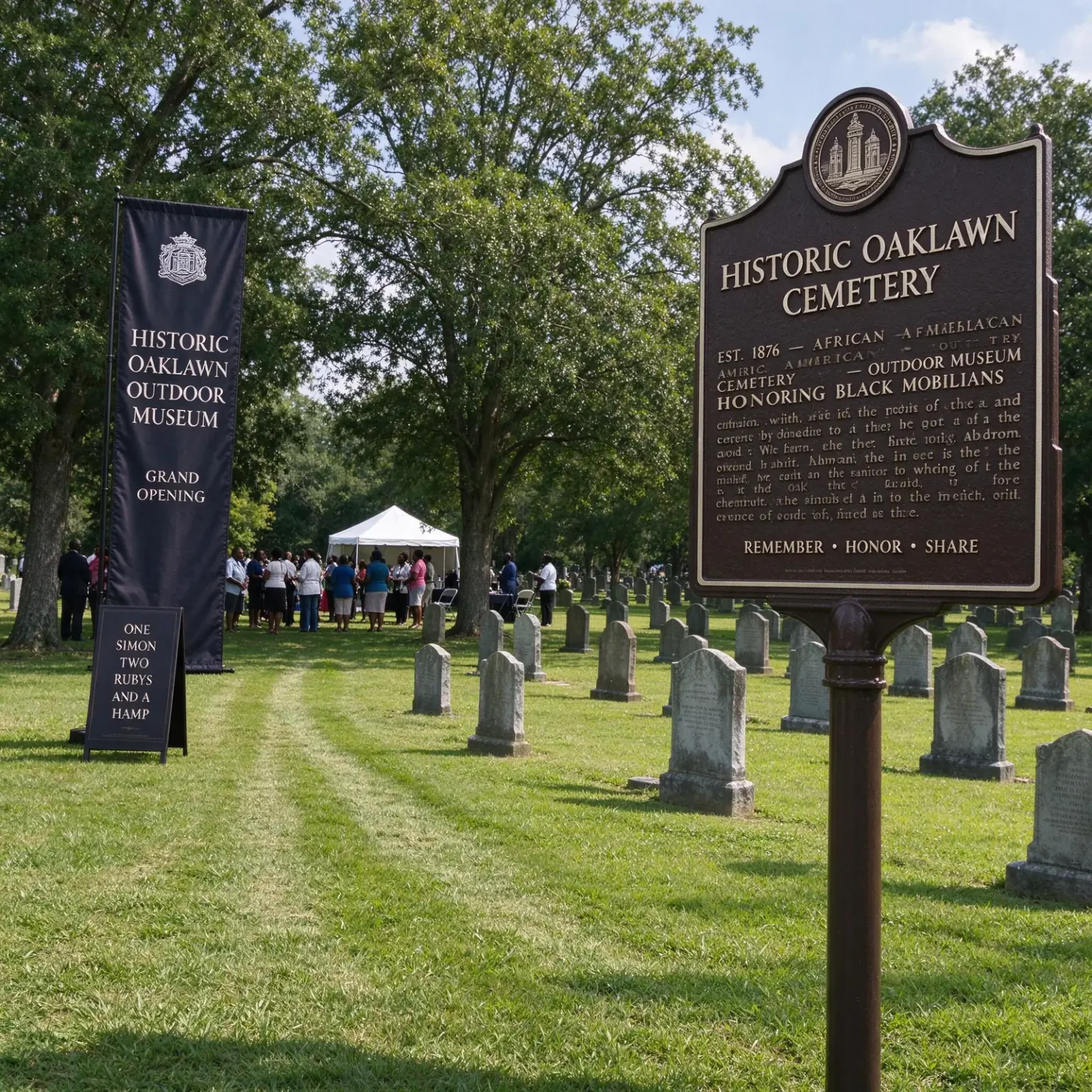
MOBILE, Ala. — A historic African American cemetery in Mobile that spent decades overgrown and largely forgotten has been formally designated an outdoor museum, as families, educators and descendants gathered on its grounds for the official opening of the Historic Oaklawn Outdoor Museum.
The free celebration at Oaklawn Cemetery was hosted by the nonprofit One Simon Two Rubys and a Hamp and honored African Americans who helped shape Mobile’s history. Descendants of people buried at Oaklawn took part in the program, and the Excelsior Band performed a musical tribute. Afterward, guests set out on self-guided tours of the grounds.
The opening marks the second phase of a long-running effort to preserve the cemetery. Designating the site as an outdoor museum is intended to protect and share the stories of the people buried there. The project is funded through an education grant from Mobile County Commission District 1, which is represented by Commissioner Merceria Ludgood.
A cemetery with deep roots
According to a historical marker at the site, Oaklawn Cemetery is believed to have begun in 1876 as a family burial plot, became a community cemetery by 1879 and was expanded into a formally organized cemetery in 1931. Historical and burial records indicate it primarily served Mobile’s African American community.
No one knows exactly how many people are buried at Oaklawn, but the marker estimates the number at as many as 10,000. Among them are veterans from every branch of the military, including the Merchant Marine, who served in World War I, World War II, Korea, Vietnam and other conflicts. Purple Heart, Bronze Star and Silver Star recipients are buried there, along with Buffalo Soldiers and Tuskegee Airmen.
Many leaders of Mobile’s African American community also rest at Oaklawn, including educators, union leaders, doctors, attorneys, church leaders, artists and politicians.
The 20-acre cemetery does not have perpetual care, meaning there is no permanent fund to pay for ongoing maintenance. After changing ownership several times, it became completely overgrown and, as the marker puts it, “seemingly forgotten and lost to time.” The cemetery was listed on the Alabama Historic Cemetery Register on Sept. 6, 2018, and the marker was erected in 2019 by the Mobile chapter of the 92nd Infantry Division Buffalo Soldiers Association.
Oaklawn sits on Holt Road in north Mobile, just north of the Catholic Cemetery of Mobile and near the historic Africatown community.
A family search that became a mission
One Simon Two Rubys and a Hamp grew out of one woman’s search for her ancestors. Executive Director Ana Wright, who relocated to Mobile after years in Chicago, wrote on the organization’s website that she first entered Oaklawn in November 2024 to find the grave of her great-great-grandmother, Ruby Roberts-Clayton.
She found the grounds so overgrown that, after four hours of searching, she still had not located the grave. Wright returned with tools and began clearing brush herself. She found her great-great-grandmother’s headstone and went on to uncover the graves of several more family members. According to the organization, her clearing work also led to the discovery of more than 30 additional graves nearby.
Wright founded the nonprofit on March 21, 2025. Its name honors four of her ancestors: Simon Roberts; his daughter, Ruby Roberts-Clayton; Hamp Jenkins; and his daughter, Ruby Jenkins-Wright, Wright’s grandmother.
“Because Oaklawn has always received such negative attention, I was like, I need to get the signs up and beautify it so that people can see the vision that I see,” Wright told WKRG in August.
Community support and county funding
The cleanup has drawn volunteers and partners from across the community. Groups including Keep Mobile Beautiful and Veterans for Recovery have worked alongside the nonprofit, and a Martin Luther King Jr. Day cleanup at the cemetery in January 2026 recruited volunteers through the University of South Alabama’s South Serves program. Keep Mobile Beautiful President Kris Enzor serves on the nonprofit’s board.
WKRG reported in August that One Simon Two Rubys and a Hamp had received nearly $30,000 in grants and donations for the work, including a $15,000 grant from the Mobile County Commission. Because the cemetery is abandoned private property and is not maintained by the city, the station reported, upkeep has largely fallen to families of those buried there and to volunteers.
What visitors will find
The museum is designed for self-guided visits. According to the nonprofit, it has identified and located the burial plots of 75 people who will serve as the museum’s founding honorees. The honorees are organized by cemetery section, and visitors can find each plot and read the person’s history through linked Find a Grave memorials.
The honoree list includes ministers, physicians, educators, military service members and longtime community figures. Among them is Dr. Yvonne Kennedy, the longtime Mobile state legislator and former president of Bishop State Community College, who died in 2012. The list also highlights graves with unique headstones.
The organization credits the research behind the database to historian volunteers Dr. Jim Ellis and Georgeann Ellis, working with the Local History and Genealogy division of the Mobile Public Library.
Why it matters
Historic African American cemeteries across the South have faced similar challenges: limited records, no perpetual-care funds and ownership that changed hands or lapsed over time. Restoration projects like the one at Oaklawn aim to reconnect families with the resting places of their ancestors and to make sure the contributions of the people buried there are remembered.
For Mobile, Oaklawn holds part of the city’s story that is not always told elsewhere, from veterans who served in segregated units to the professionals and church leaders who built institutions in the city’s Black neighborhoods.
How to visit or help
The outdoor museum is open for self-guided tours, and information on the founding honorees is available on the One Simon Two Rubys and a Hamp website. The organization welcomes volunteers for cleanup days and can be reached through its website.