Mobile Police Decline to Discuss Facial Recognition as Council Weighs $67,000 Clearview AI Renewal
The Mobile City Council is considering a $67,000 renewal with facial recognition firm Clearview AI, but police declined to discuss how they use it, citing operational security.
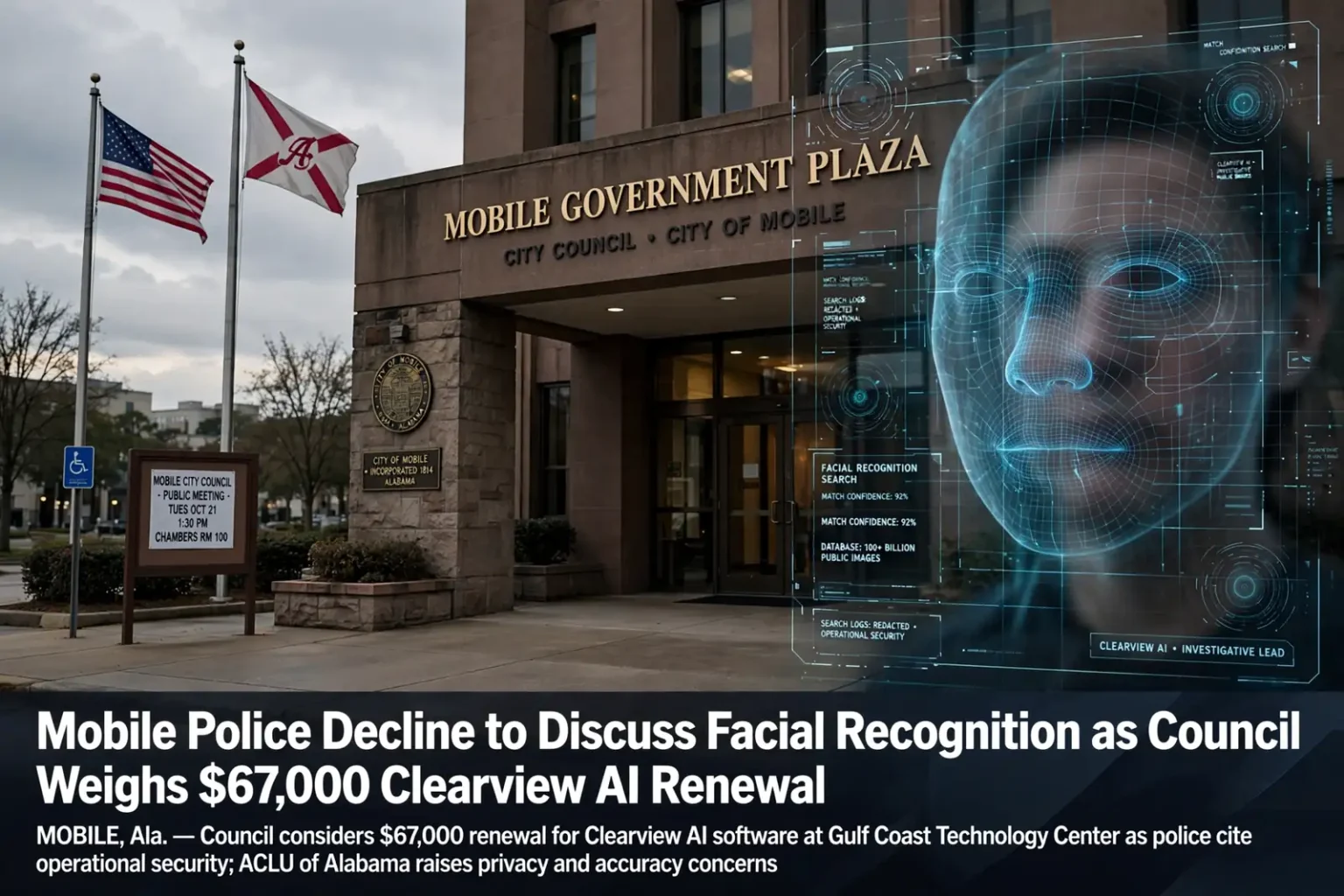
MOBILE, Ala. — The Mobile City Council is weighing a $67,000 contract to renew the city’s use of Clearview AI, a facial recognition company whose software lets investigators compare a photo of an unknown person against a vast database of images collected from the internet. But the Mobile Police Department is declining to explain how officers use the technology, saying the subject is a matter of operational security.
The proposed renewal comes as surveillance technology draws growing scrutiny in Alabama, from civil liberties advocates to newly elected state officials who campaigned on limits for license plate cameras. The ACLU of Alabama says facial recognition raises concerns about both accuracy and the potential for monitoring people who are not suspected of any crime.
What the council is being asked to approve
According to the council’s agenda summary, the $67,000 contract covers the annual renewal of Clearview AI software for the Gulf Coast Technology Center, a regional law enforcement center operated by the city of Mobile. The Mobile Police Department’s latest overview of the center says more than 40 local, state and federal agencies are represented there.
It is not clear how long the city has used Clearview AI. City invoice lists show the following payments to the company:
- $8,495 entries dated Feb. 15 and April 28, 2023
- $8,495 on March 12, 2025
- $9,995 on March 5, 2026
The proposed $67,000 renewal is considerably larger than any of those individual payments. The agenda summary does not explain what accounts for the difference, such as whether the new contract covers more users or agencies at the regional center.
The city is not the only public agency in Alabama doing business with the company. Records show the Alabama Law Enforcement Agency has paid Clearview AI since December 2019.
Police decline to discuss how the software is used
The Mobile Police Department turned down a request for an interview about its use of facial recognition technology. Reporters had hoped to ask how many searches officers run each year, how investigators verify a result before identifying someone as a suspect or making an arrest, and whether the department audits searches and user activity.
Department of Public Safety Public Affairs Manager Blake Brown said they are unable to discuss certain software items that appear on the council agenda because they are a matter of operational security.
Those questions are central to the national debate over facial recognition in policing. Without information about how often the tool is used, what safeguards are in place and how matches are confirmed, residents have little way to judge how the technology is being applied in their community.
How Clearview AI works
Clearview AI’s software allows an investigator to upload an image, such as a still frame from surveillance video, and search the company’s database for faces that appear similar. The company says its database contains more than 100 billion images gathered from public websites, including social media accounts. When the software finds a possible match, it returns the image along with a link to where it appeared online, which can help investigators work toward identifying a person.
Clearview AI says law enforcement agencies use its technology after a crime has occurred, not for real-time surveillance. The company also promotes its software as accurate across demographic groups, a response to longstanding concerns that some facial recognition systems have performed worse when identifying women and people of color.
Law enforcement agencies that use facial recognition generally describe a match as an investigative lead rather than proof of identity, meaning it should be confirmed through other evidence before anyone is charged. Whether and how Mobile police follow that kind of practice is among the questions the department declined to answer.
ACLU of Alabama raises accuracy and privacy concerns
A’Niya Robinson, policy director for the ACLU of Alabama, said the concerns go beyond whether the software gets the right answer.
Robinson said that even if the software were perfectly accurate, which it is not, it still gives governments, law enforcement, and companies the ability to basically spy on everyday Alabamians wherever they go, raising both accuracy and privacy concerns.
She also pointed to the issue of consent, since the people whose photos end up in the database typically never agreed to have their faces analyzed.
Robinson said there is obviously no opportunity to get a person’s consent or even let them know their image is being analyzed, which makes it worrisome. He added that the technology is enabling general suspicionless surveillance.
The ACLU of Alabama says it intends to advocate for legislative changes to rein in the use of facial recognition technology.
Legal challenges elsewhere
Clearview AI has faced lawsuits in several states over the way it collects images. Vermont’s attorney general sued the company, alleging it gathered residents’ facial biometric information without their knowledge or consent. A judge dismissed that case in December, ruling the court lacked jurisdiction over the company.
In 2022, Clearview AI settled a lawsuit brought by the ACLU under Illinois’ Biometric Information Privacy Act, one of the strongest biometric privacy laws in the country. Under the settlement, Illinois residents can ask Clearview AI to block their facial data from appearing in search results. The settlement also restricted the company from selling access to its database to most private businesses nationwide.
Alabama does not have a comprehensive biometric privacy law comparable to Illinois’ statute, which means decisions about whether and how to use facial recognition largely rest with individual agencies and the local governments that approve their contracts.
Part of a wider debate over police surveillance in Alabama
The Clearview renewal arrives at a moment when surveillance technology has become a political issue across the state. In the Nov. 3 general election, several winning candidates, including Gov.-elect Tommy Tuberville, Lt. Gov.-elect John Wahl and Attorney General-elect Katherine Robertson, spoke during their campaigns about rules for Flock Safety’s license plate reader cameras. State Rep.-elect John Knapp of Saraland, who won the House District 65 seat, said he would push for limits on how such data is collected, how long it is kept and who can see it.
On the Eastern Shore, Daphne Police Chief Brian Gulsby recently defended his department’s Flock cameras, saying license plate readers have helped solve homicides and find missing people, and asked the city to add more of them.
Facial recognition and license plate readers are different technologies, but they raise many of the same questions: how data is stored and shared, who can access it, what oversight is in place and whether the public has a say. Those questions could come before the Alabama Legislature when it convenes for its 2027 session.
What happens next
The Clearview AI renewal is one of many items on the Mobile City Council’s agenda, and the council will decide whether to approve the $67,000 contract. Mobile City Council meetings are open to the public, and residents who want to weigh in on agenda items can attend meetings, contact their district council member or follow the council’s published agendas on the city’s website.
Residents interested in how the city uses surveillance technology may also ask their council members about oversight measures, such as whether searches are logged and audited and what policies govern when a facial recognition match can be used to identify a suspect.