University of South Alabama Mobile
Anglers Tag and Release 172 Fish at Tag Alabama Pro-Am Tournament to Aid Inshore Fisheries Research
Seventeen teams tagged and released 172 fish, mostly speckled trout and redfish, during the two-day Tag Alabama Pro-Am, a CCA Alabama and University of South Alabama research partnership.
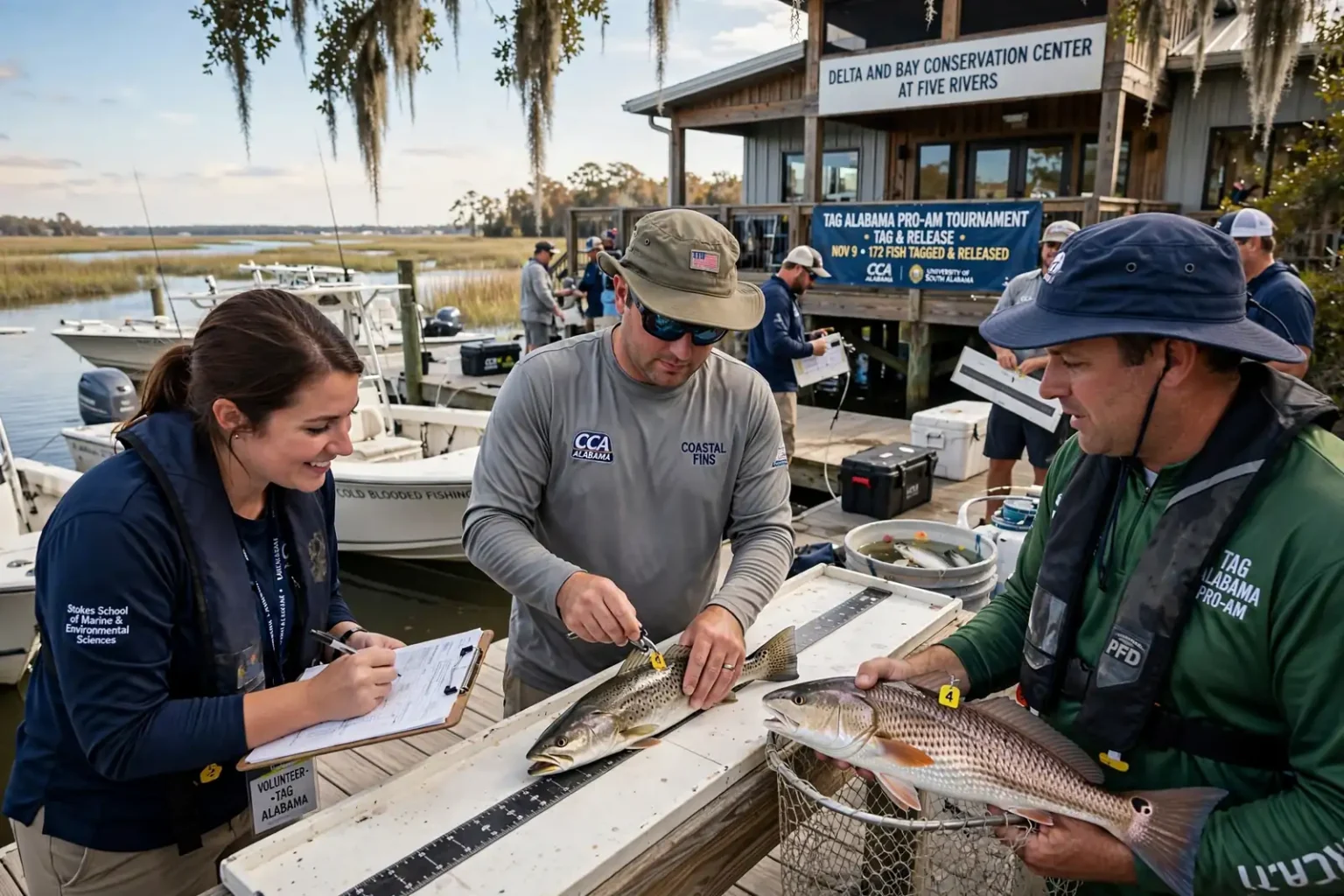
MOBILE, Ala. — Seventeen fishing teams spent two days on the water around Mobile Bay and the delta this week, and every fish they caught went back in alive, carrying a tag. The annual Tag Alabama Pro-Am Fishing Tournament wrapped up Monday, Nov. 9, at the Delta and Bay Conservation Center at Five Rivers with 172 fish tagged and released.
The tournament pairs some of the area’s best-known fishing guides with amateur volunteer anglers. Instead of weighing in fish for trophies, the teams tag and release what they catch, so scientists can gather information about how inshore species move and how heavily they are being fished.
The final tally
Dozens of anglers returned to the dock at the conservation center at noon Monday for a mandatory check-in and a final count of the fish they had tagged. Ten of the 17 teams fished on Monday, the tournament’s second and final day.
Dr. Sean Powers, director of the Stokes School of Marine and Environmental Sciences at the University of South Alabama, announced Monday’s numbers.
Powers said that today they tagged ninety-seven speckled trout and seventeen redfish.
Across both days, the tournament produced:
- 17 teams competing
- 172 fish tagged and released
- 97 speckled trout and 17 redfish tagged on Monday alone
- About a 16% recatch rate on tagged fish, according to CCA officials
“The sweet spot of fall”
The anglers had plenty of help from the weather. Richard Rutland of Cold Blooded Fishing said conditions on the water lined up nearly perfectly.
Rutland said it was beautiful out there, with great conditions including tide, moon, and water temperature, calling it the sweet spot of fall right now.
Fall is traditionally a strong season for inshore fishing along the Alabama coast, as cooling water pushes bait and gamefish into predictable patterns in the bays, bayous and rivers. Robby Howard of Coastal Fins said his team found a variety of species.
Howard said they caught speckled trout, redfish, puppy drum, and some white trout, had a great day, and tagged over thirty fish.
Why tag a fish?
Tagging programs give researchers information they cannot easily get any other way. When a fish is caught, it is fitted with a small numbered tag and released. If another angler later catches the same fish and reports the tag, scientists learn where the fish traveled, how long it has been free and, in many cases, how much it grew in between.
Since the Tag Alabama program began nearly six years ago, about 15,000 inshore gamefish have been tagged and released. Powers said that body of data reveals more than just where fish go.
Powers said that from that they learn not only the movements of the fish but can estimate fishing mortality, allowing them to advise the state on when fishing mortality is high or low and whether it lines up with state data; currently it lines up for both redfish and spotted sea trout.
In practical terms, the recatch numbers help scientists estimate what share of a fish population is being removed by fishing. That kind of information matters to anyone who fishes Alabama’s inshore waters, because it can inform how the state sets size limits, bag limits and seasons for popular species. Powers’ assessment that the current data lines up with the state’s figures for both redfish and spotted seatrout is a sign that the two species most targeted by local inshore anglers are being tracked closely.
A partnership built on conservation
The tournament is a partnership between CCA Alabama, the state chapter of the Coastal Conservation Association, and the University of South Alabama. CCA is a nonprofit organization of recreational anglers that advocates for healthy marine resources, while the university’s Stokes School of Marine and Environmental Sciences brings the scientific expertise to turn tag returns into usable data.
Unlike many fishing tournaments, the Tag Alabama Pro-Am does not offer big prizes or giveaways. The teams fished for pride and for the chance to contribute to ongoing conservation work on the species they love to catch.
The setting fits the mission. Five Rivers sits at the edge of the Mobile-Tensaw Delta, one of the most biologically diverse river systems in North America, where the Mobile, Tensaw, Apalachee, Blakeley and Spanish rivers flow toward Mobile Bay. The estuary is a nursery for many of the inshore species anglers prize, including speckled trout and redfish.
What anglers can do
The program depends on more than the anglers who take part in the tournament. Every tagged fish released this week could be caught again by someone fishing the bay, the delta or nearby coastal waters, and each report adds to the data.
- If you catch a tagged fish, note the tag number, where and when you caught it, and the fish’s length before releasing or keeping it.
- Report the information using the contact details printed on the tag.
- Handle fish carefully and return them to the water quickly if you plan to release them, to improve their chances of survival.
With roughly 15,000 fish tagged so far and another 172 added this week, the program’s picture of Alabama’s inshore fishery keeps getting sharper, one recaptured fish at a time.