Alabama Regulators Open Data Center Power Contract Review as Calvert, Prichard and Stockton Projects Loom
State regulators are rewriting how electric contracts for giant data centers get reviewed, with public comments due in August. The outcome could shape projects proposed in Calvert, Prichard and Baldwin County.
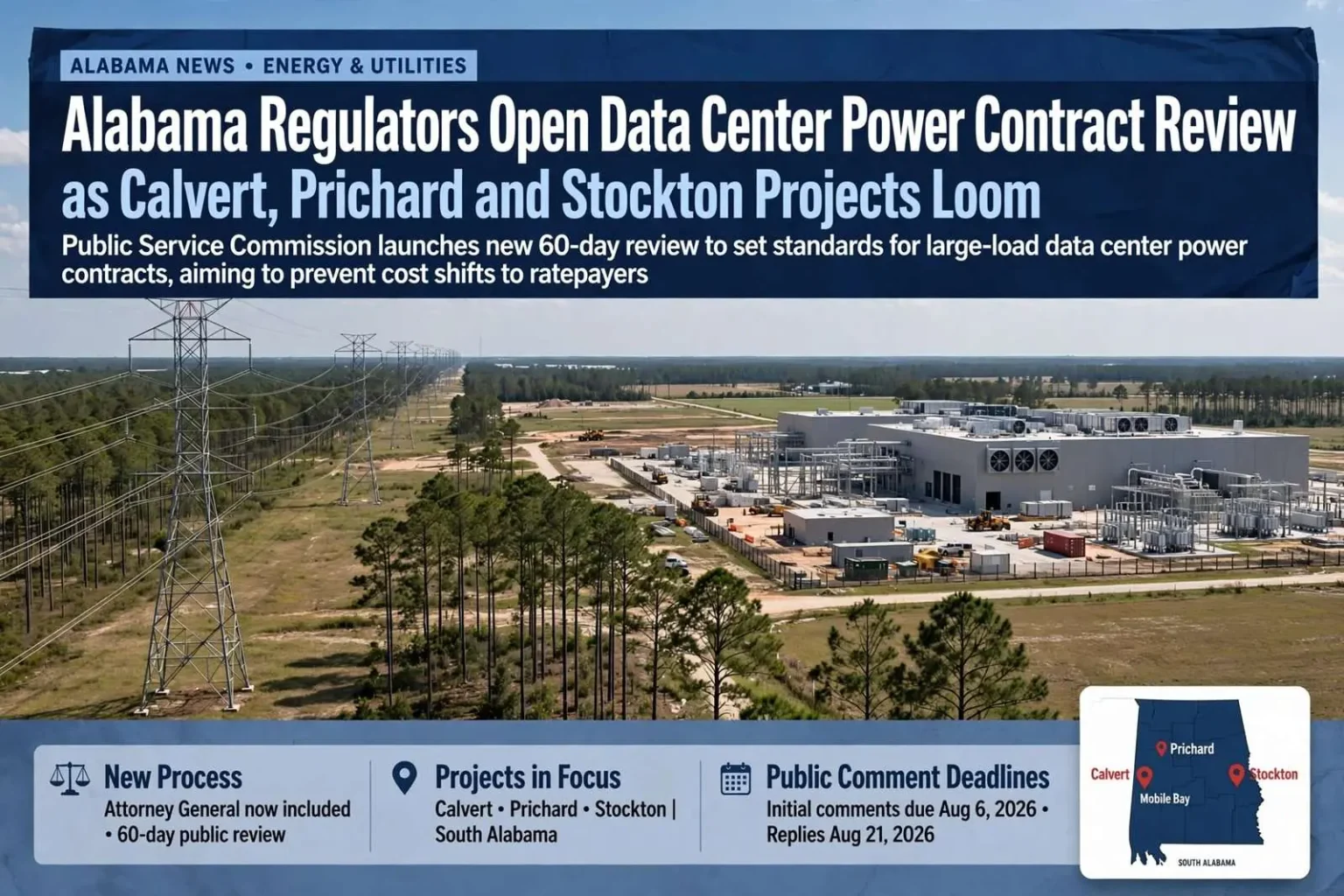
Alabama’s utility regulators have opened a formal proceeding that could reshape how the state scrutinizes the electricity deals struck with the largest data centers seeking to plug into the grid, a question with unusually direct consequences for communities across South Alabama.
The Alabama Public Service Commission’s order establishes what regulators call a generic proceeding, meaning it is not about any single company or project. Instead, it is intended to build new procedures and standards governing contracts between Alabama Power and so-called “large load” data center customers. Under the law cited by the commission, that category covers data center customers expected to require at least 150 megawatts of peak demand on one or more contiguous parcels of land.
The Question at the Center of It All
Strip away the regulatory language and one issue remains: when a data center needs an enormous amount of electricity, how does the state ensure the deal actually covers the cost of serving that customer, and that other Alabama Power customers come out ahead rather than quietly subsidizing it?
Commissioners point to a recently enacted state law, Act 610, which refined the public-interest standard applied to those contracts. Under that standard, regulators must determine whether the pricing, terms and conditions of a contract are expected to recover the incremental costs of serving the data center while promoting positive benefits for other retail electric customers.
Those incremental costs can be substantial. They may include added generation, transmission and distribution infrastructure, fuel, taxes and other expenses the utility would not incur but for the data center agreement.
A Review Process Built in 1996
The urgency, the commission’s order says, stems from the recent nationwide proliferation of data centers. The existing review framework was designed long before facilities of this scale existed.
Today many electric-service contracts are reviewed under Alabama Power’s Flexible Contract Rate, known as Rate FCR, a process dating to 1996. Under it, a contract can be deemed approved just 10 days after filing unless the commission affirmatively rejects it. The order acknowledges two weaknesses in that arrangement: it does not automatically involve the Alabama Attorney General, who represents the using and consuming public, and it may not allow enough time to meaningfully evaluate a contract of this magnitude.
What the New Process Would Require
Alabama Power would file a public version of each large-load data center contract and provide an unredacted copy to commission staff.
The Alabama Attorney General would receive a complete, unredacted copy of the contract and supporting materials at the same time.
Filings would include the full proposed contract, all exhibits and amendments, and a detailed analysis demonstrating compliance with state law, including evidence that the customer pays the incremental cost of service and that other customers benefit.
Commission staff and the Attorney General could issue questions or data requests, with Alabama Power given five business days to respond.
If staff concludes a contract falls short, it could negotiate modifications or recommend rejection.
A 60-day review period would apply. If no order disapproving the contract is issued within 60 calendar days, the contract is deemed approved and recognized at the next commission meeting without a formal vote.
Comment Deadlines
Initial public comments are due August 6, 2026. Reply comments are due August 21, 2026. All comments must be filed electronically through the commission’s filing system and will be publicly available, meaning residents of Washington County, Mobile County and Baldwin County will be able to read what utilities, developers and consumer advocates are telling regulators.
The commission is seeking input from Alabama Power, data center customers, the Attorney General, consumer advocates and any interested party. Among the questions on the table: how incremental costs should be calculated, how benefits to other ratepayers should be measured, what economic-development evidence should be required, what role the Attorney General should play, what information should remain public, and whether contracts should be monitored after approval. Regulators also want to know whether 60 days is the right timeline, and whether such deals should carry minimum contract lengths, upfront payments, security, collateral or minimum payment guarantees.
Why South Alabama Should Be Paying Attention
The commission is careful about the limits of its authority. Alabama law, the order says, does not grant it jurisdiction over where data centers are built or over local land-use and environmental decisions. Siting fights remain local fights, settled in county commission chambers and city halls.
Even so, the timing lands in the middle of a regional debate. In Calvert, a proposed multibillion-dollar data center campus spanning roughly 650 acres between Highway 43 and Shepard House Road has drawn both economic excitement and pointed questions from neighbors about land use, utilities and long-term impact. In Prichard, residents have pushed back on a proposed data center project, raising concerns about jobs, environmental effects and whether the city would see any meaningful return. And in Baldwin County, the Stockton Solar controversy showed how quickly energy projects tied to data centers can become flashpoints, after residents learned the projects had been approved without local hearings or a formal comment period.
This proceeding will not decide the fate of any of those projects. What it will decide is how much scrutiny the next power contract receives before it takes effect, how much of it the public gets to see, and whether regulators demand proof that a deal benefits more than the data center itself.
The Utility’s Position
Alabama Power has said it respects the commission and its procedures for reviewing these agreements, and that it already requires large-load customers, including data centers, to pay the full cost to serve their electric needs so that costs are not shifted to existing customers. The recently enacted law, the company said, reflects that same customer-protection standard.
For households from Chatom to Bay Minette, the practical stakes are simple. Data centers consume power on an industrial scale, and the infrastructure required to serve them does not build itself. The question this proceeding will answer is who pays for it, and how much of that answer the public is entitled to see.
What the New Standards Could Mean for the Coast
If the commission adopts the standards it has described in the order, future data center contracts in Alabama would face a more public, more rigorous review than the existing Rate FCR framework allows. The new process would require the public to see the contract, the Attorney General to evaluate it, and the commission staff to recommend approval or rejection. That combination is the closest thing to a public check on data center electricity deals that Alabama has ever attempted, and the eventual outcome will shape the kind of projects that get sited in Mobile, Baldwin and Washington counties over the next several years.
For South Alabama in particular, the stakes are unusually high. The Calvert project alone, at roughly 650 acres, has been described as a multibillion-dollar investment, and the energy it would draw from the Alabama Power grid would dwarf the needs of any single existing customer in the region. The commission’s decision about how such contracts are reviewed will influence not only whether the project moves forward but also how much of its costs are absorbed by ordinary ratepayers in towns like Saraland, Bay Minette and Atmore.
Critics of the existing Rate FCR framework have argued for years that the 10-day window and the lack of automatic Attorney General involvement leave the public in the dark until after a deal is done. The commission’s order signals that it has heard those concerns and is willing to write new rules. Whether those rules produce the kind of transparency that consumer advocates want will depend on how the comment process plays out over the coming months.
Why Data Center Power Deals Matter for Local Rates
For Alabama Power’s existing residential and small-business customers, the central question about any large-load data center contract is straightforward: does the data center pay its own way, or do other ratepayers end up subsidizing the infrastructure built to serve it? The commission’s incremental-cost standard is designed to answer that question by requiring the utility to demonstrate that every additional dollar it spends to serve a new large customer is recovered through that customer’s bill, rather than spread across the rest of the rate base.
That math can be tricky. A data center may demand a substation upgrade that costs tens of millions of dollars, or a transmission line extension that crosses multiple counties. If the data center’s contract does not run long enough to recover those costs, the remaining balance can become a stranded investment that regulators have to decide how to handle. The new proceeding is the commission’s attempt to write clear rules for that calculation before the next multibillion-dollar project arrives.
How Residents Can Weigh In
Public comments on the proceeding are due August 6, 2026, with reply comments due August 21, 2026. Anyone interested in submitting comments can do so through the Alabama Public Service Commission’s electronic filing system, and all filings are publicly accessible once submitted. South Alabama residents who have followed the Calvert, Prichard or Stockton Solar debates will have an opportunity to put their concerns into the regulatory record before the commission adopts its final standards.
Consumer advocates and ratepayer groups are expected to file comments urging the commission to keep the public version of each large-load contract as detailed as possible, while Alabama Power is likely to argue for the kind of confidentiality that protects competitive negotiations with prospective customers. Where the commission lands between those positions will determine how much South Alabama ratepayers learn about the next data center electricity deal before it takes effect.