USA Engineering Student Named First Recipient of Outokumpu Scholarship, Begins Calvert Mill Internship
Mobile native Jessica Ivory is the first recipient of the Outokumpu Scholarship in Engineering at the University of South Alabama and is interning this summer at Outokumpu's Calvert mill.
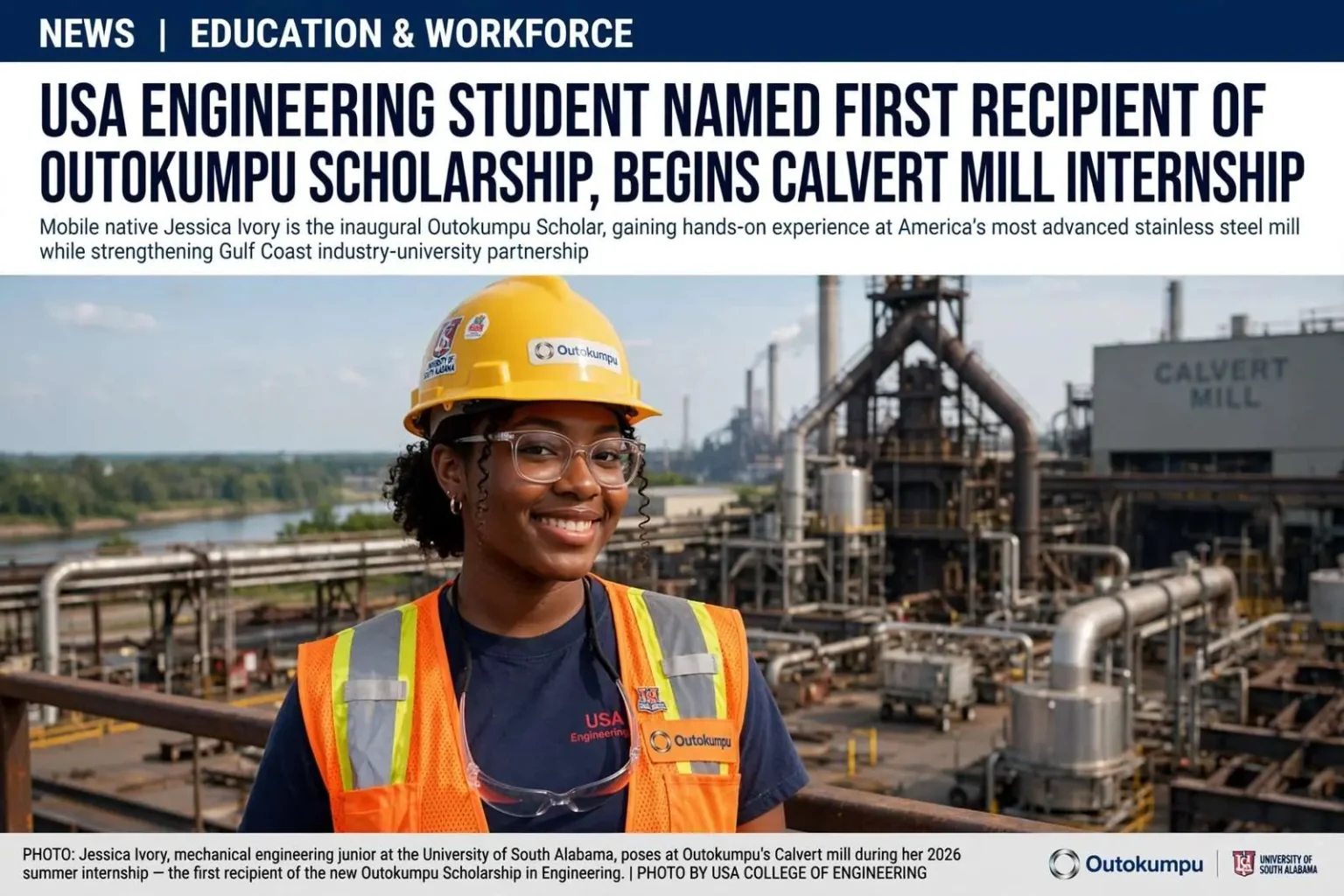
Outokumpu and the University of South Alabama are marking a milestone in their long-running partnership, as Mobile native Jessica Ivory becomes the first recipient of the Outokumpu Scholarship in Engineering and a 2026 summer intern at Outokumpu’s Calvert mill. The scholarship, funded through an endowed gift established by Outokumpu, supports engineering students at South while strengthening connections between higher education and advanced manufacturing along the Gulf Coast.
Ivory, a mechanical engineering student entering her junior year, was selected as the inaugural recipient and is spending the summer gaining hands-on manufacturing experience at the Calvert facility. For a Mobile native, the placement represents more than a line on a resume — it is a chance to learn the industry inside one of the region’s signature industrial plants, a short drive from home, while working alongside engineers who run one of the most technologically sophisticated steel operations in the country.
“South has been instrumental in helping us develop local talent,” said Chantal van der Walt, senior vice president of human resources for Outokumpu’s business area Americas. “Through this scholarship and internship opportunity, we’re investing directly in students while they’re still in school. Together, we’re helping create pathways to meaningful careers while strengthening the future workforce of our region.”
The scholarship builds on a longstanding relationship between Outokumpu and South’s College of Engineering that has included internships, recruitment initiatives and career development opportunities for students. University-industry partnerships of this kind have become a central part of how Gulf Coast manufacturers build their workforces: rather than recruiting exclusively from national talent pools, companies with major local operations increasingly cultivate relationships with regional universities so that students graduate with direct exposure to the plants and processes they may one day help run.
A hands-on summer at the mill
Outokumpu operates America’s most advanced stainless steel mill in Calvert, Alabama, and is the second-largest producer of sustainable stainless steel in the United States, with products made from up to 95% recycled materials. The Calvert plant, located in north Mobile County along the Tombigbee River, sits on one of the largest industrial sites in the state and produces stainless steel that flows into construction, manufacturing, energy and consumer products across the country. Its emphasis on recycled content has made sustainability a central part of the company’s identity, tying the mill to growing demand for lower-carbon industrial materials.
An internship inside that operation exposes students to the full arc of modern heavy manufacturing — melting, casting, rolling and finishing — along with the automation, quality control and process engineering that keep a mill of that scale running. Mechanical engineers in particular work at the intersection of equipment reliability and process improvement, the disciplines that determine whether a plant hits its production and efficiency targets. For an undergraduate, the experience translates abstract coursework into decisions with real consequences on a factory floor.
What university leaders say
“At the University of South Alabama, we are committed to preparing students to solve real-world engineering challenges through hands-on learning and strong industry partnerships,” said Dr. Darryl James, dean of the College of Engineering. “Our collaboration with Outokumpu gives students the opportunity to apply what they learn in the classroom, gain valuable professional experience and launch careers that contribute to the economic growth and innovation of our region. We are proud to see Jessica become the first recipient of this scholarship and look forward to seeing many more students benefit from this investment.”
South’s College of Engineering serves students across the traditional engineering disciplines, and its location in Mobile places it within commuting distance of a concentration of major industrial employers — shipbuilding, aerospace, chemicals, and the steel operations in the northern part of the county. The endowed scholarship model matters in that landscape because it creates a durable link: unlike one-time gifts, an endowed fund continues to support recipients year after year, giving a company like Outokumpu a recurring presence in the student body and a pipeline of graduates already familiar with its operations.
The choice of an inaugural recipient carries weight as well. As the first Outokumpu Scholar, Ivory sets the standard the program will be measured against, and her summer at Calvert will shape how subsequent recipients experience the internship component. Students selected through industry-endowed scholarships are often watched closely by both sides of the partnership — the company wants to see its investment develop into a capable future employee, and the university wants to demonstrate that its graduates can step into demanding industrial roles.
Pathways into advanced manufacturing
As a woman pursuing a degree in mechanical engineering, Ivory’s experience also highlights efforts to create more pathways for students to explore careers in advanced manufacturing. Mechanical engineering remains one of the broadest engineering disciplines, opening doors to manufacturing, energy, aerospace and design work, but women have historically been underrepresented in the field nationwide. Programs that pair financial support with direct industrial experience are among the tools universities and employers use to widen the pipeline, because they show students what the work actually looks like before graduation day.
That visibility matters on the Gulf Coast, where the manufacturing base is large, technical and expanding. The economy of south Alabama is diversified across sectors including aerospace, shipbuilding, healthcare, tourism, agriculture and port-related commerce. The Port of Mobile is among the largest in the nation by tonnage and supports a wide range of logistics and industrial activity, and major employers include military installations, hospitals, universities and manufacturing facilities. Economic development organizations at the city and county level work to attract investment and retain jobs, and state incentive programs frequently play a role in site-selection decisions.
Against that backdrop, the competition for engineering talent is regional as well as national. Employers along the Gulf Coast are not only hiring against each other but against opportunities in Atlanta, Houston and beyond, and partnerships like the one between Outokumpu and South are aimed at a simple proposition: a student from Mobile can get a first-rate engineering education, a paid industrial internship at an advanced mill, and a career that keeps her — and the skills she builds — close to home.
Why the partnership endures
The Outokumpu–South relationship illustrates how workforce development actually functions in practice along the Alabama coast. K-12 schools in Mobile County feed students into South and other regional institutions, where programs in engineering and technical fields prepare them for industrial careers, and employers close the loop with scholarships, internships and recruitment. Public universities and community colleges in the state operate under the oversight of the Alabama Commission on Higher Education and separate governing boards, but employer partnerships are where classroom preparation and industry demand meet.
For Outokumpu, the calculus is straightforward. A mill like Calvert needs a steady supply of engineers who understand both the technology and the environment, and graduates with roots in the region are more likely to build long careers there. Each scholarship recipient who interned at the facility enters the job market with insider knowledge of the operation — and each one who stays strengthens the pool of experienced industrial talent that Mobile County can offer to the next employer considering a Gulf Coast investment.
For the university, the value runs in the other direction as well. Industry-endowed scholarships raise the profile of the College of Engineering among prospective students, give faculty a direct line into current industrial practice, and generate placement outcomes that matter to accreditation, rankings and enrollment. When a dean can point to a named scholarship, a major employer and a student interned at one of the country’s most advanced steel mills, the pitch to the next class of applicants writes itself.
What the scholarship means for students
Financial support is only half of what a scholarship of this type delivers. The other half is certainty — a named award that lets a student plan semesters, co-ops and a graduation date without rebuilding the funding picture every year. Engineering degrees demand long studio and lab hours on top of coursework, and students who can rely on an endowed scholarship are far less likely to dilute their education with off-target part-time work or to drop out of a demanding program for financial reasons. Endowed gifts also signal to other employers that the college’s graduates are worth investing in, a dynamic that regional universities work to cultivate deliberately.
For Ivory herself, the summer marks the midpoint of an engineering education that began in Mobile’s public schools and now runs through South’s engineering building and the Calvert mill floor. If the partnership’s designers are right, the inaugural Outokumpu Scholarship will be remembered less as an award given to one student and more as the start of a pipeline — one that carries Mobile-area students into advanced manufacturing careers that the region’s economy, from the port to the steel mill, is built to reward. Both the university and the company say they expect many more students to follow the path she opened.