Eight Contenders Emerge in Bracket to Name Mobile River Bridge
A reader bracket narrowed the possible names for the planned Mobile River bridge to eight finalists, from war heroes to Mardi Gras icons.
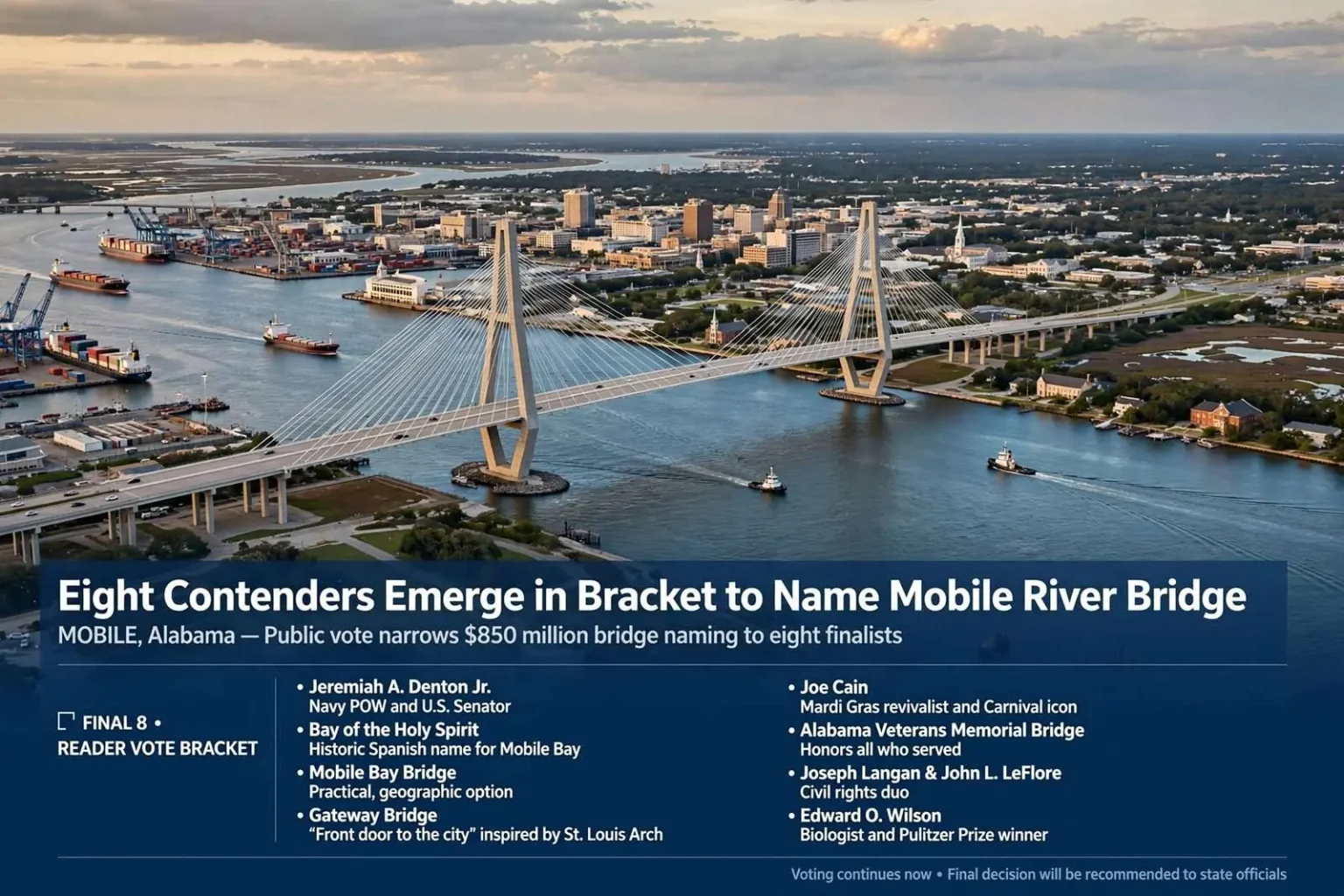
MOBILE, Alabama — With engineering plans for a proposed $850 million bridge spanning the Mobile River taking shape, attention in Mobile has turned to a lighter question: what should the towering, 215-foot-tall span actually be called? A bracket-style reader vote set up to crowdsource suggestions has now narrowed the field to eight finalists, pitting military heroes against civil rights leaders, Mardi Gras royalty and even a world-renowned scientist.
The exercise is unusual for a project of this scale. Bridge names are typically settled quietly by transportation officials and elected leaders, often years before construction crews arrive. Here, the naming has been opened to the public through a tournament-style bracket, with readers advancing their favorites round by round the way college basketball fans fill out a sheet each March. The winner will carry a formal recommendation as the project moves toward construction, though the final say will rest with officials, not voters.
The bridge itself is intended to carry Interstate 10 traffic across the Mobile River, replacing the river crossing that has funneled Gulf Coast travelers through the George Wallace Tunnel beneath the river for decades. At 215 feet tall, the new span would rise high enough for the container ships that call at the Port of Mobile to pass beneath it, clearing the constraint that forced the tunnel’s low, confined design in the first place. The $850 million price tag makes it one of the largest infrastructure projects in the region’s history — which is precisely why the name on it matters to so many people.
A war hero leads the field
The top seed belongs to Jeremiah A. Denton Jr., the Navy rear admiral and later U.S. senator who spent nearly eight years as a prisoner of war in North Vietnam. Denton became a national symbol of resilience after using Morse code blinks during a televised 1966 press conference, forced on him by his captors, to spell out the word ‘torture.’ The moment, recorded by an American journalist who understood what the blinking meant, remains one of the most famous pieces of footage from the war.
Supporters argue his story is instantly recognizable and honors a figure with deep Alabama roots, though as a former elected official he could also draw pushback from voters wary of naming infrastructure after politicians. Denton represented Alabama in the Senate from 1981 to 1987, and the debate over whether a bridge should carry the name of anyone who held elected office has followed his candidacy in the bracket from the start.
History, geography and civic pride
Several entries lean on Mobile’s colonial past and civic identity rather than on any individual. ‘Bay of the Holy Spirit’ recalls the name early Spanish explorers gave Mobile Bay in the 1500s, offering a deep historical hook with a touch of local pride over neighboring Gulf Coast states. The name predates the city itself by decades and ties the new structure to the oldest written history of the northern Gulf Coast.
A simpler option, ‘Mobile Bay Bridge,’ trades history for clarity, essentially formalizing the generic ‘I-10 bridge’ label already used by officials, radio traffic reporters and generations of motorists. Practicality has its constituency: a name that needs no explanation is a name that outlives every controversy.
Another idea, a ‘Gateway’ themed bridge inspired by a Mobile delegation’s trip to St. Louis and its famous arch, has been publicly championed by a Mobile City Council member, an association that could help or hurt its chances depending on the voter. The St. Louis model suggests the bridge as a front door to the city — the first thing travelers see arriving from the east — but a name born on a chamber-of-commerce style trip reads to some as branding rather than heritage.
Cultural icons in the mix
Mobile’s Mardi Gras heritage is represented by Joe Cain, the figure credited with reviving the city’s Carnival celebrations after the Civil War by parading through occupied Mobile dressed as a fictional Chickasaw chief. Cain’s 1866 pageant is remembered as the moment the city’s pre-war traditions restarted, and the city still marks the occasion with Joe Cain Day each Sunday before Fat Tuesday, one of the most beloved days of the Carnival season.
Backers see a chance to brand the bridge around a tradition many Mobilians consider uniquely their own, in a state that has long jockeyed with New Orleans for Mardi Gras bragging rights. Mobile’s claim to the oldest Carnival celebration in America is a point of genuine civic conviction here, and a bridge named for Cain would broadcast it to every motorist on the interstate.
A more general option, an ‘Alabama Veterans Memorial Bridge,’ aims to honor all who served rather than a single individual, sacrificing specificity for broad appeal. Memorial names avoid the political fights that follow individual honorees, but they can also feel interchangeable — a criticism its detractors have already voiced in the comment threads that accompany each round of voting.
Civil rights legacy and a scientific mind
Two finalists highlight lesser-known chapters of Mobile’s civil rights history: longtime local politician Joseph Langan and NAACP organizer John L. LeFlore. The two worked together to fight discriminatory voter registration rules in the 1940s, an alliance between a white officeholder and a Black civil rights leader that was rare anywhere in the Deep South at the time. In the years that followed, they guided the desegregation of downtown businesses, the library and a city golf course with comparatively little of the violence seen elsewhere in Alabama.
Their partnership is already honored with a statue at Unity Point Park, which organizers say could cut both ways with voters: existing recognition confirms the pair’s standing in the city’s history, while others may argue that the newest and most visible landmark in the skyline should break new ground rather than extend an honor already paid.
Rounding out the bracket is Edward O. Wilson, the Mobile-born biologist known worldwide as an authority on ants and biodiversity and a two-time Pulitzer Prize winner, whose living status sets him apart from every other name on the list. Wilson’s scientific career carried Mobile’s name into laboratories and classrooms around the world, and his candidacy is the bracket’s only acknowledgment that the city’s famous sons were not all soldiers, senators or Carnival kings.
What happens next
Organizers of the bracket say the eight names will be narrowed through successive rounds of public voting, with the ultimate goal of presenting a popular favorite as the bridge project moves toward construction. Each round winnows the field, and the head-to-head matchups in the later rounds are already generating the kind of debate that content-sourcing votes are designed to provoke: war hero versus Carnival king, colonial history versus civil rights history, sentiment versus practicality.
No timeline for a final decision by transportation officials has been set, and there is no guarantee any of the eight names will ultimately be adopted for the span once it is built. Officials have been deliberate in keeping the bracket advisory — a way to measure public sentiment without surrendering the decision itself. Naming a $850 million piece of the interstate system involves signage, emergency dispatch conventions, federal approval processes and, inevitably, the preferences of whoever holds office when the ribbon is cut.
What the vote has already accomplished is to surface the range of stories Mobilians want the bridge to tell. A span this tall — visible from the downtown waterfront, from the bay islands, and from the approach roads that carry most visitors into the city — will function as the city’s most prominent piece of public art whether anyone intends it to or not. The eight finalists amount to eight answers to the question of what the first impression of Mobile should be.
The finalists also reflect how differently residents weigh the same history. To one voter, the Spanish-era name of the bay is the deepest root available; to another, the wartime heroics of an admiral, or the quiet alliance that desegregated a golf course, matters more than anything that happened four centuries ago. Bracket voting makes those preferences concrete and head-to-head, which is exactly why the organizers chose the format: a simple suggestion box would have produced eight hundred names and no consensus, while a tournament forces a ranking.
The bracket continues through its next rounds as the engineering work proceeds on schedule below it. Whatever name finally lands on the span, it will hang 215 feet above the Mobile River, attached to the largest single investment the city’s waterfront has seen — and chosen, for the first time in recent memory, with the public’s fingerprints all over it. The vote closes with the construction timeline still ahead of it, which means the name will be settled long before the first ship sails beneath the finished deck.