Mobile Cardiologist’s Retaliation Claim Heads to Trial After Fraud Case Settles
A Mobile cardiologist's retaliation claim against his former employer is headed to trial after a related $24.5 million fraud settlement.
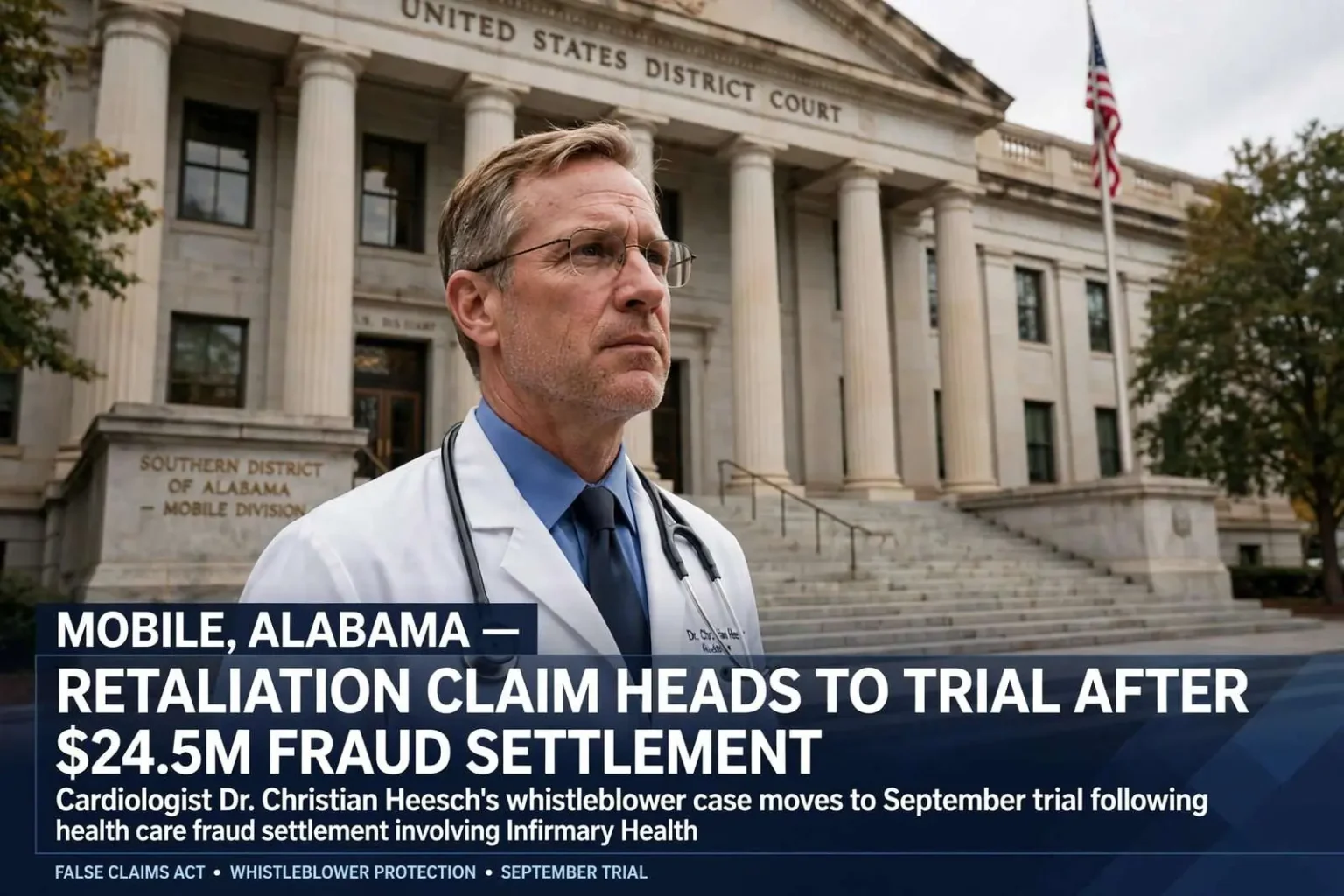
MOBILE, Alabama — A federal whistleblower case that led to one of the largest health care fraud settlements in recent memory for the Mobile area is not quite finished. While the core fraud claims against Infirmary Health and an affiliated physicians group were resolved last month, a separate piece of the lawsuit, a cardiologist’s claim that he was fired for raising concerns, is now headed toward a September trial in federal court.
The case began as an allegation about money — bonuses paid for referrals — and grew into something larger: a test of what happens inside a medical practice when one of its own doctors starts asking questions. The fraud allegations are now history, settled for $24.5 million. What remains is the employment dispute, and it will be decided by a federal jury in one of the most closely watched local courtrooms of the year.
A whistleblower’s long fight
Dr. Christian Heesch, a cardiologist who joined Diagnostic Physicians Group in 2003, filed the original lawsuit in 2011 under a federal law that allows private citizens to sue on behalf of the government when they believe fraud is occurring, then share in whatever the government eventually recovers. The statute, known as the False Claims Act, dates to the Civil War era and has become the federal government’s principal weapon against health care fraud, with whistleblowers — formally, “relators” — supplying many of the tips that grow into major cases.
Heesch alleged that two clinics affiliated with Infirmary Health had arrangements to pay physicians bonuses tied to the volume of tests and procedures they referred, a practice that can run afoul of federal rules limiting financial incentives for referring Medicare and Medicaid patients. Federal law draws a bright line around health care referrals for a simple reason: when a doctor’s income rises with every test ordered, the temptation to order tests patients do not need becomes built into the practice itself, and the taxpayers who fund Medicare and Medicaid end up paying the bill.
The statutes at issue — including the federal Anti-Kickback Statute and the physician self-referral restrictions known as the Stark Law — have generated some of the largest recoveries in the history of the Justice Department, and health systems across the country have restructured physician compensation to stay clear of them. What made Heesch’s suit notable locally was the scale of the defendant: Infirmary Health is one of the largest health systems in South Alabama, with hospitals and clinics that employ hundreds of physicians across the Gulf Coast.
A costly settlement
The federal government later took over prosecution of the case. Last month, Infirmary Health and the other defendants agreed to pay $24.5 million to resolve the allegations, one of the larger such settlements involving a South Alabama health system. Under the terms, Heesch is set to receive roughly $4.41 million for bringing the original claim forward.
The settlement resolved the fraud claims but expressly left open the question the government never took on: whether Heesch was fired because he filed the suit. That claim, which had been sealed and stayed while the fraud case ran its course, now moves to the front of the docket with a trial date in early September before U.S. District Judge Kristi DuBose.
Termination sparked a second claim
According to court filings, Heesch grew suspicious of the compensation arrangement and hired an outside accountant to look into it, but says he received only vague and conflicting answers from his employer. He claims that in June 2011 he formally requested to inspect company records, and that Diagnostic Physicians Group terminated his employment about a month later.
Heesch contends the firing was direct retaliation for pursuing the whistleblower claim, while the practice has denied wrongdoing and asked the court to rule in its favor before trial. The defense’s position, in essence, is that the termination had legitimate business grounds unrelated to the lawsuit — an argument the court will weigh even as the timeline Heesch describes sits at the center of his case: suspicion, an outside accountant, a records demand, and a pink slip within weeks.
Retaliation claims under the False Claims Act hinge on exactly this kind of sequence. The statute protects employees who act to expose fraud, and it allows a worker who is fired for it to recover double back pay, benefits and damages. Proving the link between the lawsuit and the termination is the hard part — employers rarely put the reason in writing — so juries are asked to infer motive from timing, from what supervisors said, and from how the employee’s questions were received.
The dispute also carries a message for the medical community that extends beyond one cardiologist. Whistleblower statutes only work if people inside the industry are willing to come forward, and they will not come forward if doing so costs them their careers. That is why the retaliation half of a case like this one matters as much as the $24.5 million: it is the part that tells the next doctor with doubts whether speaking up is survivable.
Trial date set, questions remain
U.S. District Judge Kristi DuBose has scheduled the retaliation claim for trial in early September, though she has not yet ruled on the defense’s request to decide the matter without a trial. Such motions — asking the judge to find that no reasonable jury could rule for the plaintiff — are standard in employment litigation, and their resolution often determines whether a case is ever heard at all.
An attorney representing Heesch said the case was originally expected to take three to four weeks to try, but that estimate has shrunk considerably now that the larger fraud allegations are no longer part of the proceedings. Exactly how much shorter the trial will be remains unclear, and it is still possible the judge could dismiss the claim before it ever reaches a jury.
Even trimmed to a single plaintiff and a single employment dispute, the trial promises to reopen uncomfortable ground. The compensation arrangements that produced the $24.5 million settlement are part of the factual backdrop of the retaliation story, and both sides will be working from a record built during years of litigation over the fraud claims. Jurors will hear about the bonuses Heesch questioned, the accountant he hired and the answers he says he never really got — the same material that persuaded the federal government to intervene in the underlying case.
What Heesch is seeking
Beyond the fraud settlement payout, Heesch is asking for damages tied specifically to the retaliation claim, including double back pay with interest, lost pension and health benefits, and pay he says he would have earned through retirement age. He is also seeking compensation for emotional distress and damage to his professional reputation.
The demand for future earnings through retirement age reflects what is at stake for a specialist in mid-career when a position ends. Cardiology is a late-blooming discipline — years of training before the first paying job, and prime earning years that stretch into a physician’s sixties. A termination at that stage does not just cost a salary; it can cost a professional identity, particularly in a medical community the size of Mobile’s, where the major practices and hospitals know one another well and reputations travel fast.
Attorneys for Diagnostic Physicians Group have not publicly detailed their defense strategy beyond denying the allegations. Whether the case reaches that fight in September depends on Judge DuBose’s ruling on the pretrial motion — and until it does, the largest whistleblower recovery in recent Mobile memory will remain, like the cardiologist who started it, a story with its final chapter still unwritten.
The September hearing will also be watched by employment attorneys across the region, because the legal question at its center comes up constantly in ordinary workplaces: how much timing must weigh when a termination follows hard on the heels of protected activity. Judges and juries in retaliation cases are asked to separate correlation from cause, and the answers they reach shape how employers in Alabama handle the paperwork of firing — documenting reasons, papering performance concerns and considering carefully what a personnel file will look like when it is read aloud in federal court.
For Infirmary Health, the settlement closed the fraud case without any admission of liability, and the system has continued operating as the region’s dominant health care provider. For the physicians group, the September trial is the remaining exposure in a litigation saga that began with one doctor’s suspicion about how his own paycheck was calculated. And for anyone watching from inside another practice, the outcome will be read as a measure of what the law will actually do for the employee who blows the whistle — after the government has taken its share and gone home.