Daphne Council Upholds Firing of Police Captain, Delays Vote on Finance Director’s Appeal
Daphne's City Council backed the firing of a longtime police captain after a lengthy hearing, while a finance director's appeal remains undecided.
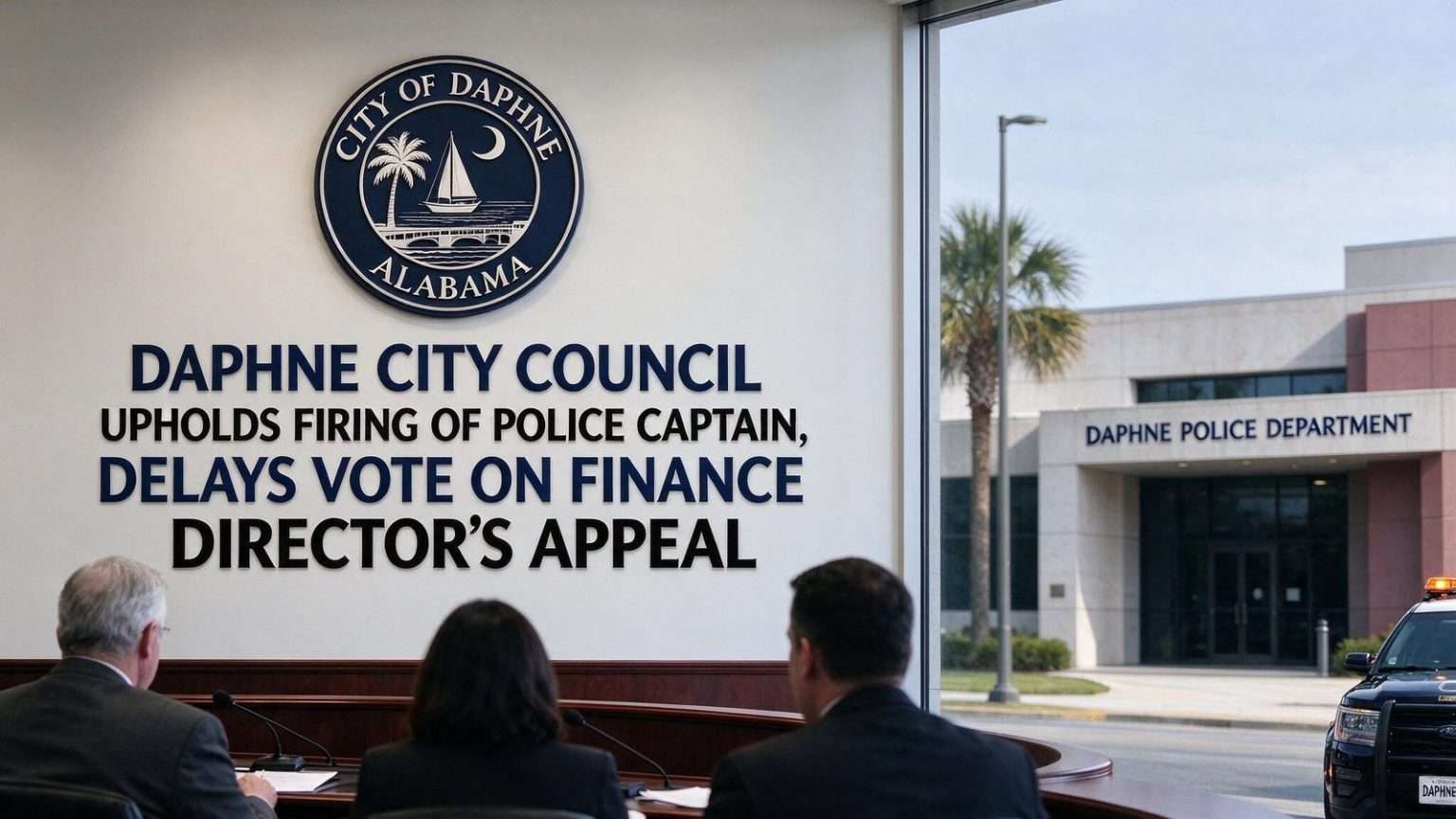
DAPHNE — The Daphne City Council held two lengthy personnel hearings last week, upholding the dismissal of a longtime police captain while postponing a decision on the appeal filed by a former interim finance director.
Council members spent roughly four hours weighing the case of Capt. Danny Bell, who had served the city’s police department for two decades before his termination in June. Mayor Dane Haygood removed Bell from his post following a recommendation from Police Chief David Carpenter. The council voted 6-1 to uphold that decision, with Councilman John Lake casting the lone dissenting vote.
Council President Randy Fry said Bell’s hearing lasted about four hours, while a separate hearing two days later for former interim finance director Mike Hinson ran even longer, nearly five hours. Both men had been dismissed from their positions in June and were entitled to appeal directly to the full council under the city’s personnel handbook.
The two hearings put Daphne’s municipal personnel process under an unusually bright spotlight. Under the city’s handbook, employees who are terminated may carry their appeals to the elected council rather than to a personnel board or outside arbitrator, which places the seven council members in the role of hearing officers — weighing testimony, reviewing documents and voting on the employment decisions of a mayor most of them serve alongside week to week.
A Four-Hour Hearing and a 6-1 Vote
Fry noted that the mayor had sole authority over Hinson’s firing since the finance director reported directly to Haygood, unlike Bell’s case, which involved a recommendation from the police chief. Because of the added complexity, council members opted to take more time before ruling on Hinson’s appeal, with a decision expected at the council’s next regular meeting on Aug. 18.
The distinction between the two cases shaped how each was handled. Bell’s appeal followed the standard chain of a departmental termination — a chief’s recommendation, a mayor’s decision and a council review — while Hinson’s involved a direct report to the mayor and questions about how the city’s executive and legislative branches share authority over a finance office that answers to both. Council members chose to study that structure further before ruling, delaying the outcome by two weeks.
Fry emphasized that Bell’s termination was separate from a pending criminal case. The former captain had been arrested in early June on a third-degree domestic violence charge related to harassing communications. “His pending criminal charge really had nothing to do with it,” Fry said, adding that other workplace issues had made his continued service in the public safety department untenable.
That separation mattered to the council’s deliberation. A third-degree domestic violence charge under Alabama law is a misdemeanor, and criminal cases can take months or years to resolve in the courts. The council’s vote, Fry indicated, rested on the internal workplace record rather than the pending charge — a distinction intended to keep the employment decision independent of whatever outcome the criminal case eventually produces.
The vote upheld one of the more consequential personnel decisions of Haygood’s administration. Bell had spent twenty years rising through the ranks of the Daphne Police Department, and the loss of a captain-level officer — a rank few departments in Baldwin County have to replace — leaves a gap in the department’s command structure that the chief will need to fill. The 6-1 margin, however, showed the council was not closely divided on the underlying question of whether the termination should stand.
Hinson’s Appeal and the Mayor’s Authority
Hinson, for his part, disputed the circumstances of his dismissal. A letter from a Mobile law firm representing him alleged he was let go in retaliation after pushing for upgrades to the city’s financial software and disclosing a budget surplus to a council member. The letter requested reinstatement to his former roles as finance director and treasurer.
City Attorney Jay Ross said the city disputed several claims made in that correspondence. The clash sets up a test of how Daphne’s government handles allegations that reach beyond a single personnel decision into the structure of the city’s financial reporting — including who controls information about the city’s budget position and how disclosures between the administration and the council are handled.
Modernizing a city’s financial software is a project most municipalities of Daphne’s size eventually face. Aging accounting systems can leave finance staff reconciling records manually and make it harder for elected officials to see a real-time picture of city finances, and proposals to replace them typically involve significant expense and a months-long transition. The allegation that Hinson’s advocacy for such an upgrade preceded his dismissal is among the claims the city says it disputes, and the Aug. 18 council decision will address only his appeal — not the underlying software question.
The claim that he disclosed a budget surplus to a council member also touches on the relationship between Daphne’s mayor and council. In Daphne’s form of government, the council adopts the budget and the mayor’s administration executes it, and finance personnel sit at the junction of the two. Disclosures that move from the administration to individual council members — rather than through formal reports — are the kind of internal friction that personnel hearings rarely resolve, even when the appeal itself is decided.
Fry acknowledged the difficulty of both proceedings, saying council members had to weigh the personal and professional toll on employees, some of whom had relocated to Daphne for their jobs. He praised Bell’s two decades of service but said the council ultimately concluded that keeping him on the force was not in the city’s best interest.
The personnel handbook protections at the center of both cases are a standard feature of municipal government in Alabama, designed to give career employees a buffer against arbitrary dismissal. Cities typically spell out progressive discipline, termination procedures and appeal rights in the handbook, and the appeal to the full council is the final administrative step before any employee’s remaining option is the courthouse. In Daphne, the process played out in public sessions that stretched across two evenings, a level of transparency not every city offers.
For the Eastern Shore city of roughly 26,000 residents, the episodes land at a demanding moment for the municipal workforce. Daphne has grown steadily along the I-10 corridor between Mobile and the Baldwin County beach communities, expanding its police, public works and administrative operations along the way, and the personnel decisions that keep those departments staffed carry higher stakes as the city’s budget and payroll have grown.
The Aug. 18 regular meeting, where the council is expected to rule on Hinson’s appeal, will close out the pair of terminations that began in June. Until then, the council’s decision on Bell stands — twenty years of service ending with a 6-1 vote — and the questions raised in Hinson’s case about financial software, budget disclosures and the division of authority inside Daphne’s government remain unresolved, awaiting the council’s next word.
Police command terminations of this kind are among the most difficult decisions a city government faces, and Daphne’s handling of the case reflected that. A captain serves as a bridge between the chief’s office and the officers on patrol, often overseeing shift commanders, internal affairs functions and day-to-day operations. Removing one mid-year requires the department to restructure responsibilities quickly, and colleagues within the force watched the appeal unfold with the knowledge that the outcome could define how the city handles similar cases in the future.
The council’s role in personnel appeals also varies sharply from one Baldwin County city to another. Some municipalities route employment appeals through personnel boards appointed for the purpose, keeping elected officials at arm’s length, while others — Daphne among them — give the final word to the council itself. The arrangement means personnel hearings in Daphne double as public tests of the council’s judgment, with each member accountable to voters for the outcome in a way appointed board members are not.
For city employees watching both cases, the outcome of Hinson’s appeal will complete the picture of how much protection the handbook provides in practice. The Bell decision demonstrated that the council will sustain a mayor’s termination when the workplace record supports it, by a decisive margin. The Hinson decision, coming two weeks later, will show how the council treats allegations that the termination process itself was entangled with a dispute over financial disclosures — a harder question, and one the council took the extra time to answer deliberately.
The pair of hearings, held across three days in the council chamber, ranked among the longest personnel proceedings in recent Daphne memory — nearly nine hours of combined testimony and deliberation over two terminations that began with a single month of decisions in June.