FBI and Daphne Police Train Baldwin County School Officers to Spot Online Threats to Children
School resource officers and educators from across Baldwin County gathered at Daphne Middle School for an FBI-led course on online child exploitation, radicalization and the warning signs adults most often miss.
The threats facing children in Baldwin County classrooms no longer stop at the schoolhouse door. They travel home in a backpack, live inside a phone and often arrive through an app the adults in a child’s life have never heard of.
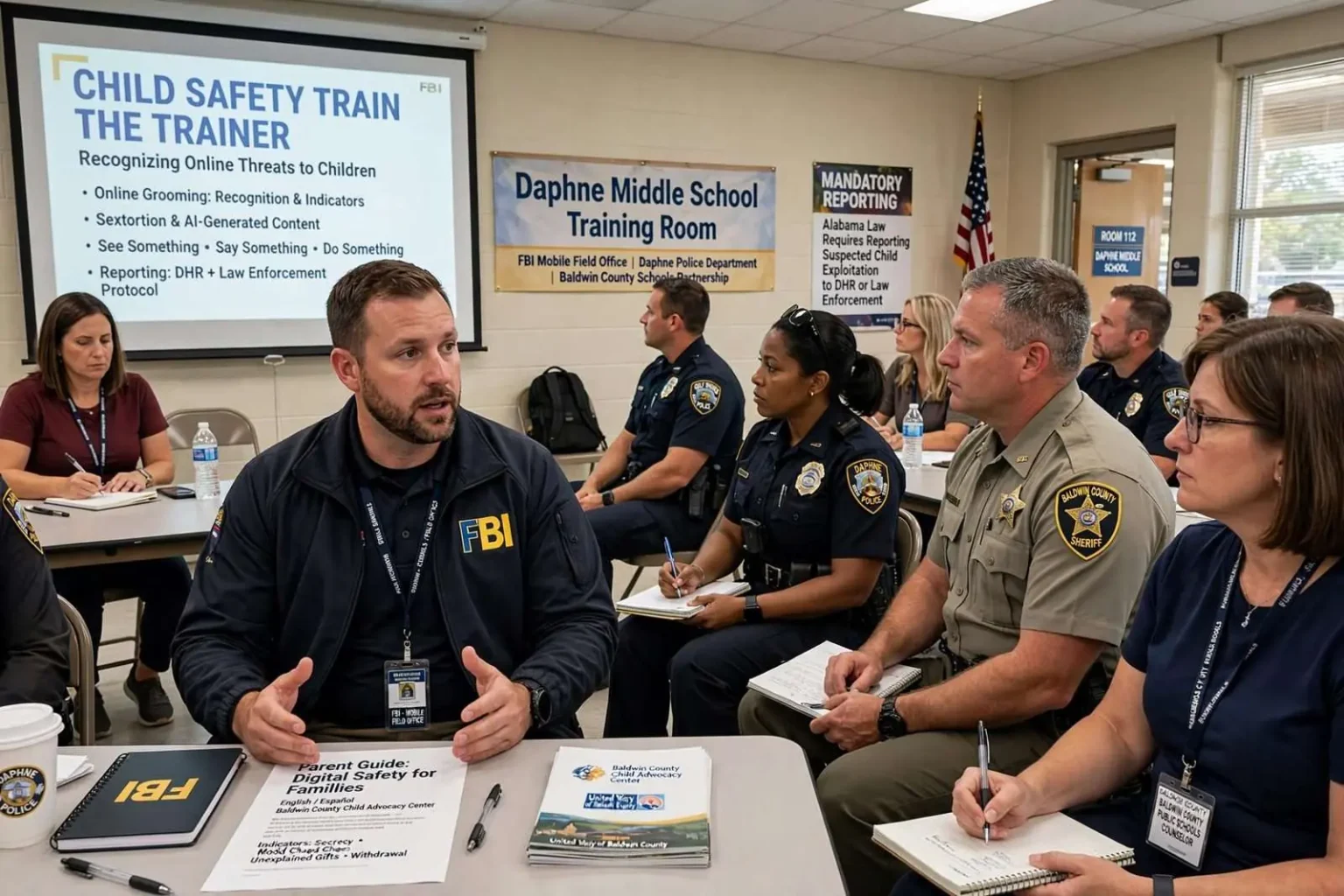
That reality brought federal agents and local officers together this week at Daphne Middle School for a day of training aimed squarely at the people best positioned to notice when something has gone wrong. The FBI’s Mobile Field Office partnered with the Daphne Police Department to lead a “Child Safety Train the Trainer” course for school resource officers, educators and law enforcement personnel drawn from across Baldwin County.
The session focused on the fast-moving world of online child exploitation and radicalization, and on giving the adults who see students every day a practical framework for recognizing danger and responding to it.
A Digital Landscape That Changes Faster Than the Response
Jordan Hadfield, assistant special agent in charge of the FBI’s Mobile Field Office, framed the problem plainly. The digital environment children inhabit, he said, is evolving faster than ever before, forcing the bureau and its partners in local law enforcement to confront new forms of child exploitation head on.
That evolution is the central challenge. A decade ago, online risk was largely understood in terms of a handful of well-known social platforms. Today, the pathways a predator can use to reach a child include gaming chat channels, encrypted messaging services, livestreaming apps, disappearing-message tools and platforms that launch, gain a following among teenagers and fade again within a single school year.
“There are new platforms and applications that come out all the time, so it’s important that our officers, our teachers and our educators know what those are and know what those indicators are to look at so that we can safeguard our kids,” Hadfield said, emphasizing that prevention depends on ongoing, advanced training rather than static knowledge.
The FBI’s Internet Crime Complaint Center reported a 35 percent increase in online enticement complaints nationally in 2023 compared to the previous year, with Alabama tracking consistent with the national trend. The Mobile Field Office’s jurisdiction, which covers the southern third of the state, accounted for a disproportionate share of the state’s total — a reflection of the region’s population density, military presence, and tourism economy.
The Training Framework: See Something, Say Something, Do Something
The “Train the Trainer” model is designed to multiply the FBI’s reach. Rather than trying to place an agent in every school, the bureau trains school resource officers and designated educators who then train their colleagues, creating a distributed network of informed adults across the district.
The curriculum covers three core areas: recognition of online grooming patterns, identification of radicalization indicators, and protocols for mandatory reporting and evidence preservation. Participants learn to distinguish between typical adolescent digital behavior and the behavioral shifts — secrecy, mood changes, unexplained gifts or money, withdrawal from family and friends — that may signal exploitation.
Officers from the Daphne Police Department, the Baldwin County Sheriff’s Office, and municipal departments from Fairhope, Foley, Gulf Shores, and Robertsdale attended, along with counselors and administrators from Baldwin County Public Schools, Gulf Shores City Schools, and Orange Beach City Schools.
Grooming Tactics and Platform Vulnerabilities
FBI victim specialists detailed the progression of online grooming: initial contact on a public platform, migration to private or encrypted channels, establishment of trust through shared interests or emotional support, gradual introduction of sexual content, and eventual coercion — often through sextortion, where the predator threatens to share explicit images unless the child produces more.
The training highlighted platforms popular with Baldwin County youth: Discord for gaming communities, Snapchat for disappearing messages, TikTok for livestreaming, and newer entrants like BeReal, Gas, and various anonymous question apps. Each platform presents different evidentiary challenges; some retain user data for law enforcement requests, others are designed to leave no trace.
Hadfield noted that the FBI’s Mobile Field Office has seen a sharp increase in sextortion cases involving teenage boys — a demographic that historically underreports due to shame and fear. The perpetrators are often overseas, operating from jurisdictions with limited cooperation, which makes prevention and early intervention even more critical.
The training also covered the rise of AI-generated child sexual abuse material — a category that did not exist two years ago but now accounts for a growing share of referrals to the National Center for Missing and Exploited Children. Generative AI tools can create photorealistic images of real children from social media photos, compounding victimization and complicating investigations.
Radicalization and Extremist Recruitment
The training also addressed a newer threat vector: the use of gaming platforms, encrypted chats, and fringe social networks to radicalize youth toward violent extremism. FBI analysts presented case studies of adolescents who were recruited through multiplayer games, Discord servers, and message boards, moving from mainstream conversation to private channels where extremist ideology was normalized.
Indicators include sudden fixation on conspiracy narratives, dehumanizing language toward specific groups, glorification of violence, and withdrawal from previous social circles. The training emphasized that these signs overlap with typical adolescent identity exploration, requiring careful assessment rather than alarm.
Baldwin County’s proximity to military installations — including Naval Air Station Pensacola just across the state line and the Coast Guard Aviation Training Center in Mobile — adds a layer of concern, as extremist groups have historically targeted military-connected youth for recruitment.
Local Context: Baldwin County’s Unique Risk Profile
Baldwin County’s geography and demographics create specific vulnerabilities. The county’s rapid growth — it has been among Alabama’s fastest-growing for two decades — means new schools, new neighborhoods, and a constant influx of families unfamiliar with local resources. The tourism economy brings seasonal workers and visitors, expanding the pool of potential offenders and complicating jurisdiction.
The Eastern Shore’s affluent communities — Fairhope, Daphne, Spanish Fort — have high smartphone penetration among youth and robust broadband access, meaning children are online earlier and more consistently. Meanwhile, rural areas in north Baldwin County may have limited law enforcement presence and fewer school-based mental health resources.
Daphne Middle School, the training site, sits at the intersection of these dynamics. Its student body draws from suburban neighborhoods, rural acreage, and apartment complexes housing service workers from the tourism corridor. Principal and counselors report that digital incidents — cyberbullying, sexting, inappropriate contact — now account for a significant share of disciplinary referrals and counseling interventions.
Mandatory Reporting and the Legal Framework
Alabama law requires teachers, school administrators, counselors, law enforcement officers, and other designated professionals to report suspected child abuse or neglect, including sexual exploitation, to the Department of Human Resources or law enforcement. Failure to report is a misdemeanor.
The training clarified the reporting chain: when a school resource officer or educator identifies a potential exploitation case, they contact DHR and local law enforcement simultaneously. The FBI’s Mobile Field Office serves as the federal point of contact for cases involving interstate commerce, foreign perpetrators, or organized exploitation networks.
Evidence preservation is critical. Officers were trained to secure devices without viewing content unnecessarily — viewing child sexual abuse material, even in an investigative context, can constitute a federal offense if not done under proper authority. The FBI’s Computer Analysis Response Team provides forensic support for device extraction and analysis.
Parental Engagement and Community Prevention
Prevention extends beyond school walls. The training included a module for parent outreach, emphasizing that the most effective protective factor is a child who feels safe disclosing uncomfortable online experiences to a trusted adult. Fear of device confiscation or punishment often silences victims.
Daphne Police and the FBI have developed parent guides — available in English and Spanish — covering privacy settings, location sharing risks, the danger of meeting online contacts in person, and how to talk to children about digital boundaries without inducing panic.
Community organizations, including the Baldwin County Child Advocacy Center, the United Way of Baldwin County, and faith-based groups, partner with law enforcement to host digital safety nights at schools, libraries, and community centers. These events combine presentations with hands-on device safety workshops.
School-Based Mental Health and Intervention Capacity
Baldwin County Public Schools has expanded its mental health staffing in recent years, adding licensed counselors and social workers at the district level and increasing the number of school-based therapists through contracts with community mental health centers. However, the student-to-counselor ratio remains above the recommended 250:1 standard, and waitlists for intensive services persist.
The training emphasized that school resource officers are not therapists. Their role is recognition, referral, and safety — not counseling. But officers who understand trauma-informed approaches can avoid re-traumatizing a child during an initial disclosure, preserving trust and evidence alike.
Ongoing Commitment and Resource Allocation
The “Train the Trainer” session is not a one-time event. The FBI’s Mobile Field Office has committed to quarterly refresher trainings, an annual symposium on emerging threats, and a dedicated liaison for each school system in the Mobile Field Office’s territory — covering Mobile, Baldwin, Washington, Clarke, Monroe, Conecuh, and Escambia counties.
Funding for the training comes from the FBI’s Victim Services Division, the Alabama Department of Education’s Safe Schools initiative, and local law enforcement training budgets. The Daphne Police Department provided the venue, logistics, and officer time at no cost to the school systems.
As Hadfield concluded the session, he returned to the core message: “The technology will change. The apps will change. The predators will adapt. But if we build a community where every adult who interacts with a child knows what to look for and what to do, we create a net that’s harder to slip through.”