Dauphin Island Seeks New Municipal Judge as Bench Vacancies Stir Legal Community
The Town of Dauphin Island opened a search for a new municipal judge, drawing a dozen applicants in a contest that offered an early glimpse at the coming competition for a circuit judgeship in Mobile County.
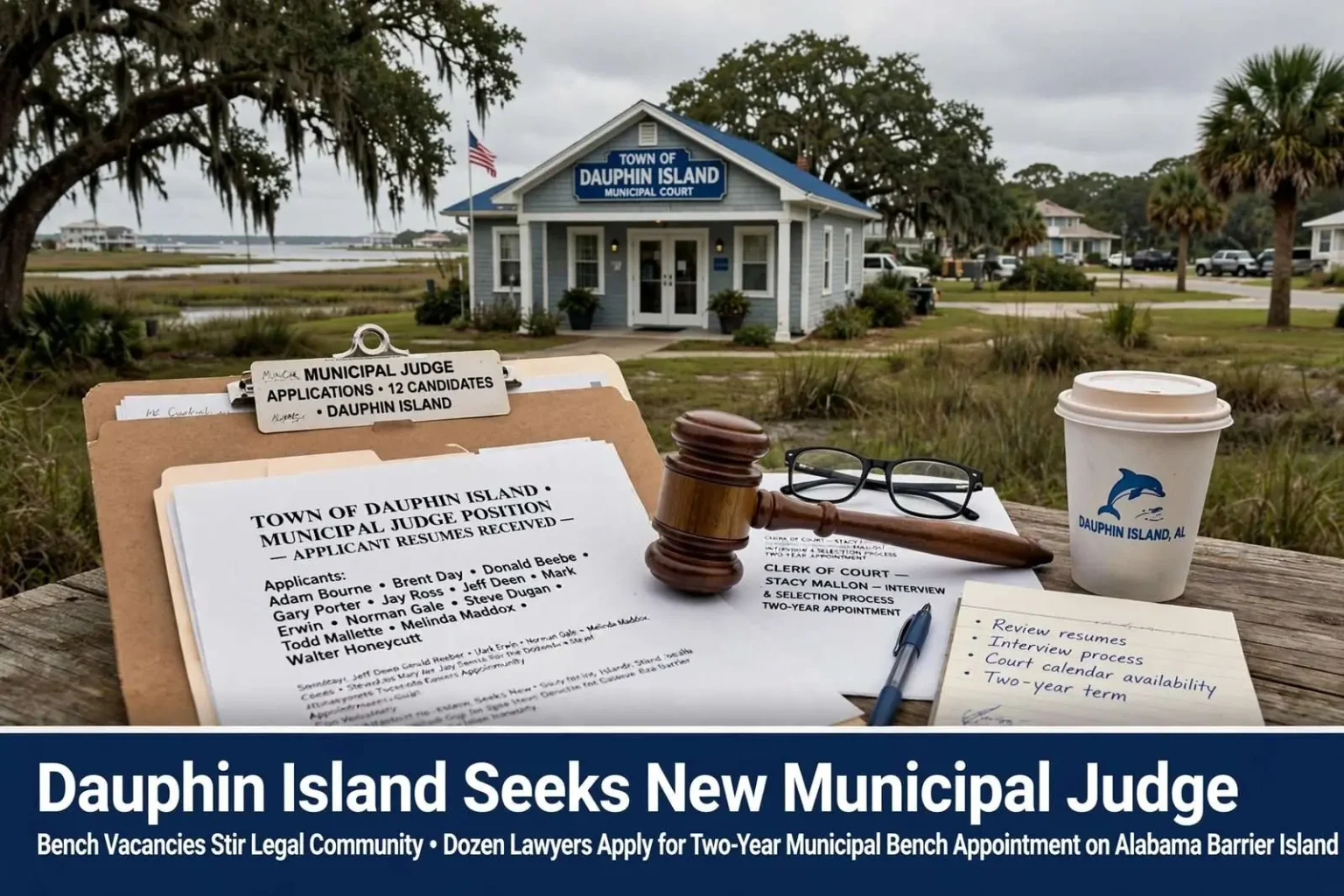
The Town of Dauphin Island solicited resumes from what it called “highly qualified candidates” for a two-year appointment to its municipal bench, and the response offered an early window into the ambitions stirring within the Mobile County legal community. A dozen lawyers applied for the modest part-time judgeship, a level of interest that surprised some observers of municipal government and provided an unusually public look at how Alabama’s bench openings, even at the lowest rung, attract serious attention from practicing attorneys.
Municipal judgeships in Alabama are appointed positions, typically serving two-year terms renewable at the council’s discretion. The judges preside over traffic cases, municipal ordinance violations, and minor misdemeanors, with more serious offenses bound over to county courts. The work is part-time in most of the state’s smaller municipalities, and the pay reflects it — but the seat carries a title, a public platform, and a foothold in the legal community that many attorneys find valuable.
A Crowded Island Field
Applicants for the island judgeship included Adam Bourne, Brent Day, Donald Beebe, Gary Porter, Jay Ross, Jeff Deen, Mark Erwin, Norman Gale, Steve Dugan, Todd Mallette, Melinda Maddox and Walter Honeycutt. Ross already served as the town’s prosecutor, so his selection would have created a vacancy in that post. Officials were developing an interview and selection process, according to Stacy Mallon, clerk of court.
The roster reflected the breadth of the Mobile County bar. Among the twelve applicants were attorneys in private practice, lawyers with municipal government experience, and figures with names familiar from years of local legal and political activity. For a town of Dauphin Island’s size — a barrier island community of roughly 1,300 year-round residents whose population swells with tourists in summer — the volume of interest underscored how a small appointment can function as a signal of standing within the profession.
The town’s process was straightforward but deliberate. With the clerk of court coordinating, officials planned to move from the stack of resumes to a structured interview and selection process, weighing each applicant’s experience, familiarity with municipal law, and availability for the island’s court calendar. Because the appointment runs two years, whoever was chosen would face the council again before long, with the option of renewal if the relationship worked.
Observers See a Larger Contest Ahead
Observers suggested the competition for the modest municipal seat could preview a larger contest to come. Circuit Judge Jim Wood was age-barred from seeking re-election to the Mobile County Circuit Court bench in 2012, and several names already surfaced as possible contenders for that seat, among them GOP state Sen. Ben Brooks, drug court magistrate Ed Blount, veteran Mobile attorney Eaton Barnard and Honeycutt.
Alabama’s age requirement for judicial candidates effectively announced openings years in advance, and lawyers ambitious for a circuit judgeship could see the calendar as clearly as anyone. A circuit seat in Mobile County is a full-time, countywide elected position with far greater visibility and pay than any municipal appointment, and the contest to replace Wood was shaping up as one of the more watched local judicial races of the coming cycle. The presence of Honeycutt — an applicant for the island bench — among the names floated for the circuit seat illustrated how the two contests could overlap: lawyers weighing a small appointment now were often the same ones positioning for the bigger race later.
Brooks, then a Republican state senator representing part of Mobile County, brought legislative experience and name recognition to any judicial contest he might enter. Blount’s work in the drug court system gave him direct judicial-adjacent experience, and Barnard’s decades in Mobile legal circles made him a fixture of the local bar. None of the speculation had hardened into campaigns at this point, but the Dauphin Island application file showed how early the maneuvering could begin.
On the Eastern Shore, Daphne Fills Its Bench
Across the bay, Daphne officials interviewed applicants to replace Tom Doyle as municipal judge. The candidates reportedly included Buddy Brackin, Ken Hitson, Jim Sweet, Will Chason and Brian Dasinger. The nod went to Hitson, who had unsuccessfully sought the Republican nomination for district attorney in Baldwin County in the primary earlier that year. His two-year term began Sept. 1.
Hitson’s selection came fresh off a countywide campaign, and the municipal bench offered the kind of public judicial experience that complements a prosecutor’s race. In Baldwin County’s fast-growing legal community, a municipal judgeship on the Eastern Shore — the population center of the county — carries meaningful visibility. Daphne’s municipal court handles a substantial caseload for a city of its size, with traffic and ordinance cases flowing steadily from one of the bay area’s busiest commercial corridors along U.S. 98 and near the I-10 interchange.
Doyle, the departing judge, left behind a particular reputation. Under his watch, the Daphne bench was known for stiff findings and sentences, a toughness that colored how cases moved through the court and, notably, how often defendants appealed. Predecessor reputations always shadow a successor, and Hitson inherited a docket where defendants and local attorneys alike had grown accustomed to a particular style of adjudication.
A Notable Change in the Job’s Terms
Daphne’s selection came with a notable change in the job’s terms. After reviewing neighboring municipalities, the city reduced compensation for its municipal judge from $49,000 annually plus health insurance benefits to $35,000 per year without insurance. Some members of the Baldwin County legal community suggested the change might carry consequences beyond the paycheck.
The council’s review was practical municipal budgeting. Comparing what nearby cities paid their part-time judges, Daphne’s leaders concluded that the old package was generous for the hours required, and the cut brought the city’s compensation in line with its peers. Cities across Baldwin County had grown rapidly in the previous decade, but so had their payrolls, and benefits packages for part-time positions had come under particular scrutiny.
Unless Hitson matched the reputation of his predecessor for stiff findings and sentences, they said, Baldwin County Circuit Court could see its appeals backlog ease as cases appealed out of Daphne municipal court subsided toward rates comparable with other Baldwin municipalities. A related benefit to Daphne, they added, would be more timely collection of court costs.
The mechanics were simple. Municipal court convictions can be appealed for trial de novo to the county circuit court, and a judge whose sentences run tough generates more appeals. Each appeal sends a case back into the county system, adding to the circuit court’s workload and delaying the collection of fines and court costs on which municipal governments rely. A municipal bench that resolves cases definitively, the theory went, keeps those revenues flowing on schedule — and Daphne’s leaders, having trimmed the judge’s pay, had an added incentive to see the court run efficiently.
Municipal Courts in Alabama’s Legal Landscape
The two searches together illustrate how Alabama’s municipal courts fit into the wider judicial system. Every incorporated municipality in the state may operate a municipal court, and the hundreds of such courts across Alabama handle millions of dollars in fines and court costs each year alongside their caseloads of traffic violations and ordinance infractions. Judges are appointed by the governing body rather than elected, serving short terms that keep them dependent on council satisfaction — a structure that keeps the courts close to local government and local budget realities.
For the cities, the courts are more than a legal function. Fine revenue, court costs, and the visibility of enforcement all shape a municipality’s budget and its relationship with residents and drivers passing through. A judge’s temperament, efficiency, and appellate rate directly affect all three. That is why the terms of employment — pay, benefits, term length — receive the same council scrutiny as police contracts or sanitation agreements, and why Daphne’s compensation review prompted such close attention from the local bar.
For the lawyers who take the jobs, the value is different. Municipal judgeships offer relatively modest pay and limited jurisdiction, but they also serve as proving grounds and stepping stones, giving attorneys a public platform and a taste of the bench before larger opportunities open. Lawyers who sit even briefly on a municipal bench build a judicial record, familiarity with court administration, and name recognition that can translate into runs for district court, circuit court, or district attorney.
Small Seats, Larger Stakes
Taken together, the two searches illustrated how even the lowest rungs of the judicial ladder can carry outsized significance in local politics. Municipal judgeships offer relatively modest pay and limited jurisdiction, but they also serve as proving grounds and stepping stones, giving attorneys a public platform and a taste of the bench before larger opportunities open.
For Dauphin Island, the immediate task was straightforward: sift the dozen applications, settle on an interview format and fill a two-year appointment. The island town’s government runs lean, and a dozen-resume competition for a part-time judgeship ranked among its more animated personnel matters of the year. Whatever the council decided, the choice would shape traffic court and ordinance cases on the island for two years — and possibly launch a longer judicial career for whichever applicant prevailed.
For the wider Mobile County bar, the exercise was a reminder that the retirement of a sitting circuit judge two years out was already reshaping the calculations of ambitious lawyers, some of whom were positioning themselves for the higher-profile race even as they weighed the smaller one. Judgeships are scarce in any county, and Mobile County’s combination of a large bar and a handful of elected bench seats makes every opening a candidate-sorting event.
What Comes Next on Both Sides of the Bay
In Daphne, Hitson’s term had begun Sept. 1, with the new judge taking the bench under reduced terms and under the eyes of attorneys watching to see whether the court’s appellate rate would drift downward toward the county norm. In Dauphin Island, the interview process was still taking shape under the clerk of court’s direction, with a dozen resumes and one complicating factor — the prospect that choosing the town’s own prosecutor would open a second vacancy in need of filling.
The maneuvering on both sides of Mobile Bay signaled that the region’s courthouses would remain fertile ground for political jockeying well past the November election. Between Dauphin Island’s appointment, Daphne’s new bench, and the slow-motion contest to succeed Jim Wood in 2012, the region’s legal community had a full slate of decisions ahead — and residents of both counties would see the consequences, one case and one election at a time.
The episode also offered a civics lesson in miniature. Alabama’s judicial system runs from hundreds of part-time municipal judges to elected circuit judges, and the career paths between the two rungs are real and well traveled. A dozen resumes on a barrier island turned out to be a snapshot of how the whole system grows its judges.