Mobile County Weighs More Faith Displays After ‘In God We Trust’ Vote
Mobile County Commission hears calls for atheist, Pagan and Universalist plaques at Government Plaza after a religious display was approved.
More Groups Line Up for Plaques at Government Plaza
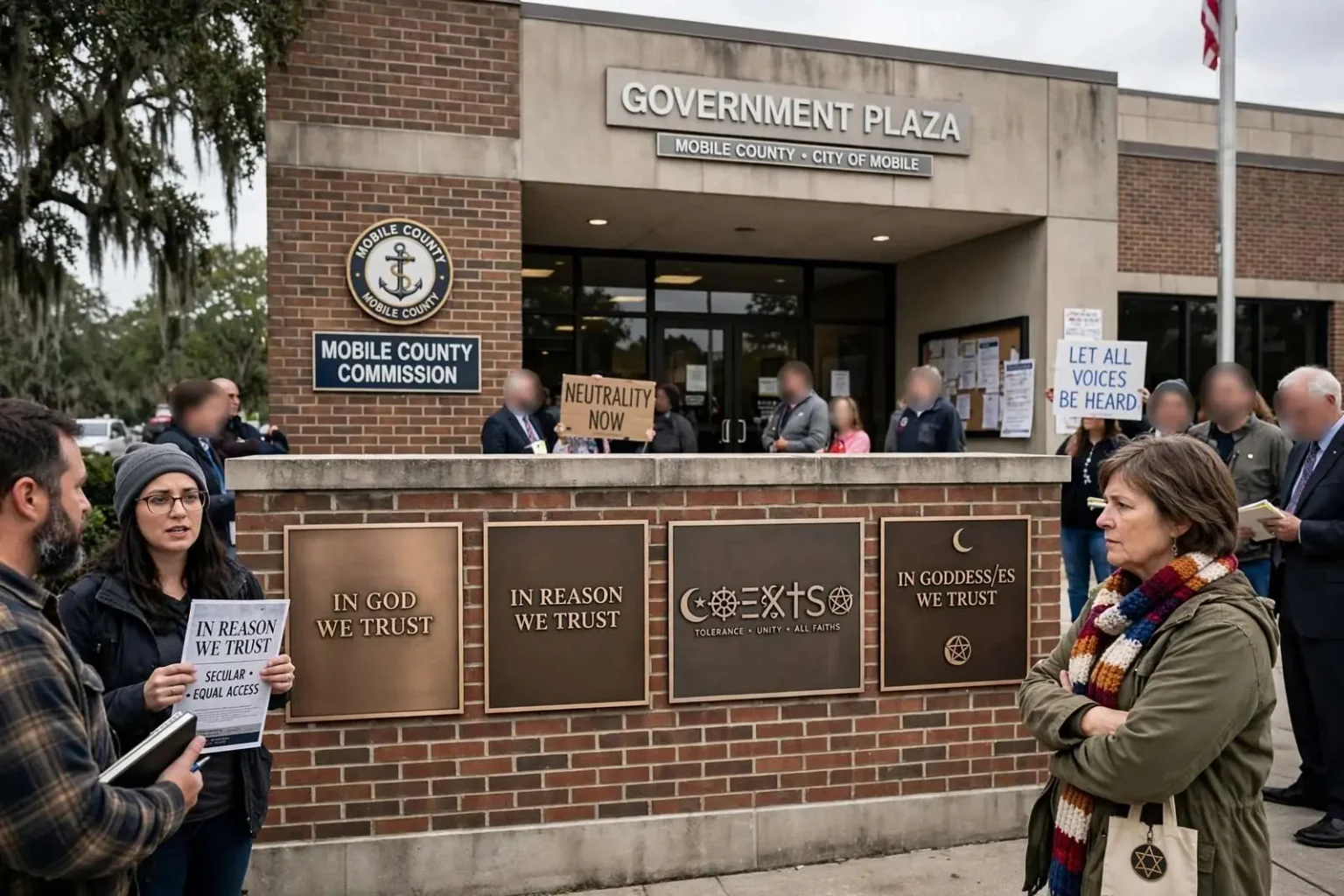
The debate over religious expression on public property in downtown Mobile is heating up again, with several community groups preparing to ask the Mobile County Commission to let them install their own privately funded plaques at Government Plaza. The push follows a commission vote earlier this summer that approved a privately funded plaque reading “In God We Trust” for display in the public building. That 2-1 decision drew criticism from residents who argued the county should not favor one religious viewpoint over others in a space used by the entire public. Now, groups representing different beliefs say if one message of faith is allowed, theirs should be too, setting up a test of the commission’s own logic.
Organizers with a local atheist community group say they intend to ask commissioners for a plaque reading “In Reason We Trust,” framing it as a secular counterpart to the existing display. The wording mirrors the original plaque’s format while substituting the humanist principle at the center of secular thought, and organizers have described it as a way to hold the commission to the standard it created. If the county approved a privately funded message of faith for the public building, the atheists argue, it cannot constitutionally refuse a privately funded message of doubt. The request puts commissioners in the position of either broadening the display or explaining why the original was different.
A Universalist-aligned group is expected to request a sign with the word “Coexist,” a symbol often used to promote religious tolerance. The Coexist emblem, built from the symbols of Islam, Judaism, Christianity, Buddhism and other traditions arranged into the word itself, has become one of the most widely recognized interfaith images in the country. A Universalist request is notable because Universalist congregations sit within the Judeo-Christian broadly defined fold while embracing other traditions, making their display harder to dismiss as hostile to religion generally. The group’s message, tolerance rather than atheism, tests a different boundary than the secular plaque does.
Meanwhile, a Pagan advocacy group plans to seek approval for wording along the lines of “In Goddess/es We Trust,” reflecting polytheistic and earth-based spiritual traditions. The slash in the wording signals the plural theology at the heart of modern Pagan practice, which honors multiple deities rather than a single God. Pagan and Wiccan communities have organized openly across the Gulf South in recent decades, though their public visibility remains far lower than mainstream denominations. If the commission approves the display, Mobile County would become one of the few government seats in the South with a Pagan message on its walls.
Private Funding, Public Consequences
Each proposal would reportedly be funded privately, following the same model used to install the original plaque, meaning no taxpayer money would be spent regardless of which, if any, additional displays are approved. That funding structure matters legally, since government buildings can host private religious and ideological displays under certain conditions without violating the Establishment Clause, particularly when the forum is open to other viewpoints on equal terms. By approving the first plaque, the commission effectively opened a door whose width it did not fully control. Every group now arriving at the plaza can cite the county’s own precedent, and refusing any of them invites a lawsuit the original vote made harder to defend.
Speakers on multiple sides of the issue are expected to address commissioners directly at a regularly scheduled meeting in the multipurpose room at Government Plaza. The Government Plaza building, which houses both city and county operations downtown, has hosted some of the most contested public debates in the region in recent years. Commission meetings follow a format that reserves time for citizens to address the body, and controversial items routinely draw standing-room crowds. The plaque dispute has the ingredients of one of those sessions, with clergy, secular organizers and ordinary residents likely to split their three minutes at the podium across the full range of positions.
The legal backdrop to the requests is well established in church-state law. Courts evaluate displays on public property under tests that ask whether the government appears to endorse a particular faith, and they have allowed displays that include religious content when the overall setting is educational or when access is open to differing viewpoints. Mobile County now sits squarely inside that framework: having accepted one faith-based message, it must either accept the rest or argue that its building is not a forum for such displays at all. Either argument can be made, but only one of them is consistent with the vote the commission already took, and commissioners know it.
Public comment periods at county commission meetings have become a flashpoint in recent months as residents from different backgrounds weigh in on how much religious messaging belongs in government spaces. The pattern is familiar to observers of local government: an issue that costs nothing to escalate and nothing to resolve quietly instead becomes a recurring test of identity for the community. Speakers who support the display have framed it as an affirmation of the region’s heritage, while opponents have argued that government neutrality is what protects everyone’s freedom to worship, or not, as they choose. The multipurpose room has heard both arguments before, and it will hear them again.
A Petition to Reverse Course Entirely
Adding another layer to the dispute, an online petition has been circulating asking the commission to reverse its original decision and remove the “In God We Trust” plaque altogether, rather than opening the door to additional religious or secular displays. Petition organizers argue that allowing a rotating cast of plaques representing different belief systems could turn the plaza into an ongoing point of contention rather than resolving the underlying church-and-state question. Their preferred outcome is cleaner: no ideological displays in the building at all, and no queue of groups waiting to test the commission’s fairness. Online petitions have become a standard first move in local church-state disputes, giving organizers a visible show of support before the meeting itself.
The petition’s logic appeals to commissioners in neither camp, since it asks the two members who voted for the original plaque to undo their own vote. Removal would spare the county the spectacle of adjudicating between “In Reason We Trust” and “In Goddess/es We Trust,” but it would also hand a symbolic win to the display’s critics. Commissioners have not signaled whether the petition has moved any votes, and the two-member majority that approved the original display has shown no public appetite for reversal.
Commissioners Weigh Their Options
County commissioners have not indicated how they plan to handle the new requests, and it remains unclear whether any additional plaques will receive the same 2-1 approval that cleared the way for the first display. The arithmetic of the situation is uncomfortable for everyone involved. Approving every request converts a single faith message into a gallery of worldviews and changes the character of the building; approving some and not others creates the appearance, and likely the legal liability, of viewpoint discrimination; approving none beyond the first is difficult to justify once the first was allowed. Each path carries political and legal costs that the original 2-1 vote did not fully anticipate.
Commissioners could also delay, referring the requests to legal staff or simply letting them languish without action, which is a common response when a governing body would rather not vote. Such a strategy only postpones the question, since groups denied a timely decision have their own recourse. The county attorney’s office would likely be consulted before any vote, both on the constitutional exposure of each option and on the mechanics of the display policy itself. Many counties that have faced similar disputes ultimately adopted written policies for public displays precisely to avoid deciding each case by vote.
For now, the Government Plaza building continues to serve as the focal point of a broader conversation in Mobile County about religious symbolism, free expression and the boundaries of public space. The dispute is a local chapter in a national argument that has played out in courthouses, school boards and city halls for decades, and Mobile County’s version has drawn attention well beyond the commission chamber. Whatever the commission decides, the decision will be watched by both sides of the debate across the Gulf Coast.
Residents interested in the outcome are encouraged to follow future commission meeting agendas, as the issue is expected to resurface as more groups formalize their requests. Agendas are published ahead of each meeting, and the multipurpose room is open to the public for those who wish to hear the arguments firsthand. Between now and then, the “In God We Trust” plaque remains on display, the first of what may be several messages, or the only one the county ever allows, depending on what a majority of commissioners decides when the requests come before them.