National Watchdog Groups Challenge Mobile County’s ‘In God We Trust’ Plaque Decision
National church-state watchdog groups pushed back on Mobile County's approval of an 'In God We Trust' plaque within days of the June 2014 vote.
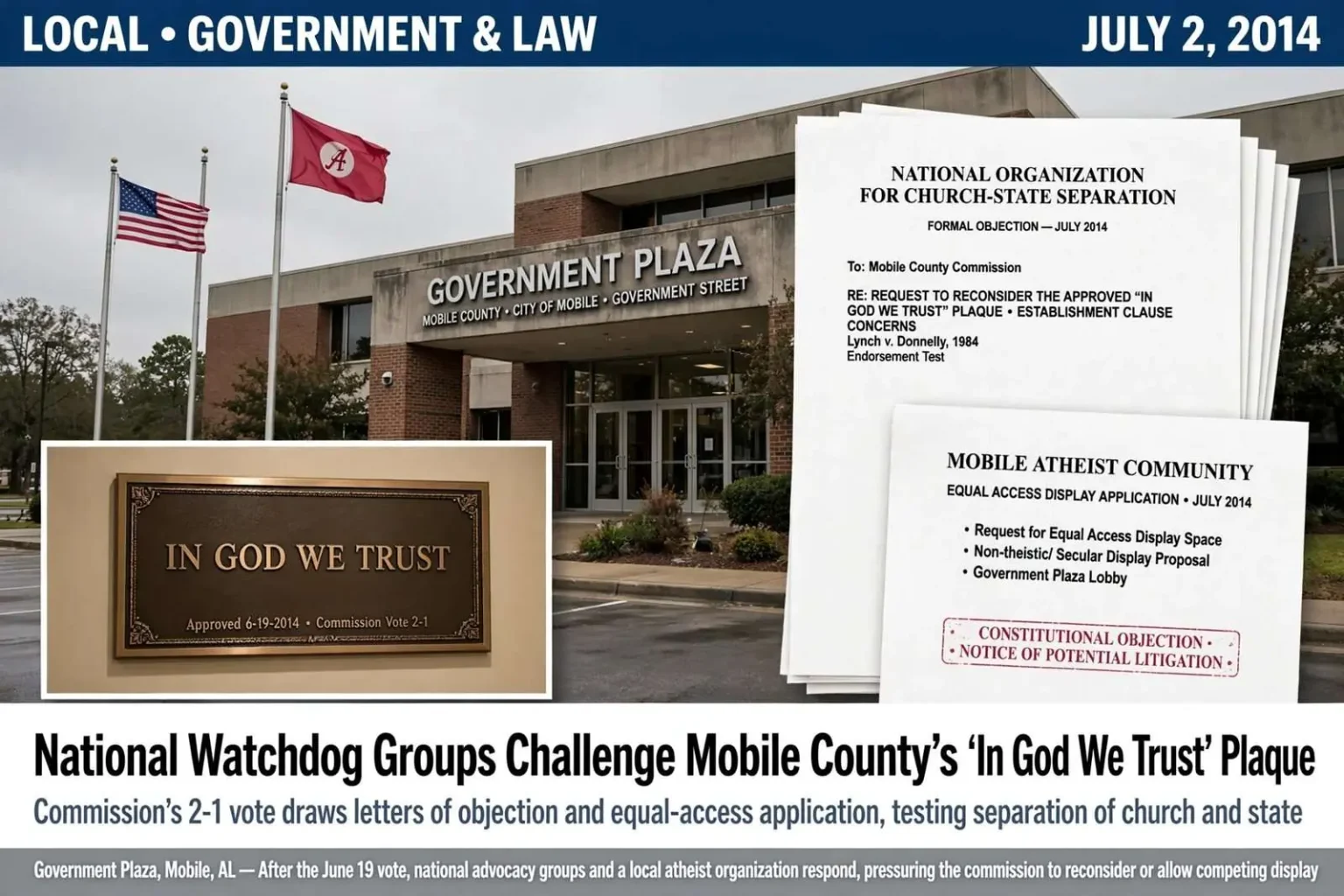
Within a week of the Mobile County Commission’s decision to approve an “In God We Trust” plaque for display inside Government Plaza, national organizations focused on the separation of church and state were already weighing in with formal objections. Commissioner Merceria Ludgood, the lone dissenting vote when the plaque was approved on June 19, 2014, had predicted in her prepared remarks that the decision would invite legal challenges and a wave of requests for other religious displays. That prediction began playing out almost immediately.
The commission’s vote placed Mobile County among a growing number of local governments across the country that had approved similar displays in the years following the September 2001 attacks, when legislative bodies in several states began posting the national motto in courthouses and administration buildings. Those earlier displays had themselves drawn letters, complaints and occasional lawsuits, giving both supporters and critics of the Mobile County decision a familiar playbook to work from.
Watchdog group sends formal letter
A national organization dedicated to church-state separation sent a letter to the commission strongly urging members to reconsider their decision, arguing it was inappropriate for a county government to display a religious statement inside a public building. The letter cited a 1984 U.S. Supreme Court case and a concurring opinion from Justice Sandra Day O’Connor, which warned that government endorsement of religion sends a message to non-adherents that they are outsiders in the political community while signaling to believers that they are favored insiders.
O’Connor’s reasoning, set out in her concurrence in the 1984 case Lynch v. Donnelly, became known as the endorsement test, and it remains one of the standards lower courts use to evaluate religious displays on government property. Under that analysis, the question is not whether a display has some secular purpose, but whether a reasonable observer would see the government as endorsing religion. Critics of “In God We Trust” plaques argue that the motto, displayed alone in a government lobby, fails that test; supporters counter that the phrase is ceremonial patriotism rather than a religious statement.
A second national organization focused on the separation of church and state also sent the commission a letter condemning the approved plaque, adding further pressure just days after the vote. Letters of this kind typically warn governing bodies that the display could invite litigation and ask them to either remove the plaque or refuse to install it, and they serve as a formal record that the government was put on notice of a potential constitutional objection.
For the commissioners, the letters created a procedural fork: they could stand by the vote and risk a legal challenge, or revisit the decision and face criticism from constituents who supported the display. Neither response came quickly, and the commission made no immediate move to rescind the approval.
Local atheist group seeks equal access
Rather than pursuing outright removal, at least one local group signaled it would seek a compromise by requesting equal space for its own display. A representative of the Mobile Atheist Community said the group, along with others representing non-monotheistic viewpoints, planned to formally apply to place a display of their own next to the religious plaque inside the same public space.
He argued that under the Constitution, government buildings should either display no religious viewpoints at all or give every belief system equal opportunity to be represented in the same space, and warned that allowing one viewpoint while excluding others would put the county in a weaker legal position than either of the cleaner alternatives.
That equal-access argument has a real track record in federal courts. Where a government opens a public forum to private displays, courts have often required it to accept displays of widely varying viewpoints rather than pick and choose, a principle that has led some municipalities to host atheist, pagan and secular-humanist exhibits alongside religious ones during holiday seasons.
A formal application from the group would force the commission to make a second, more consequential decision: approve a display many commissioners would find objectionable, or decline it and hand critics a textual demonstration that the plaque decision was about preference rather than neutral policy. It was precisely the cascade Ludgood had forecast when she cast the lone dissenting vote.
The national motto in public buildings
“In God We Trust” has been the official national motto of the United States since 1956, when Congress adopted it and President Dwight D. Eisenhower signed it into law, replacing the unofficial motto “E Pluribus Unum.” The phrase first appeared on United States coins during the Civil War era, and it has appeared on paper currency since the 1950s, so it occupies an unusual position: simultaneously a religious reference and an act of Congress with more than a half-century of official standing.
Supporters of displaying the motto in government buildings lean on that history. Federal courts have repeatedly upheld the phrase on currency, reasoning that its ceremonial, patriotic use has drained it of the kind of religious endorsement the Establishment Clause prohibits. County commissions that approve the plaques routinely describe them as statements of national heritage rather than faith.
Critics respond that context matters. A motto on a coin, in their view, is different from a motto mounted on the wall of a county commission chamber, where the government itself is the speaker. The legal fight over that distinction has produced mixed results across the country, with some courts allowing the displays and others ordering changes when the surrounding circumstances suggested a religious purpose.
Alabama has its own long history at the center of these disputes, from decades of litigation over prayer and religious displays in public institutions to constitutional provisions on the state’s books. Cases that begin with a county plaque frequently draw on that accumulated case law, and legal observers in the state noted that Mobile County’s decision would be measured against the same standards that governed earlier disputes elsewhere in Alabama.
What happens next
For the moment, the commission’s options remained open. The letters from national organizations asked for reconsideration, the local group prepared a formal application for its own display, and no lawsuit had been filed in the days immediately after the vote. The most common endgame in disputes of this type is one of three outcomes: the government quietly keeps the display and the objection fades, the parties negotiate a resolution, or litigation begins in federal court.
A federal lawsuit would be expensive for a county government, which must either defend the case through its own counsel or outside attorneys, and litigation over religious displays can run for years through district court, appeals and sometimes a petition to the Supreme Court. Those costs are part of what watchdog groups cite when they send warning letters, and part of what supporters weigh when they decide to hold their position.
Ludgood’s prepared remarks at the June 19 meeting had urged her colleagues to consider exactly that trajectory — the legal exposure, and the certainty that approving one display would open the door to applications for others. The events of the following week gave her argument a concrete shape: two national organizations on record in opposition, and a local group preparing to ask for equal space on the same wall.
Government Plaza, the shared home of Mobile County and City of Mobile offices on Government Street downtown, functions as the county’s most visible civic building, hosting commission meetings and public business daily. Whatever the commissioners ultimately decided about the plaque would be seen by every resident who walked through the lobby, which is why both sides treated the decision as something more than a decoration.
How similar disputes have resolved elsewhere
County commissions elsewhere that faced the same combination of warning letters and counter-applications have taken different paths. Some kept the plaques and were never sued; others faced federal complaints that ended in negotiated removals; a few adopted written display policies that opened public areas to any group that met neutral criteria, effectively converting a religious question into a forum-management question.
A written policy is often the route attorneys recommend, because a neutral, viewpoint-blind application process gives a government its strongest defense. Without one, a commission that approves a religious plaque and then declines a secular display leaves itself open to the argument that it favored one belief system — the exact scenario the Mobile Atheist Community representative warned the commission it was creating.
The organizations behind the letters operate nationally and send such correspondence routinely, and governing bodies treat them with varying degrees of seriousness. Some officials dismiss the letters as posturing; others consult county attorneys immediately, since the cost of defending even a weak constitutional claim can dwarf the cost of a plaque.
In Mobile County, the three-member commission operates with each commissioner representing a district, and decisions of this kind are made by majority vote at public meetings. The 2-1 split on the plaque indicated the issue divided the board, and the dissent’s predictions coming true within days put pressure on the majority to articulate a rationale that could survive scrutiny.
Why the dispute matters locally
Beyond the legal questions, the dispute touched on how Mobile County residents see their own government. Supporters of the plaque viewed it as an affirmation of values shared by a substantial majority of county residents, appropriate for the building where the county’s business is conducted. Opponents, religious and secular alike, argued that government buildings belong to everyone, including residents of no faith and minority faiths, and that the lobby wall should not declare any of them outsiders.
The Mobile Atheist Community’s approach also illustrated a practical reality of church-state disputes: local groups frequently have standing to apply for their own displays even when they could not easily sue over someone else’s, and a formal application changes the posture of the debate from complaint to negotiation.
Whether the county adopted a display policy, left the plaque in place, or eventually faced a lawsuit, the episode became part of the region’s ongoing conversation about religion in public life — a conversation Alabama governments have returned to repeatedly, and one that tends to resurface each time a new commission, council or school board faces the same choice.
The immediate facts, though, were simple enough: a 2-1 vote on June 19, 2014; a plaque approved for Government Plaza; two national letters of objection within a week; and a local group ready to apply for space beside it. The commissioners’ response to those pressures would determine whether the dispute ended as a symbolic vote or grew into a years-long legal question.